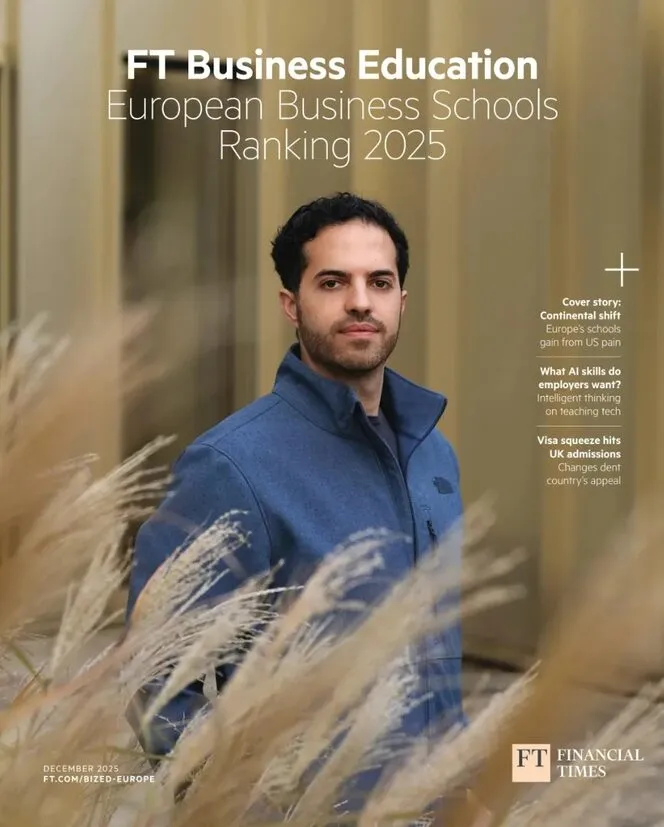
FT Business Education – European Business Schools Ranking 2025
Summary
Insead tops the Financial Times European Business Schools Ranking 2025 for the second consecutive year, but the real story in this December 2025 FT Business Education special report is the structural shift reshaping the landscape: US politics are driving students to Europe, AI is transforming curricula, and sustainability coalitions are forming across institutions. Edited by Jerry Andrews and Global Education Editor Andrew Jack, the 36-page report packs ranking tables, data analysis and sector-wide intelligence.
HEC Paris holds at No 2, and London Business School moves up for open executive education programmes. ESCP ranks first in Europe and third worldwide for Executive MBAs. Iese is top for MBA in Europe and third in the FT global ranking. Teaching AI (page 8) profiles how business schools innovate to meet employers' needs for AI-literate graduates. The Trump bump (page 10) documents how US politics are handing European schools a boost in applications. Data insights (page 12) translates ranking trends into charts. Visa vexation (page 24) examines the UK paying a price for foreign-student restrictions. Green shift (page 26) covers European schools uniting to tackle carbon emissions. Across borders (page 28) notes rising demand for multi-country study programmes. The case study (page 31) tackles slavery in the chocolate-making supply chain.
—————
Content Guide
▸ Ranking / Business Schools
p.4 · European Business Schools 2025 — The Ranking
The top 100 European business schools ranked by FT methodology. Insead leads, followed by HEC Paris and London Business School. The ranking table includes salary uplift, career progression, international mobility and research quality scores for each school. Use the "salary uplift" column (percentage increase pre-to-post MBA) as your primary metric when comparing schools—it correlates most strongly with long-term career outcomes.
p.8 · Teaching AI — Business Schools Innovate to Meet Employers' Needs
Schools are embedding AI into core curricula: Insead launched a mandatory AI for Decision-Making module; HEC Paris introduced an AI specialization track; ESMT Berlin created an AI Ethics certificate. Employer surveys indicate 73% of recruiters now consider AI literacy a "critical" hire factor. Verify a programme's AI curriculum depth before applying by checking whether AI is a standalone module or woven across multiple courses.
▸ Geopolitics / Admissions
p.10 · Trump Bump — US Politics Are Handing European Schools a Boost
Applications to European business schools from US candidates rose 24% in 2025, with schools reporting increased interest following US political uncertainty. LBS saw a 32% increase in US applications; HEC Paris reported 28% growth. The trend is most pronounced among female and international-student applicants. If you are a US candidate considering a European MBA, apply in Round 2 (January) this year for the strongest scholarship negotiation position.
▸ Sustainability / Collaboration
p.26 · Green Shift — European Schools Unite to Tackle Carbon Emissions
The Business Schools for Climate Leadership (BSCL) alliance now includes 8 schools representing 12,000 students annually. Members commit to curriculum carbon accounting, campus net-zero by 2035, and shared research on sustainable business models. A pilot carbon-footprint tool for business travel is being tested across 3 campuses. Factor BSCL membership into your school choice if corporate sustainability is your target career path.
▸ International / Programmes
p.28 · Across Borders — Rising Demand for Multi-Country Study Programmes
Multi-country MBA programmes grew 18% year-on-year, with 27 schools now offering dual-location or exchange-embedded MBAs. The most popular corridors: Europe-Asia (32% of multi-country enrolments) and Europe-North America (28%). Graduates of multi-country programmes reported 22% higher international mobility post-graduation. Choose a multi-country programme with at least one campus in your target post-MBA job market.
▸ Supply Chain / Ethics
p.31 · Case Study — Tackling Slavery in the Chocolate-Making Supply Chain
The case examines Barry Callebaut's efforts to map forced-labour risks across its West African cocoa supply chain. Students analyze auditing gaps, certification limitations and the economics of premium pricing for ethical cocoa. The case is now used at 6 European schools. Apply the case's "traceability maturity model" to your own supply chain—level 1 (no traceability) to level 5 (full chain-of-custody verification).
—————
Editor's Take
This is FT Business Education's most newsworthy ranking report in three years. The "Trump bump" US-to-Europe application data is original and significant for anyone in admissions strategy or international recruitment. The Teaching AI survey provides the sector's most concrete picture yet of curriculum transformation in progress. Weakest content: the case study on chocolate supply chains is well-designed but only relevant to FMCG and sustainability readers. The Across Borders multi-country piece states growth percentages without enough context on cost differentials. Production is clean FT style: excellent tables, clear charts, consistent typography. Best for MBA candidates, business school administrators and corporate L&D executives.
Strengths
• US-to-Europe application growth data is original and admissions-relevant
• AI curriculum survey names specific school programmes and modules
• Green shift alliance membership numbers provide concrete sustainability benchmarks
Weaknesses
• Chocolate supply-chain case study is too narrow for a general education audience
• Multi-country programme growth lacks cost-comparison data
Verdict: Essential — The definitive European business school ranking report with the strongest sector trend analysis of the year.
