
The Australian Womens Weekly – Mediterranean Diet 2026
Summary
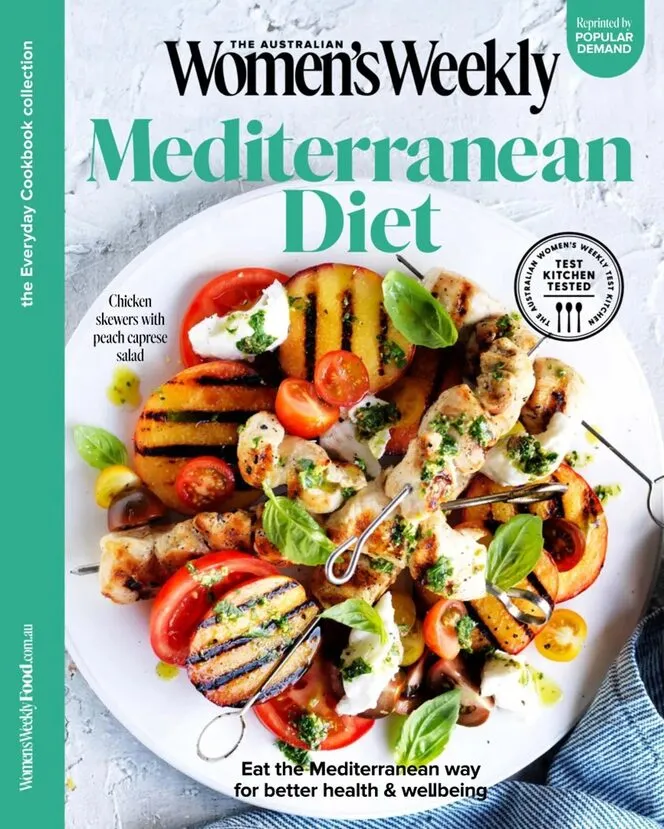
The Australian Women's Weekly Mediterranean Diet 2026 is a recipe collection organised into Light Meals (p.8), Mains (p.38), and Family Gatherings (p.80), with a Mediterranean Living introduction (p.6) that outlines the diet's core principles. The AWW team adapts Mediterranean flavours for Australian home cooks, prioritising accessible ingredients and straightforward techniques.
The "Light Meals" section (p.8-37) covers soups, salads, and starters including grilled halloumi with watermelon, rosemary and lemon sardines on toast, and zucchini and pea fritters. "Mains" (p.38-79) includes lamb backstrap with olive and caper salsa, whole roasted snapper with preserved lemon, chicken and chorizo paella, and eggplant moussaka. "Family Gatherings" (p.80-115) scales recipes for groups — whole shoulder of lamb with roasted vegetables, seafood platters, and large-format salads. The glossary (p.116) and conversion chart (p.119) are included.
Each recipe follows the AWW format: preparation and cooking times listed at the top, crisp ingredient list in order of use, numbered steps, and a serving suggestion. The photography is consistent with AWW's studio style — clean, well-lit, and styled for the Australian home cook audience.
—————
Content Guide
p.6 · Mediterranean Living
A 2-page introduction covering the Mediterranean diet pyramid, emphasising vegetables, legumes, and whole grains at the base. The introduction advises that olive oil is the primary cooking fat and that dairy should come from fermented sources like yoghurt and cheese. The tone is encouraging without being prescriptive.
p.28 · Grilled Halloumi with Watermelon and Mint
A 15-minute starter combining salty halloumi, sweet watermelon, fresh mint, and a lime-chilli dressing. The recipe notes that halloumi must be patted dry before grilling to achieve a proper sear. Perfect for summer entertaining with zero cooking skill required beyond operating a grill pan.
p.56 · Whole Roasted Snapper with Preserved Lemon and Oregano
A 45-minute centrepiece fish dish that requires only 5 active minutes of preparation. The preserved lemon is pulsed with garlic and oregano into a paste, rubbed inside and outside the snapper, and roasted at 200 degrees Celsius. The recipe works equally well for barramundi or bream.
p.88 · Slow-Roasted Shoulder of Lamb with Mediterranean Vegetables
A 4-hour roast serving 8-10 people, with the lamb cooked at 150 degrees Celsius until pull-apart tender. Eggplant, zucchini, capsicum, and cherry tomatoes roast alongside the meat in the last hour. The make-ahead instructions are practical for hosts.
p.112 · Individual Baklava Pastries with Honey and Pistachio
A simplified version of the classic dessert using store-bought filo pastry and a 5-spice honey syrup. The recipe reduces the traditional 40-plus layers to 12, bringing assembly time down to 30 minutes. Home bakers intimidated by filo will find this approachable.
—————
Editor's Take
A reliable, unfussy Mediterranean recipe collection from a test kitchen that knows its audience. The recipes are scaled for Australian families — the lamb shoulder and paella serve 8-10, not 2-4 — and the ingredient sourcing is realistic (no imported niche products). The weakness is that there is nothing innovative here. Every recipe appears in multiple other Mediterranean cookbooks, and the "Mediterranean Living" introduction is too brief (2 pages) to justify the title. The photography is competent but generic — it looks like every other AWW cookbook. For an AWW subscriber who knows the brand's reliability, this will deliver dependable weeknight meals. For a cook seeking new Mediterranean perspectives or techniques, there are better options.
Strengths
• Reliable AWW test kitchen recipes scaled for families
• Ingredient sourcing is realistic and Australia-aware
Weaknesses
• No recipe is new — all are Mediterranean standards
• Mediterranean Living section is only 2 pages deep
Verdict: Selective read — Dependable AWW cooking for the family cook, but offers nothing innovative for readers who already own a Mediterranean cookbook.
