
Time Special Edition – 100 Health Innovations 2026
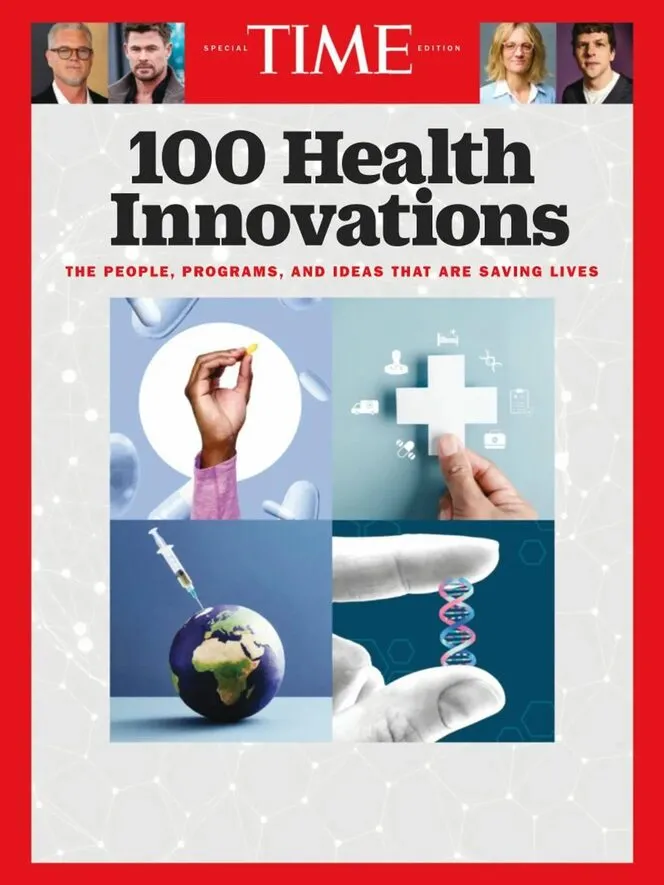
Summary
Time Special Edition 2026 assembles 100 health innovators — from Dr. Kiran Musunuru, who administered the first customised CRISPR therapy, to Sabin Nsanzimana, Rwanda's health minister stopping viral outbreaks — in a single volume that reads more like a who-is-saving-lives than a who-is-who. The editors, led by Emma Barker Bonomo and Mandy Oaklander, frame health innovation not as gadgetry but as people, programs, and ideas that are actively lowering mortality.
The issue opens with a legal landmark — a judge invalidating government vaccine rollbacks — then moves to new Dietary Guidelines, the first pregnancy achieved through an AI-assisted procedure, and a Q&A with Sprout CEO Cindy Eckert on female sexual-health drug access. Mike Doustdar of Novo Nordisk discusses multiplying GLP-1 production capacity. Dr. Kerry Burnight addresses geriatric loneliness as a clinical intervention target. The selection spans CRISPR, AI diagnostics, weight-loss drug equity, African medicines agency building, and lung-cancer screening expansion.
Beyond the 100 profiles, the issue includes a Q&A with Michael Osterholm on pandemic preparedness and a feature on the lawyer suing social-media companies on behalf of children. A spread on the GiveDirectly CEO argues for unconditional cash transfers as a health intervention. The methodology note explains how the TIME editorial team consulted global health experts to narrow the field. For anyone tracking who is actually bending the mortality curve, this is the reference document of the year.
—————
Content Guide
▸ Leaders & Policy
p.27 · Q&A with Cindy Eckert, Sprout CEO
Eckert recounts the regulatory battle to bring the first female sexual-desire drug to market and why she believes the next frontier is neurostimulation devices. She names three barriers that keep women's health innovations from reaching Phase III trials. The takeaway: a clear-eyed assessment of why "female Viagra" is still a lonely category.
p.21 · Doctors Report the First Pregnancy Using a New AI Procedure
A team at a US fertility centre describes how a machine-learning model identified the optimal embryo-implantation window for a patient who had failed four IVF cycles. The algorithm analysed 60,000 previous transfer outcomes. Reproductive endocrinologists now have a blueprint for AI-assisted precision embryo transfer.
p.48 · The Push to Broaden Lung Cancer Screens
A profile of the advocacy effort to lower the screening-eligibility age from 50 to 45 and include never-smokers with family history. The article cites the 25% mortality reduction achieved by the expanded criteria in the NELSON trial. Primary-care readers gain the talking points needed to refer high-risk patients under the new threshold.
▸ Science & Treatment
p.8 · Vaccine Rollbacks Invalidated — What Happens Now?
A legal analysis of the federal judge's ruling that struck down the government's COVID-19 vaccine mandate rollback. The piece unpacks the implications for future CDC emergency rulemaking. Public-health professionals get a timeline of what regulatory steps come next.
p.68 · A Huntington's Disease Treatment Is Closer Than Ever
A feature on the antisense oligonucleotide therapy that has slowed symptom onset in Phase IIb trials by 18 months. The article profiles one Utah family with the HD mutation who enrolled three generations in the trial. Neurologists and genetics counsellors can use this as a patient-education resource.
p.74 · A Self-Injectable Alzheimer's Drug Is Now Available
The FDA-approved lecanemab auto-injector that shifts administration from infusion centres to home settings. The piece calculates the time and cost savings — roughly $12,000 per year in infusion-centre fees eliminated. Caregivers and geriatric practitioners get a practical update on access.
▸ Global Health
p.83 · Q&A with Michael Osterholm
The epidemiologist discusses why the next pandemic will likely emerge from a livestock-interface setting and why wastewater surveillance is still underfunded in 2026. He names three specific biosecurity gaps the US has not closed. Policy readers get a priority list for pandemic-prep funding.
—————
Editor's Take
This is a genuinely useful curation. The TIME editorial team has done the heavy lifting of finding the people who are actually reducing mortality — not just the ones with the biggest research grants. The CRISPR and AI-fertility pieces are specific enough for a general-interest reader to understand. The weakness is that the "100" format means some profiles are only 100 words long, and several major categories (maternal mortality, antibiotic resistance) get single representatives. The Q&As — especially with Eckert and Osterholm — are stronger than the short profiles because they allow for real argument. Also, the self-injectable Alzheimer's drug piece feels like it was written before full real-world data was available. Still, as a snapshot of who is moving the needle in 2026, this is the most reliable single issue you can buy.
Strengths
• Curated by global health experts, not just editors
• CRISPR and AI-fertility stories are genuinely new
• Osterholm Q&A is the most honest pandemic-prep assessment in print
Weaknesses
• 100-profile format spreads coverage thin on major topics
• Alzheimer's drug piece lacks real-world outcomes data
Verdict: Recommended — The best single-issue reference on who is actually saving lives in 2026, despite the inevitable thinness of a 100-entry format.
