
All About History Medieval History – 11th Edition – 13 August 2026
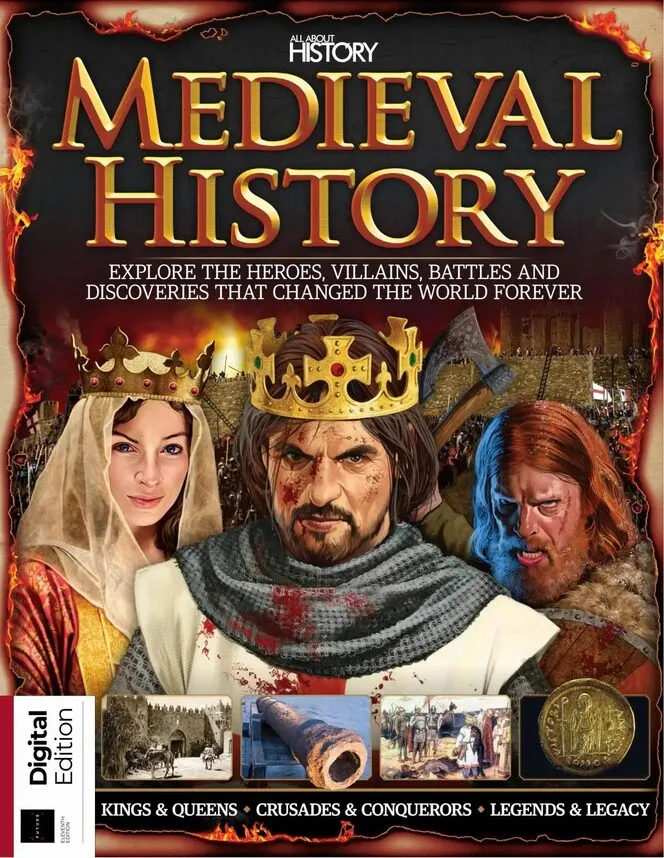
Summary
Alfred the Great, Saladin's Jerusalem campaign, and the Black Death that killed 50 percent of Europe's population structure All About History's Medieval History 11th Edition, 13 August 2026. The 124-page volume spans wars, invasions, church politics, and daily life from Charlemagne to Joan of Arc across three thematic sections.
Wars, Invasions and Exploration opens with arms and armour (p.16), then moves through castle capture techniques, Alfred the Great's defensive reforms, Viking maritime dominance, William the Conqueror's 1066 campaign, Marco Polo's Asian journey, the Hundred Years' War, Agincourt, and Joan of Arc. Church and State covers the Holy Roman Empire, Charlemagne, Saladin's capture of Jerusalem in 1187, Richard the Lionheart's crusade, the Knights Templar betrayal, the Magna Carta signing in 1215, and Isabella of Castile's Inquisition. Life, Death and the Gateway to Modernity includes feudalism, daily medieval life, banquets, arts and culture, crime and punishment, and surviving the Black Death.
The volume opens with "The Medieval era: An age of darkness and light" (p.6), framing the period as both violent and culturally foundational. Each chapter runs 4-8 pages with maps, timelines, and artefact photography.
—————
Content Guide
▸ Wars, Invasions & Exploration
p.18 · How to capture a Medieval castle
Siege techniques from mining to trebuchet bombardment are explained with labelled diagrams of concentric castle design. The article covers the 1204 siege of Chateau Gaillard as a worked example of how each technique was countered. The weak-point diagram marks the exact masonry joints where sappers placed explosive charges.
p.26 · Alfred the Great
Alfred's defensive strategy against Viking incursions — the burghal system of fortified towns — is mapped across Wessex with the Burghal Hidage document reproduced. The map shows that no settlement in Wessex was more than 20 miles from a fortified town. The network design influenced English county boundaries into the 19th century.
p.30 · When Vikings ruled the waves
Viking ship technology — clinker construction, square sail, shallow draught — is analysed through the Gokstad and Oseberg ship finds. The navigational range map shows raids reaching Constantinople and North America. The cargo-capacity table for a typical knarr explains why Viking settlements could trade across 3,000 miles of open water.
p.54 · A century of blood and wrath
The Hundred Years' War is summarised with a campaign-phase map showing English and French territorial control at 10-year intervals from 1337 to 1453. The population-impact sidebar estimates that France lost 40 percent of its population through war and plague combined. The phased map is the clearest single-page summary available for classroom use.
▸ Church & State
p.74 · Saladin's battle for Jerusalem
The 1187 campaign from Hattin to Jerusalem's surrender is reconstructed from Arab and Crusader chronicles. The battlefield map at Hattin shows how Saladin's forces blocked access to water. The article reproduces the text of the surrender negotiated with Balian of Ibelin, guaranteeing safe passage for Jerusalem's population.
p.90 · Betrayal of the Knights Templar
Philip IV of France's 1307 mass arrest of the Templars is traced through the interrogation records from the Paris Temple. The article reproduces the papal bull Vox in Excelso dissolving the order. The financial records sidebar shows the Templars' banking network that Philip both exploited and destroyed.
p.98 · The birth of Magna Carta
The 1215 sealing at Runnymede is presented with the original Latin clauses translated into modern English. The article identifies which clauses remain in UK law today — clauses 1, 13, 39, and 40. The survival map shows how the charter was reissued in 1216, 1217, and 1225.
▸ Life, Death & the Gateway to Modernity
p.112 · Daily life in the Middle Ages
Peasant and noble daily routines are compared through estate records and household accounts. The diet comparison table shows a peasant consuming 4,500 calories daily (mostly grain and ale) while a noble's diet included 3 pounds of meat per day. The table is useful for debunking the "everyone ate gruel" stereotype.
p.124 · Surviving the Black Death
The 1348-1351 pandemic is modelled through mortality estimates per region — 50 percent in urban areas, 35 percent in rural — using manorial court roll data. The long-term wage-effect chart shows labour prices doubling within a decade. The chart demonstrates why the labour shortage broke the feudal bond.
—————
Editor's Take
All About History's Medieval History 11th Edition is a competent survey volume that does nothing new. The castle-siege and Magna Carta chapters are well executed for a general audience. Weakest parts: the Joan of Arc chapter is too short to do her campaign justice at 4 pages, and the "Medieval banquet" entry is essentially a recipe page with no social context. The book lacks a chapter on women's roles beyond aristocracy, which is a noticeable gap for a 2026 publication. This edition suits the KS3 history student or the adult reader who wants a single-volume refresher before a castle visit.
Strengths
• Burghal Hidage map showing Alfred's 20-mile defensive network
• Magna Carta clause survival in modern UK law
• Black Death wage-effect chart linking plague to feudalism's decline
Weaknesses
• Joan of Arc compressed to 4 pages
• No dedicated chapter on non-aristocratic women's roles
Verdict: Selective read — Adequate as a school reference, thin for committed medievalists.
