
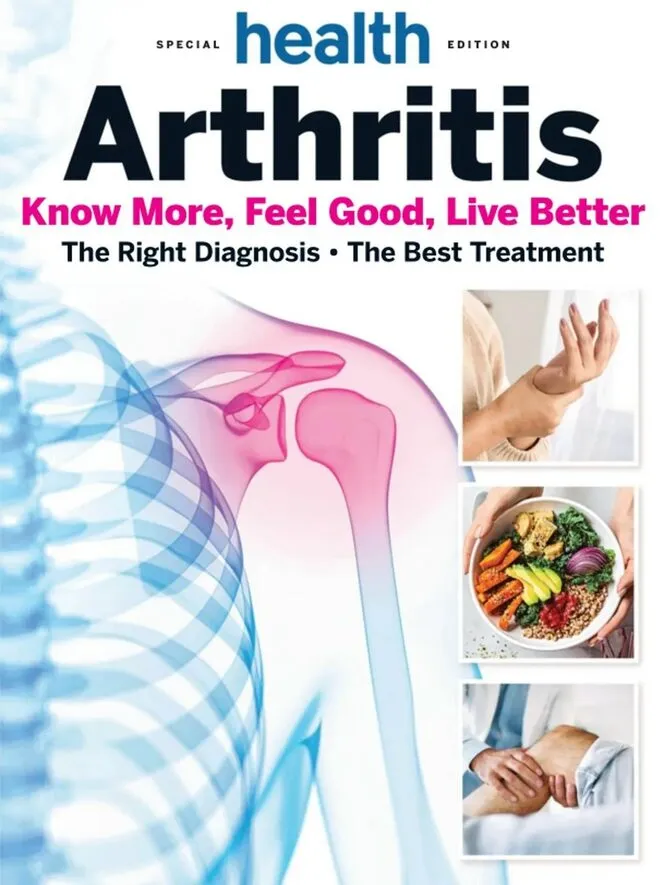
Health Special Edition – Arthritis, 2026
Summary
The Health Special Edition Arthritis 2026 delivers a comprehensive guide to understanding, treating and living with the most common joint conditions — osteoarthritis, rheumatoid arthritis, psoriatic arthritis, axial spondyloarthritis and gout. The 96-page special covers everything from the first signs of joint pain through diagnosis, medication options, lifestyle management and the emerging evidence for DIY acupressure and dietary interventions. Structured in three parts — Arthritis ABCs, Treatment and Living with Arthritis — the guide emphasises that early diagnosis and consistent movement are the two most effective interventions for slowing disease progression.
The ABCs section (p.6-47) covers signs and symptoms of each arthritis type, the differences between osteoarthritis and rheumatoid arthritis, arthritis in the feet and hands, carpal tunnel versus arthritis, and surprising causes of sudden joint pain. The Treatment section (p.50-70) provides an overview of pain medications from NSAIDs to disease-modifying antirheumatic drugs (DMARDs), knee arthritis treatment pathways and self-care for ankylosing spondylitis. The Living with Arthritis section (p.76-96) covers best foods for joint health, why sugar worsens inflammation, walking with hip arthritis, shoe-fitting guidance and the truth about weather and arthritis pain.
The issue includes a full acupressure protocol for knee pain relief, a two-page guide to arthritis-friendly socks and footwear, and a diet-and-inflammation tracker template. Patient stories are woven throughout, including one woman's four-year road to an accurate diagnosis and another's experience managing psoriatic arthritis through diet modifications.
—————
Content Guide
▸ Arthritis ABCs
p.6 · What You Need to Know
An overview of arthritis as a whole: not a single disease but more than 100 related conditions, all involving joint inflammation. The article distinguishes osteoarthritis (wear-and-tear, 32 million US adults affected) from inflammatory autoimmune types. Catch arthritis early: persistent joint pain lasting more than six weeks warrants a rheumatology referral regardless of your age.
p.10 · Signs and Symptoms of Osteoarthritis
The most common form of arthritis, typically presenting as morning stiffness under 30 minutes, pain that worsens with activity and improves with rest, and bony enlargements called Heberden's nodes in finger joints. If you wake with stiff knees that loosen within 20 minutes of walking, start a daily quadriceps strengthening programme before the cartilage damage advances.
p.12 · Osteoarthritis vs. Rheumatoid Arthritis
A side-by-side comparison of the two most common arthritis types. OA is asymmetrical and affects weight-bearing joints; RA is symmetrical, affects smaller joints in hands and feet and presents with morning stiffness lasting over 60 minutes plus systemic fatigue. Request a rheumatoid factor and anti-CCP blood test if you have symmetrical joint pain with morning stiffness exceeding one hour.
p.16 · What Is Axial Spondyloarthritis?
A less common inflammatory arthritis primarily affecting the spine and sacroiliac joints, typically starting before age 45. The hallmark symptom is inflammatory back pain — pain that improves with movement and worsens at rest — distinguishable from mechanical back pain. If your back pain wakes you in the second half of the night and improves with a hot shower, ask about an HLA-B27 blood test.
p.24 · The Five Types of Psoriatic Arthritis
A breakdown of the five clinical subtypes: oligoarticular (asymmetric, <5 joints), polyarticular (symmetric, >5 joints), distal interphalangeal-predominant, spondylitis-predominant and arthritis mutilans. Each type has different treatment pathways and prognosis.
p.44 · Gout: Symptoms, Causes and Treatment
Gout is caused by urate crystal deposition in joints, triggered by high purine levels from red meat, shellfish and alcohol. The classic presentation: sudden, excruciating big-toe pain that peaks within 12-24 hours. Acute attacks respond to NSAIDs or colchicine; long-term management requires urate-lowering therapy targeting serum urate below 6mg/dL.
▸ Treatment
p.54 · Joint Pain Medications
A tiered guide from OTC NSAIDs (ibuprofen, naproxen) through prescription COX-2 inhibitors, corticosteroids, DMARDs (methotrexate, sulfasalazine) and biologics (TNF inhibitors, IL-17 inhibitors). Each drug class includes mechanism, typical onset time, common side effects and monitoring requirements. NSAIDs should be used at the lowest effective dose for the shortest duration to minimise gastrointestinal and renal risk.
p.58 · How Knee Arthritis Is Treated
A stepwise approach: conservative (physical therapy, weight management, activity modification), intermediate (intra-articular corticosteroid or hyaluronic acid injections) and surgical (partial or total knee replacement). Each kg of weight lost reduces knee joint load by 4kg, making weight management the single most effective non-surgical intervention for knee OA.
p.62 · DIY Acupressure Could Relieve Arthritis Knee Pain
A practical guide to acupressure points for knee pain relief, with illustrated point locations and stimulation protocols. Acupressure works by stimulating anti-inflammatory substance release, modulating pain pathways and improving local circulation. Apply firm thumb pressure to the ST36 point (four finger-widths below the kneecap, one finger-width lateral to the shin bone) for 3 minutes daily.
▸ Living with Arthritis
p.76 · Best Foods for Joint Health
Anti-inflammatory foods ranked by evidence: fatty fish (omega-3 EPA/DHA), berries (anthocyanins), olive oil (oleocanthal), leafy greens (vitamin K) and turmeric (curcumin with piperine for absorption). Aim for 2 servings of fatty fish weekly and 1 tablespoon of extra-virgin olive oil daily for measurable inflammatory marker reduction.
p.80 · Why Sugar Is Bad for Arthritis
The mechanism by which added sugar promotes inflammation: advanced glycation end-products (AGEs) trigger inflammatory cytokines, and sugar spikes worsen oxidative stress. Reducing added sugar below 25g daily correlates with reduced CRP levels in observational studies within 8-12 weeks.
p.84 · Walking and Hip Arthritis
A guide to maintaining walking as exercise even with hip OA: proper footwear, walking surface selection, pace modulation and the use of Nordic walking poles to reduce hip joint load by up to 30%. Walk on soft, even surfaces and use trekking poles to engage upper-body muscles and offload the hip joint.
p.96 · Does Weather Really Make Arthritis Symptoms Worse?
A review of the evidence connecting barometric pressure, temperature and humidity to arthritis pain. Most studies show a small but consistent correlation: drops in barometric pressure precede increased pain reports by 24-48 hours. You cannot change the weather, but you can pre-emptively adjust activity levels and warm up joints longer before cold-weather exercise.
—————
Editor's Take
This arthritis special edition achieves what most health-magazine condition guides do not: it treats the reader as an intelligent partner in their own care rather than a passive recipient of doctor's orders. The auto-immune diagnosis flowcharts and the drug-class tiered guide are genuinely useful for anyone navigating the confusing landscape of rheumatology referrals. The strongest section is the knee arthritis treatment pathway, which gives clear, staged options from conservative through surgical without editorial bias toward any approach. The weakest is the acupressure section — not because the evidence is absent, but because the illustrations needed to show point locations are not reproducible in text format, limiting its practical value. This guide suits anyone recently diagnosed with any form of arthritis, as well as the millions of adults over 40 with undiagnosed joint pain who need to know when to seek specialist care.
Strengths
• OA vs RA comparison table clarifies a common diagnostic confusion point
• Knee arthritis treatment pathway covers all stages from conservative to surgical
• Drug-class tiered guide with mechanism, onset and side-effect profiles
Weaknesses
• Acupressure guide lacks adequate visual point-location aids for self-administration
• No dedicated section on cannabis-based pain management despite reader interest
Verdict: Essential — The most practical, evidence-respecting arthritis guide in consumer health media, particularly strong on differential diagnosis and staged treatment decision-making.
