
Todays Dietitian – May-June 2026
Summary
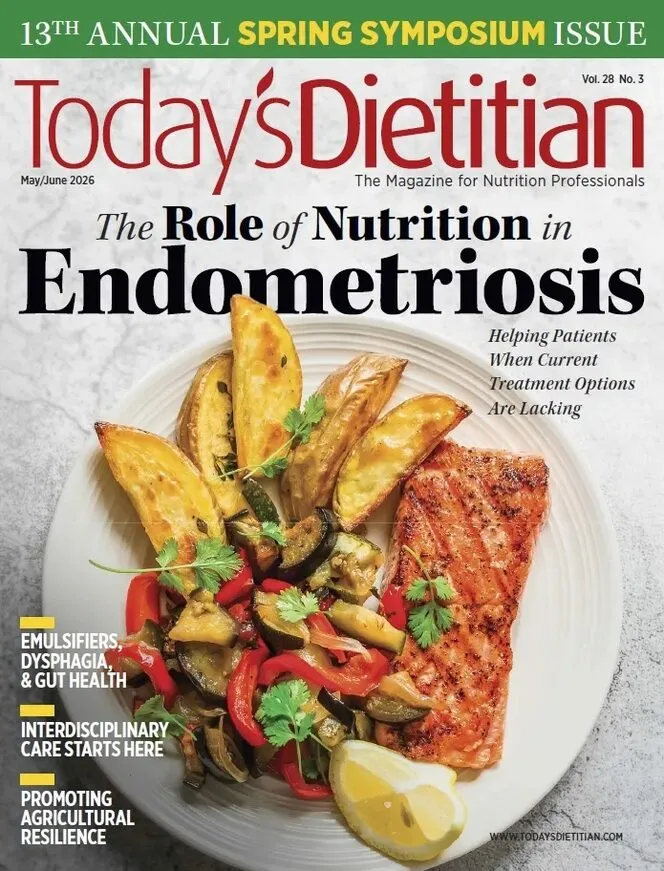
Today's Dietitian Vol. 28 No. 3, the 13th Annual Spring Symposium Issue, leads with endometriosis — "The Role of Nutrition in Endometriosis" (p.20) — a condition affecting 1 in 10 women, yet one that RDs rarely feel equipped to counsel on. The May/June 2026 issue also interrogates emulsifiers in dysphagia and IBS care, dietitians' role in interdisciplinary medical training, and agricultural resilience policy in the Farm Bill era.
The endometriosis feature compiles clinical wisdom from three RDs who specialise in pelvic pain, offering dietary patterns that reduce inflammation and modulate hormones when conventional treatment falls short. "Emulsifiers, Dysphagia, & Gut Health" (p.24) updates the debate on food additives in eosinophilic oesophagitis and IBS — a topic that reaches every RD with a GI caseload. "Interdisciplinary Care Starts Here" (p.28) argues that dietitians belong in medical resident training, modelling collaborative care from day one. The CPE Monthly on GLP-1 Receptor Agonists (p.36) is a must for any practitioner now fielding questions about Ozempic, Mounjaro, and the new wave of oral GLP-1s.
Regular columns include "Cultural Foodways" (p.10), which explores traditional remedies in Latin American diets, and "Career Development" (p.14) on negotiating salary in non-clinical roles. "News Bite" (p.48) covers the latest FDA label changes, and "Bookshelf" (p.44) reviews three new nutrition titles. Dietitians preparing for the spring conference circuit will find the Datebook (p.50) especially useful for deadline planning.
—————
Content Guide
▸ Cover Story / Clinical Practice
p.20 · The Role of Nutrition in Endometriosis
Three RDs who specialise in pelvic pain share elimination protocols that target prostaglandin-driven inflammation. The article maps specific food triggers — red meat, high-glycaemic carbs, trans fats — to symptom clusters. Practitioners leave with a reproducible 4-week elimination framework they can hand to patients whose Gynaecologist said "nothing helps."
p.24 · Emulsifiers, Dysphagia, & Gut Health
A research-driven dive into how carboxymethylcellulose and polysorbate-80 may disrupt the gut barrier in susceptible patients. The author distinguishes between tolerable intake levels and the doses used in ultra-processed foods. Readers will know which emulsifiers to flag when a patient with eosinophilic oesophagitis reports symptom flares.
p.36 · CPE Monthly: Understanding GLP-1 Receptor Agonists
This 2-CE course covers mechanism of action, common side effects, and MNT adjustments for patients on semaglutide and tirzepatide. The authors include a drug-nutrient interaction table and a sample meal-timing protocol that reduces nausea. Finish with a clinical checklist for monitoring patients on GLP-1 therapy.
▸ Professional Development
p.28 · Interdisciplinary Care Starts Here
A case study from a teaching hospital where RDs co-facilitate medical resident workshops on nutrition therapy. The authors provide a replicable curriculum template for introducing MNT in internal-medicine rotations. The message: referrals increase when you train the referrers.
p.32 · Promoting Agricultural Resilience
Four RDs working in food-system policy explain how the Farm Bill affects the produce supply that reaches WIC and SNAP patients. The article includes a one-page guide for RDs who want to submit comments on conservation-program funding. Practical policy engagement for dietitians who think "food systems" is someone else's job.
▸ Regulars
p.10 · Cultural Foodways — Latin American Healing Foods
A column that profiles cinco de mayo dishes reimagined with whole-food swaps. The author, a Mexican-American RD, explains why caldo de res and nopales deserve a place in diabetes meal plans. One recipe, a hibiscus agua fresca without added sugar, is clinic-ready this afternoon.
p.42 · Get to Know … An RD in Public Health
A short profile of a dietitian who shifted from clinical work to county-level nutrition policy. She describes the day she presented to the board of supervisors on soda-tax revenue allocation. Useful for RDs considering a move into government work.
—————
Editor's Take
This is the strongest issue of Today's Dietitian in 2026 so far. The endometriosis piece fills a genuine clinical void — most RDs have no training in pelvic-pain nutrition, and this gives them a safe starting protocol. The GLP-1 CPE is timely (every RD is getting these questions), and the emulsifiers article is genuinely research-up-to-date. The weakness is that "Career Development" feels generic — salary negotiation advice with no dollar ranges specific to dietetics. "Agricultural Resilience" is conceptually important but reads like a white paper summary rather than a practical guide. Still, the feature well is unusually strong for a conference issue, which often leans light.
Strengths
• Endometriosis nutrition protocol closes a major training gap
• GLP-1 CPE is timely and clinically detailed
• Emulsifiers article brings additive science to the GI clinic
Weaknesses
• Career Development column lacks dietetics-specific salary data
• Agricultural Resilience feature needed more clinical connection
Verdict: Recommended — Conference issues often coast; this one delivers three genuinely useful clinical features plus a timely GLP-1 CE course.
