
American Scientist – July-August 2026
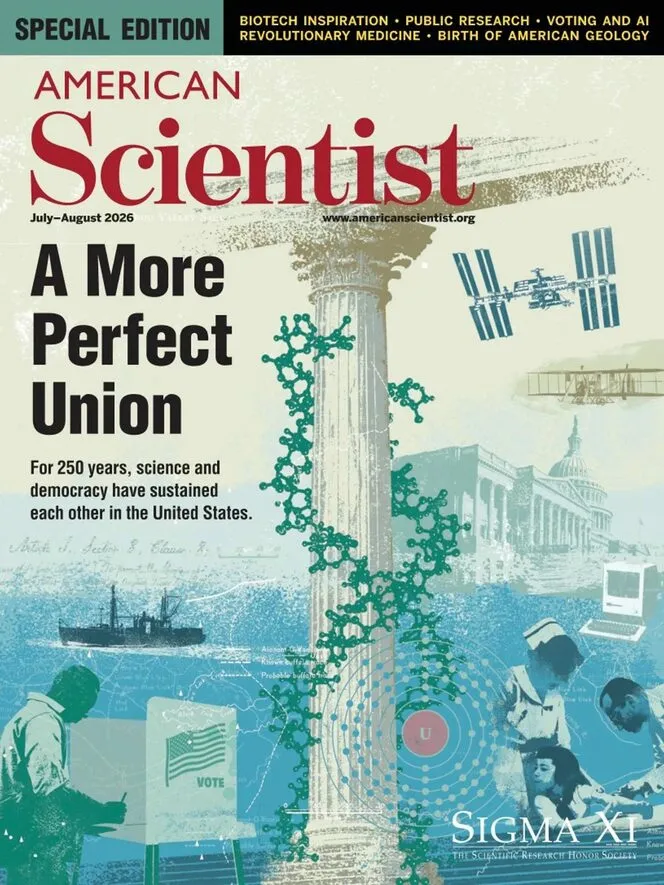
Summary
A 1775 smallpox outbreak may have altered the outcome of the American Revolution, argues Philip A. Rea in American Scientist's July-August 2026 special edition marking 250 years of science and democracy. The issue spans biotechnology policy, AI election security, consciousness research, and the history of salt commerce — all framed around the relationship between evidence-based inquiry and self-governance.
Fenella Saunders introduces the special edition (p.194) with Sigma Xi's 140th anniversary and the recent blows to federal research funding. Philip A. Rea's Spotlight (p.198) examines how smallpox misinformation during the Continental Army's Quebec campaign may have tipped military momentum. Senator Todd Young and Michelle Rozo's Commentary (p.204) argues for the National Biotechnology Security Commission and new bio-economy legislation. R. Michael Alvarez's Technologue (p.222) traces election-technology research from the 2000 Florida recount through current AI-generated disinformation detection. Robert T. Pennock (p.226) connects the Founders' Enlightenment ideals directly to the language of the Declaration and subsequent US code. Viviana Masia (p.232) examines how understanding the brain's capacity for self-deception can inoculate voters against manipulation. Alexander Mugar Klein (p.240) surveys 150 years of failed attempts to agree on reliable markers of consciousness.
First Person interviews Ahmer Arif on community-centred approaches to disinformation. Science Communication examines a museum exhibition that revealed competing narratives of American science history.
—————
Content Guide
▸ Cover Feature: 250 Years of Science and Democracy
p.198 · Spotlight: When Inflammation Met Insurrection
Philip A. Rea examines how smallpox and medical misinformation during the Continental Army's 1775 Quebec campaign may have altered the Revolution's trajectory. He draws on General Washington's quarantine orders and variolation records to show how command decisions on inoculation became a political flashpoint. The primary-source sidebars quote directly from soldier letters — usable as classroom discussion starters on science policy in wartime.
p.204 · Commentary: Biotechnology and the Spirit of American Discovery
Senator Todd Young and Michelle Rozo present the case for the National Biotechnology Security Commission and funding for the National Biotechnology Initiative. The article lists three specific bills under committee review in 2026. Track the commission's first public hearing date — the outcome determines federal bio-manufacturing investment for the next five years.
p.214 · Science Communication: Competing Histories
Judith Kaplan reconstructs a museum exhibition that exposed multiple conflicting narratives of American science history — from indigenous knowledge systems to corporate-funded research — and how each narrative serves a different political constituency. The exhibition label transcripts are reproduced in full. Apply the exhibition's framing questions to your own institution's next display on scientific progress.
p.222 · Technologue: Elections in the Age of AI
R. Michael Alvarez traces election-technology research from the 2000 Florida recount to real-time AI-generated disinformation detection in 2026. He explains why synthetic-media detection algorithms degrade faster than the content they track and recommends audit-log transparency as a more durable safeguard. Cite the five-state pilot programme list when discussing voting-system reform with local election officials.
▸ Research & Philosophy
p.226 · Science and Engineering Values: Revolutions and Revolutionaries
Robert T. Pennock traces how the Founders' engagement with Enlightenment science — Franklin's electricity experiments, Jefferson's Notes on Virginia — directly shaped the Declaration's language on natural rights and the Constitution's structure. The article includes a concordance table linking Enlightenment texts to drafting committee records. Useful for any exhibit or curriculum connecting 1776 to 2026.
p.232 · Implicating the Brain
Viviana Masia explains how neural mechanisms of self-deception — confirmation bias, motivated reasoning, identity-protective cognition — make voters vulnerable to manipulation, and argues that metacognitive training can serve as a civic intervention. The two-page diagram maps brain regions to specific bias types. The classroom exercise in the sidebar trains recognition of one bias per week over a semester.
p.240 · Hallmarks of Consciousness
Alexander Mugar Klein surveys 150 years of philosophy and neuroscience attempting to settle on reliable markers of consciousness — from the 1870s associationist models through integrated information theory. The timeline shows each proposed marker and why it failed to gain consensus. Use the timeline to frame a debate on whether current AI systems meet any of the historical criteria.
▸ Regulars
p.202 · First Person: Ahmer Arif
Arif discusses community-centred approaches to online disinformation, arguing that top-down fact-checking is less effective than local information-literacy networks. He cites a Pakistan-based pilot that reduced shared misinformation by 37% through peer-to-peer correction. The interview transcript includes actionable questions for starting a community information circle in your own neighbourhood.
p.218 · Perspective: Salt of the Earth
Laura Clerx traces how early US salt companies — from Syracuse's Onondaga mines to San Francisco Bay solar evaporation ponds — influenced the direction of chemical research and federal land-grant policy. The map of 18th-century salt works overlays modern county boundaries. A sharp reference for anyone arguing that commercial interests have always shaped American science.
—————
Editor's Take
American Scientist's 250-anniversary special edition is ambitious and uneven. The Spotlight piece on smallpox and the Revolution is the clear standout — original, provocative, and grounded in primary sources. The AI-election security article offers rare practical utility. Weakest parts: the consciousness survey is too compressed to do its subject justice, and the "Salt of the Earth" piece, while well researched, feels tangential to the democracy theme. This issue suits the academic or policy reader who wants science-history arguments ready for the America250 conversations.
Strengths
• Smallpox-misinformation link to Quebec campaign outcome
• AI election-security article with five-state pilot list
• Brain self-deception diagram with classroom exercise
Weaknesses
• Consciousness survey too broad for 8 pages
• Salt-commerce piece tangential to the democracy theme
Verdict: Recommended — Buy for the Spotlight and Technologue; skip the stretched features.
