
Todays Dietitian – October 2025
Summary
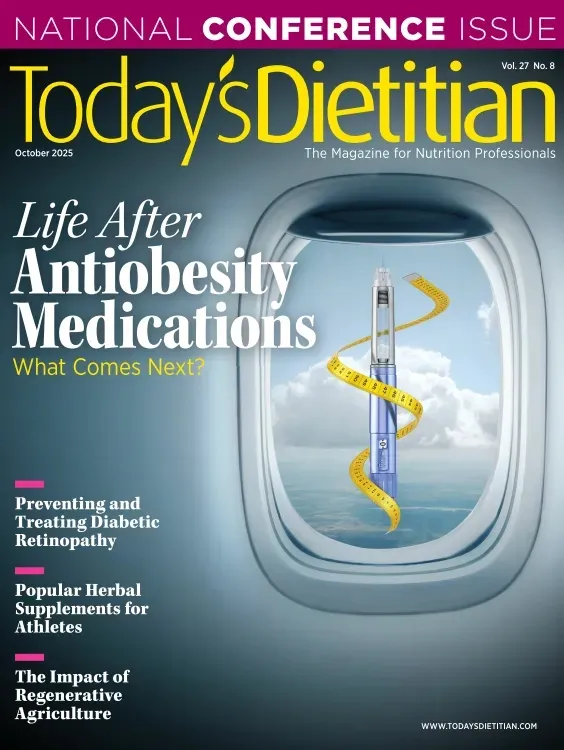
Life after antiobesity medications opens the October 2025 issue of Today's Dietitian (Vol. 27 No. 8), the National Conference edition that asks what happens when patients stop taking GLP-1s. The 50-page issue arms registered dietitians with clinical guidance on diabetes, supplements, and regenerative agriculture.
The cover feature (p20) synthesises expert perspectives on AOM discontinuation, covering metabolic rebound, appetite return, and the RD's role in behavioural support. A clinical feature on diabetic retinopathy (p24) links nutrition intervention to vision preservation, while a review of popular herbal supplements for athletes (p30) grades evidence for ashwagandha, beetroot juice, and curcumin. Regenerative agriculture (p36) examines soil health's connection to crop nutrient density and greenwashing risks in food marketing. The CPE Monthly (p40) delivers continuing education on omega-3 fatty acids and inflammatory markers in metabolic syndrome.
Departments include Editor's Spot "Sculpting Behavior" (p4), Education (p6), Food for Thought (p10) on nudging healthier habits, Career Development (p14), and Clinical Nutrition (p16). Get to Know (p46) profiles a dietitian working in community health, and Ready, Set, Dietetic (p48) guides students toward exam readiness.
—–
Content Guide
▸ Cover Feature
p.20 · Life After Antiobesity Medications
Experts outline metabolic and behavioural changes when patients discontinue GLP-1 receptor agonists, including appetite rebound and weight regain patterns. The article covers screening tools for identifying who may need prolonged support. RDs learn three conversation starters for patients considering discontinuation.
▸ Clinical Nutrition
p.24 · Preventing and Treating Diabetic Retinopathy
Links between glycaemic control, inflammation, and retinal health with specific micronutrient targets (lutein, zeaxanthin, omega-3s). A progression chart maps stages from non-proliferative to advanced retinopathy. Dietitians prioritise lutein-rich food sources in patient meal plans.
p.40 · CPE Monthly: The Influence of Omega-3 Fatty Acids on Inflammatory Markers in Metabolic Syndrome
A review of trial evidence on EPA and DHA dosing for reducing CRP, IL-6, and TNF-alpha in metabolic syndrome patients. The article specifies effective dose ranges and bioavailability differences between fish oil and algal sources. Readers complete the CPE quiz for continuing education credit.
▸ Sports Nutrition
p.30 · Popular Herbal Supplements for Athletes
Evidence-graded review of ashwagandha for cortisol reduction, beetroot juice for nitric oxide, and curcumin for exercise-induced inflammation. A table lists contraindications and drug interactions for each supplement. RDs screen athlete clients for supplement quality seals before recommending.
▸ Sustainability
p.36 · The Impact of Regenerative Agriculture
Examines how rotational grazing, cover cropping, and reduced tillage affect soil carbon sequestration and crop micronutrient density. A buyer's guide helps dietitians evaluate food company sustainability claims for greenwashing. The practice tip: ask suppliers for soil-test data before accepting "regenerative" labels.
▸ Departments
p.4 · Editor's Spot: Sculpting Behavior
Editor argues that dietitians must be experts in behaviour change science, not just nutrition science. Two related department stories on nudging and trust-building anchor the issue's theme. Readers reflect on their own patient communication style.
p.10 · Food for Thought
"Nudging Healthier Habits" explores cafeteria layout changes, plate colour contrasts, and default-option menu design. Case studies from hospital and corporate cafeterias show measurable shifts in produce selection. Dietitians test one nudge in their workplace within a week.
p.14 · Career Development
"Building Trust to Support Behavior Change" covers motivational interviewing techniques and cultural competence in dietary counselling. A role-play script demonstrates open-ended questioning for resistant patients. RDs record one session and review their own question-to-statement ratio.
—–
Editor's Take
This National Conference issue delivers exactly what practising dietitians need: CPE credits, clinical updates, and a behaviour-change framework threaded through the editorial. The antiobesity-medication feature is timely given GLP-1 uptake in the US, and the omega-3 CPE module earns its credit hours with solid trial data. The regenerative agriculture piece adds a sustainability lens most clinical nutrition publications ignore. The weakness: the Education and Career Development departments are shorter than they should be for a conference issue, and the "Get to Know" profile feels like filler. The datebook (p50) is useful only for US-based conference attendees. This issue is essential for clinical RDs in weight-management settings and worth the read for students preparing for the exam.
Strengths
• Antiobesity-medication feature with practical RD protocols
• Omega-3 CPE module with evidence-based dosing
• Regenerative agriculture buyer's guide for greenwashing detection
Weaknesses
• Education and Career Development sections feel abbreviated for a conference issue
• Get to Know profile lacks depth compared to clinical features
Verdict: Essential — The most clinically relevant issue of 2025 for RDs working with metabolic health and weight-management patients.
