
All About History The Dark History of the Victorians – 5th Edition – 27 August 2026
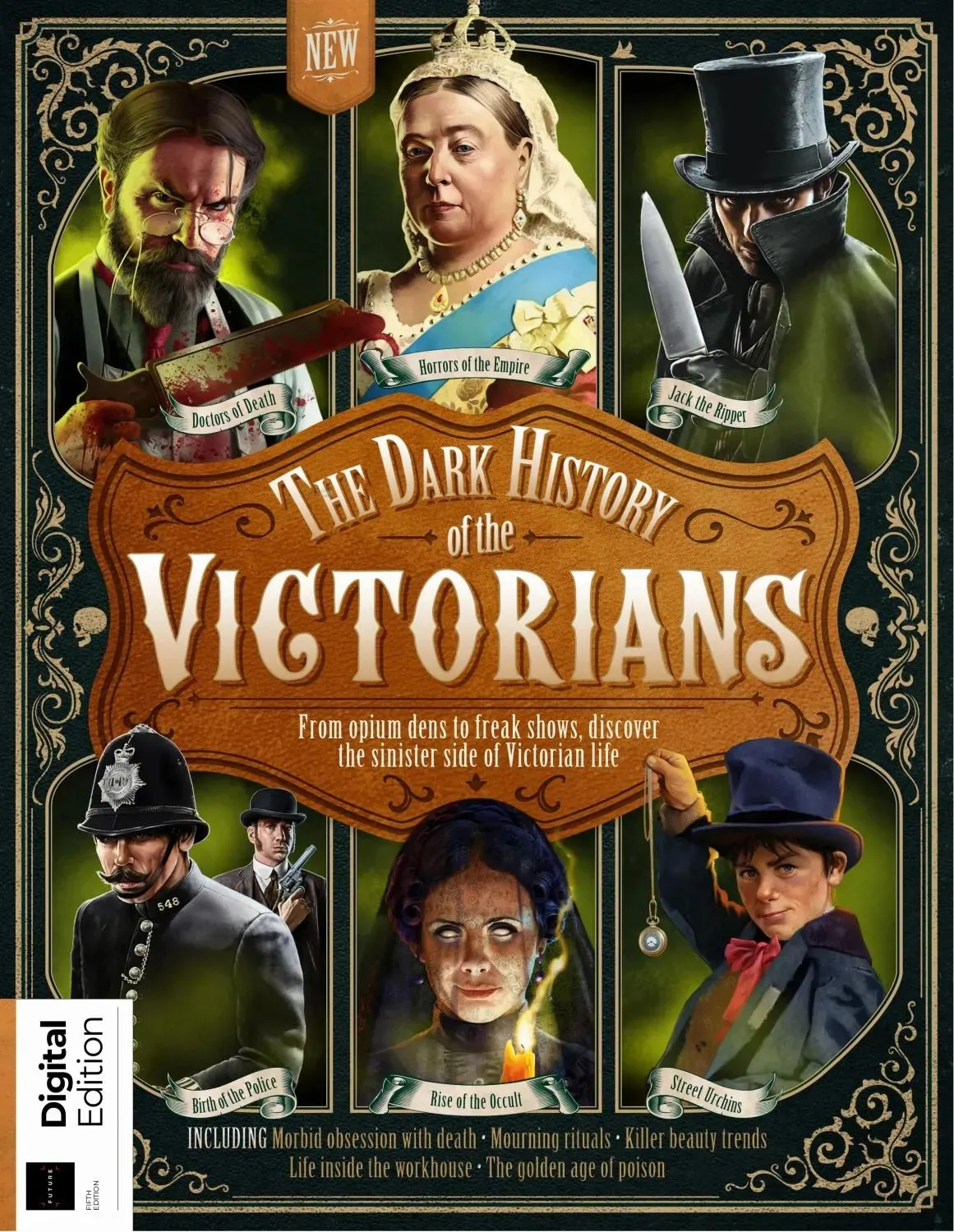
Summary
Scheele's green wallpaper dye, the golden age of poisoning, and the infant child-taking network of Victorian baby farmers fill 120 pages of All About History's Dark History of the Victorians 5th Edition, 27 August 2026. From opium dens to the freak-show stage, the book documents the underside of imperial Britain that school textbooks skip.
Twenty chapters span the British Empire's brutalities, the Irish Great Famine, slum housing, the Great Stink of 1858, workhouse conditions, Bedlam asylum, Victorian surgery, the birth of suffrage, and the cult of death. "Horrors of the British Empire" (p.6) documents colonial violence from Jamaica to India. "Shamrock suffering" (p.12) traces British policy failures that worsened the Irish Famine. "The Great Stink" (p.30) describes the 1858 summer when the Thames overwhelmed Parliament. "All work and no pay" (p.34) reconstructs workhouse life through union records. "Victorian medicine" (p.48) covers surgery before anaesthesia and the anatomy-act corpse trade. "The golden age of poisoning" (p.98) details how improved chemistry turned household substances into murder weapons. "The Victorian cult of death" (p.104) explains elaborate mourning rituals and post-mortem photography.
Crime chapters cover the birth of organised policing, Jack the Ripper, and the Victorian opium trade. The occult section traces seances, spirit photography, and the founding of the Theosophical Society.
—————
Content Guide
▸ Empire & Society
p.6 · Horrors of the British Empire
Colonial violence from the Morant Bay Rebellion in Jamaica to the Amritsar Massacre is documented through parliamentary papers and missionary accounts. The article includes mortality figures for the 1876-78 Indian famine, estimating 10 million excess deaths. The colonial timeline side-by-side with domestic reform dates makes the Empire's dual standard explicit.
p.12 · Shamrock suffering
British relief policy during the Irish Great Famine — stopping grain exports, requiring workhouse admission for food aid — is traced through 1845-1852 Poor Law records. The population-loss chart shows Ireland's decline from 8.5 million to 6.5 million within a decade. The chart is essential for any debate on whether the famine constituted genocide.
p.30 · The Great Stink
The 1858 summer when Thames sewage overwhelmed the House of Commons is reconstructed from Hansard records and contemporary cartoons. The article reproduces the Punch illustration "Father Thames Introducing his Offspring to the City of London." Joseph Bazalgette's sewer system, built in response, still carries London's waste today.
▸ Medicine & Crime
p.48 · Victorian medicine
Surgery before anaesthesia, the body-snatching trade, and the 1832 Anatomy Act are documented through hospital records and the case of Burke and Hare. The article includes survival rates for amputations before and after Lister's antiseptic method. The rate jump from 40 percent to 85 percent is worth citing in any medical-history timeline.
p.92 · Into oblivion
The Victorian opium trade — from laudanum sold at corner shops to the East India Company's supply chain — is traced through pharmacy records and literary accounts. The article reproduces a typical 1850s laudanum label showing dosage instructions for infants. The label demonstrates why addiction crossed all social classes.
p.98 · The golden age of poisoning
Improved 19th-century chemical analysis made both detection and perpetration easier. The article profiles five celebrated poisoners — William Palmer, Thomas Cream, Mary Ann Cotton — and the specific compounds they used: strychnine, arsenic, antimony. The solubility-and-symptom table helps distinguish each poison in period crime reports.
▸ Death & Belief
p.104 · The Victorian cult of death
Mourning etiquette — black crepe for two years, jet jewellery, sealed rooms — is documented through etiquette manuals and undertaker records. The article reproduces a full-page 1860s mourning catalogue. The catalogue prices show that a proper mourning wardrobe cost a working-class family two months' wages.
p.112 · Memento mori
Post-mortem photography practice is documented from the 1840s daguerreotype era through the 1880s. The article reproduces 12 examples, showing the living-relative posing with the deceased as if sleeping. The technical section explains the long exposure times that required the deceased to appear naturally posed.
p.120 · Rise of the occult
The Victorian fascination with seances, spirit photography, and the Theosophical Society is traced through the careers of the Fox sisters and Helena Blavatsky. The article reproduces a 1870s spirit photograph with the exposure and plate-manipulation techniques explained. The photograph is a case study in how credulity and technology intersect.
—————
Editor's Take
All About History's Dark History of the Victorians 5th Edition delivers the most consistently grim coverage in the series, which is exactly what the title promises. The opium and poisoning chapters offer genuinely useful reference material for true-crime readers. Weakest parts: the "Birth of Suffrage" chapter is too brief for a movement that spanned 60 years, and the Bedlam asylum entry relies on secondary accounts rather than patient records. This edition suits the true-crime and social-history reader looking for primary-source material on the Victorian underbelly.
Strengths
• Opium trade documentation from pharmacy labels to East India Company records
• Mourning catalogue pricing showing economic burden on working class
• Spirit photograph with plate-manipulation technique explanation
Weaknesses
• Suffrage chapter compressed to 6 pages for a 60-year movement
• Bedlam asylum entry lacks original patient-record material
Verdict: Recommended — Darkest coverage in the series, ideal for true-crime reference.
