
Spirituality Health – March-April 2026
Summary
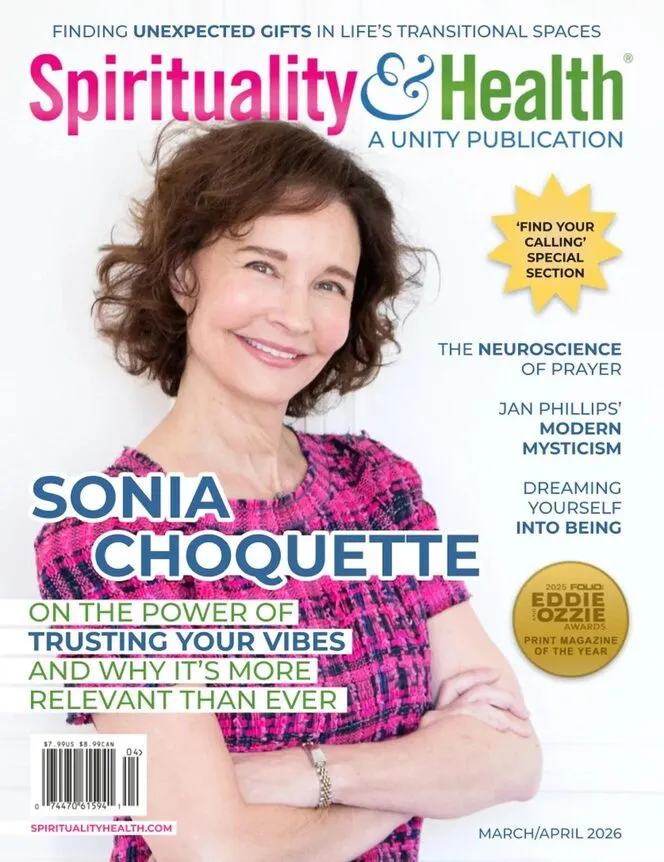
Spirituality & Health Vol. 3 No. 2 for March/April 2026 invites readers to find "unexpected gifts in life's transitional spaces" — the cover line that frames an issue about liminality, mysticism, and the neuroscience of prayer. Allan Hamilton, M.D. contributes "The Neuroscience of Prayer" (p.34), which maps what happens in the brain during intercessory prayer, while Sonia Choquette (p.26) offers guidance on trusting intuitive "vibes" in an Enlightened Perspectives interview.
"Sacred Journeys: How Belize Became My Path to Freedom" (p.18) by Ajani Inez opens the travel section with a narrative about tracing Mayan ancestral routes. "Mysticism, Mindfulness, and the Act of Mattering" (p.22) by Jan Phillips argues that contemporary mindfulness has been stripped of its mystical roots and proposes a recovery plan. "Dreaming Yourself Into Being" (p.30) by Bonnie Buckner, Ph.D. reports on a dream-incubation practice she tested with 40 participants over six weeks. "Find Your Calling: Midwifing the Soul" (p.39) by Winter Ross profiles three doulas who see their work as spiritual accompaniment rather than medical support.
Regulars include "The Soul of Therapy" (p.10) on the therapist's own spiritual practice, "Sacred Earth Connections" (p.16) by Cylvia Hayes on regenerative agriculture as a spiritual act, and "Bookmarked" (p.62) reviewing three new titles on Christian mysticism. The "Bright Lights" profile (p.48) features Steve Nygren, founder of Serenbe, on building community as a spiritual infrastructure. For readers navigating career changes, divorce, or geographic moves, this issue treats uncertainty as a spiritual curriculum.
—————
Content Guide
▸ Cover Story / Liminality
p.34 · The Neuroscience of Prayer
Hamilton reviews fMRI studies showing that intercessory prayer activates the anterior cingulate cortex and the default-mode network differently than meditation. He distinguishes petitionary prayer from contemplative prayer at the neural level. The article gives spiritually oriented clinicians a neurological vocabulary for discussing prayer with sceptical patients.
p.30 · Dreaming Yourself Into Being
Buckner's 6-week dream-incubation protocol asks participants to set an intention before sleep and record results immediately upon waking. Of 40 participants, 28 reported at least one dream that addressed their stated intention. The protocol takes 5 minutes before bed and 10 minutes upon waking.
▸ Interviews & Profiles
p.26 · Enlightened Perspectives: Sonia Choquette
The author and spiritual teacher describes her transition from academia to intuitive consulting. She distinguishes "intuitive hits" from anxiety by body-location: intuition resides in the solar plexus, anxiety in the chest. Readers get a 3-question test to differentiate the two.
p.48 · Bright Lights: Steve Nygren at Serenbe
Nygren, founder of the 1,000-acre planned community in Georgia, discusses designing walkable neighbourhoods that force neighbourly interaction. He argues that spirituality is infrastructure. Community planners and intentional-community seekers will find the practical design principles as compelling as the philosophy.
▸ Sacred Travel
p.18 · Sacred Journeys: How Belize Became My Path to Freedom
Inez traces her Mayan ancestry through a journey to the Actun Tunichil Muknal cave, where she performed a ceremony her grandmother taught her. She includes a responsible-tourism checklist for readers who want to visit sacred sites without exploiting them.
▸ Regulars
p.60 · Toolbox — Journaling for Transition
Hunter Liguore provides five journaling prompts designed for people in liminal periods: "What am I being released from?" "What wants to be born?" Each prompt includes a suggested writing duration of 7 minutes. The column directly supports the issue's transitional-spaces theme.
—————
Editor's Take
This issue's theme — transitional spaces — is well-chosen and executed with unusual consistency across features and columns. The neuroscience-of-prayer piece by Hamilton is the most distinctive contribution, offering something you won't find in the typical spirituality magazine (brain scans of petitionary prayer). Sonia Choquette's intuition-versus-anxiety framework is genuinely useful. The weakness is that "Sacred Earth Connections" on regenerative agriculture is only loosely connected to the liminality theme, and the Cylvia Hayes column relies more on assertion than evidence. "Dreaming Yourself Into Being" is intriguing but its sample size (n=40) is too small for the claims it makes. Still, the issue reads as designed rather than assembled, which is a rare editorial achievement.
Strengths
• Hamilton's neuroscience-of-prayer piece is genuinely distinctive
• Transitional-spaces theme runs consistently across features
• Choquette's intuition-anxiety differentiation is practically useful
Weaknesses
• Dream-incubation study needs replication, not claims
• Sacred Earth Connections column feels thematically forced
Verdict: Recommended — A thematically cohesive issue anchored by a standout neuroscience-of-prayer feature that few spirituality magazines could publish.
