
History of War Operation Market Garden – 5th Edition – 20 August 2026
Summary
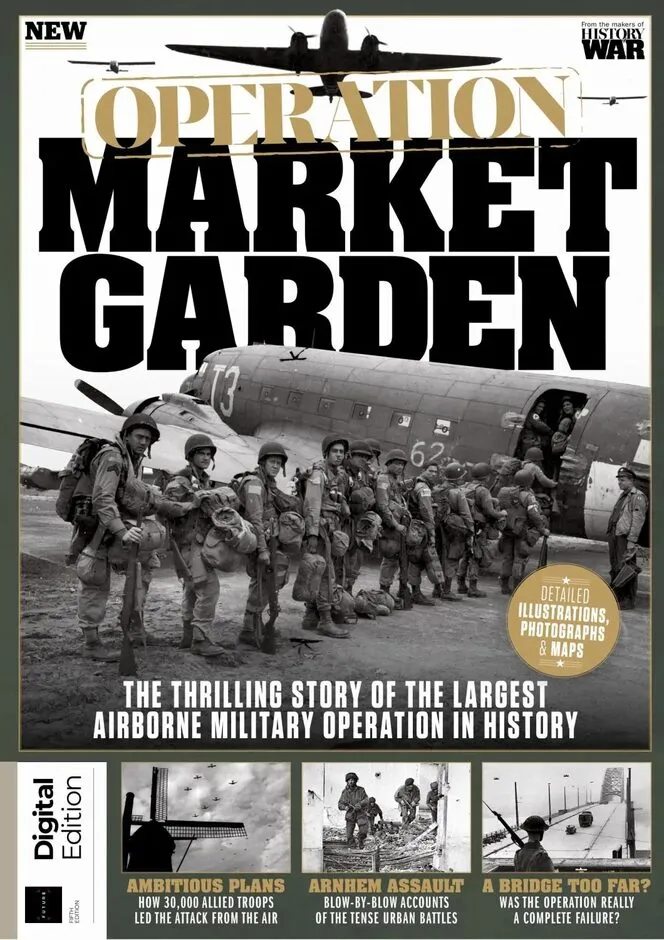
History of War: Operation Market Garden — 5th Edition (20 August 2026) covers the largest airborne military operation in history — 41,000 paratroopers dropped into the Netherlands in September 1944 to capture eight bridges and open a route into Germany. The 130-page edition traces the operation from the liberation euphoria of August 1944 to the failed final objective: Arnhem bridge.
The 17-chapter narrative is divided into four sections. Introduction sets the scene with Liberation at Last (p.6) and The Beginning of the End? (p.12). Market Forces covers the planning: The Plan Unfurls (p.20), Operations Begin (p.30), The British Land (p.40), The Second Day at Arnhem (p.50) and The Second Day in the American Zones (p.56). Garden Assault covers the ground offensive: Making Plans for the Ground Offensive (p.66), The XXX Corps Attack Begins (p.72), The Arnhem Bridge is Lost (p.78), Mid-Week in Oosterbeek (p.86), Mid-Week in Nijmegen (p.92), Actions Elsewhere (p.100), Black Friday, Dark Weekend (p.102) and Operation Berlin (p.110). Denouement: Why Did Market Garden Fail? (p.116) and The Aftermath (p.122).
The edition argues that Market Garden failed for three reasons: intelligence failures (Allied commanders ignored Dutch resistance reports of German Panzer divisions near Arnhem), communications breakdown (paratroopers' radios did not work beyond five miles) and XXX Corps' slow advance along a single raised road that became known as "Hell's Highway."
—————
Content Guide
▸ Introduction
p.6 · Liberation at Last
August 1944: Allied forces had broken out from Normandy and swept across France. Brussels was liberated on 3 September; Antwerp fell the next day. German forces were in retreat across the entire Western Front. The mood among Allied commanders — particularly Field Marshal Bernard Montgomery — was that one decisive blow could end the war by Christmas. The article captures the optimism that drove planners to approve a high-risk airborne operation.
p.12 · The Beginning of the End?
German resistance stiffened in early September 1944 as supply lines stretched thin. The Allied advance outran its fuel supplies — the "Red Ball Express" truck convoy delivered 5,000 tonnes of supplies daily but could not keep pace. Field Marshal Montgomery proposed Operation Market Garden as a way to bypass the German Siegfried Line and cross the Rhine. The article includes the original planning map: eight bridges across five major rivers and canals.
▸ Market Forces — The Airborne Assault
p.20 · The Plan Unfurls
Three Allied airborne divisions would land simultaneously: US 101st Airborne (bridges at Eindhoven and Veghel), US 82nd Airborne (bridges at Grave and Nijmegen) and British 1st Airborne (Arnhem bridge — the final objective). XXX Corps would advance 105 kilometres along a single road in under 48 hours to link all three divisions. The article reproduces the planning timeline: Day 1 bridges captured, Day 2 XXX Corps links with 101st, Day 3 reaches Arnhem.
p.30 · Operations Begin
17 September 1944: 1,545 aircraft and 478 gliders carried 20,000 troops to the Netherlands in the first wave — the largest airborne operation in history. The Luftwaffe offered minimal resistance. However, the British 1st Airborne's landing zones were chosen eight miles from Arnhem bridge to avoid anti-aircraft guns — a decision that cost them the element of surprise.
p.50 · The Second Day at Arnhem
Only one battalion — 2nd Battalion under Lieutenant Colonel John Frost — reached the Arnhem bridge. Frost's 740 men held the northern ramp against a German force that grew to 9,000 men over three days. German tanks destroyed buildings one by one. Frost's final radio message on 20 September: "Out of ammunition. God save the King." The battalion held the bridge for 81 hours.
▸ Garden Assault — The Ground Advance
p.72 · The XXX Corps Attack Begins
XXX Corps advanced along a single raised road through flat, open farmland — defended by German anti-tank guns on both sides. The lead tank, a Sherman named "Jumbo," was knocked out within the first hour. The column stretched 24 kilometres by midday. The advance averaged 2 kilometres per hour — against Montgomery's plan of 4.5 kilometres per hour on Day 1.
p.78 · The Arnhem Bridge is Lost
20 September 1944: German forces overwhelmed Frost's remaining defenders. Only 70 of the original 740 men were still fit to fight. The German commander, SS General Wilhelm Bittrich, used captured British radios to issue false orders to Allied paratroopers. The bridge remained in German hands for the rest of the operation.
p.116 · Why Did Market Garden Fail?
Three causes: intelligence (Dutch resistance warnings about II SS Panzer Corps at Arnhem were dismissed), communications (paratrooper radios had a range of five miles — most units could not contact each other) and terrain (XXX Corps' single-road advance meant one disabled tank halted an entire column). The article adds a fourth factor: the operation's ambitious timeline allowed no room for delay.
—————
Editor's Take
History of War: Operation Market Garden 5th Edition is a tightly focused operational history that benefits from its single-battle scope — 17 chapters across 130 pages allow each day's tactical decisions room to breathe. The Second Day at Arnhem chapter (p.50) is the edition's strongest entry: Frost's 740 men holding the bridge for 81 hours against 9,000 Germans is a story that works at both the strategic and personal level. The Why Did Market Garden Fail? conclusion (p.116) distils the operation into four clean causes — intelligence, communications, terrain and timeline — giving readers a framework that the battle narrative alone would not provide. The weakness is the visual presentation: the tactical maps showing divisional movements are reproduced at a scale that makes unit labels illegible. The plan-unfurling map from p.20 is never referenced again in the chapter text — readers must flip back to check unit positions. The Aftermath chapter (p.122) is too brief at four pages for an operation that influenced NATO's airborne doctrine for the next 50 years.
Strengths
• Frost's 740-men-holding-for-81-hours narrative is the edition's best chapter
• Four-cause failure framework (intelligence, communications, terrain, timeline) is clean and teachable
• XXX Corps 2-km-per-hour average advance fact grounds strategic ambition in tactical reality
Weaknesses
• Tactical maps are reproduced too small to read unit labels
• Aftermath chapter at four pages is too brief for NATO airborne doctrine analysis
Verdict: Recommended — The best single-volume Market Garden primer for general readers; the Frost chapter alone justifies the purchase. (19 words)
