
National Geographic Kids Australia – Issue 141 2026
Summary
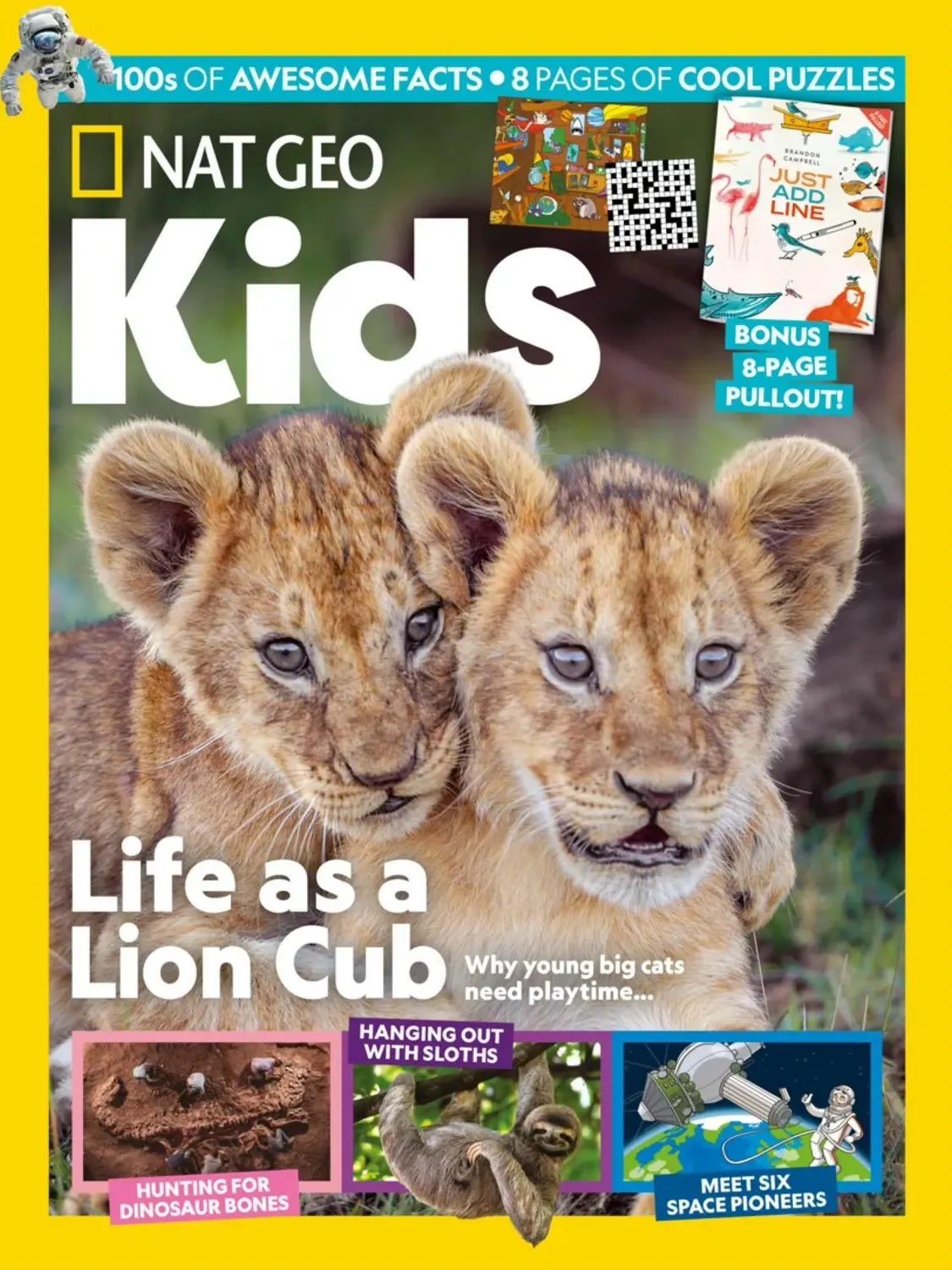
National Geographic Kids Australia Issue 141 (2026) leads with lion cubs in Botswana learning to survive through play — a cover feature mirrored in Nat Geo's global edition network. Inside, a palaeontologist digs up dinosaurs (p.13), six space pioneers are profiled (p.18), sloths demonstrate their upside-down life (p.28), and a bonus 8-page pullout adds extra puzzles. Wacky World (p.3), Cool News (p.4) and Explorer HQ (p.32) fill the regular slots.
The lion cub feature (p.6) tracks a pride across Botswana's Okavango, where cubs spend 18 months practising stalking and pouncing before making their first kill alongside adult females. Digging Up Dinos (p.13) interviews a female palaeontologist who discovered a new horned dinosaur in Morocco's Sahara after hiking 20 kilometres daily to the dig site. Space Heroes (p.18) profiles six overlooked figures: Katherine Johnson (NASA mathematician), Mary Jackson (NASA's first Black engineer), Dr. Mae Jemison (first Black woman in space), plus three international astronauts from non-spacefaring nations. Hanging With Sloths (p.28) covers three-toed sloth metabolism and the algae that grows on their fur. Make It (p.38) provides a no-bake hedgehog cake recipe using shredded wheat and chocolate.
—————
Content Guide
▸ Cover Story
p.6 · Lion Cub Life
Botswana lion cubs spend 18 months learning to hunt through play: stalking grasshoppers, pouncing on siblings and practising the throat-bite on their mother's tail. Females hunt 90% of the time and cubs begin joining kills at 11 months. The photo sequence shows a two-month-old cub missing its pounce — a miss rate that drops from 90% to 30% over the first year. Find a video of house cat kittens stalking — the ear flatten, rear wiggle and leap sequence is identical to lion cubs.
▸ Features
p.13 · Digging Up Dinos
Dr. Nizar Ibrahim describes the discovery of a new five-metre horned dinosaur in the Moroccan Sahara. Each day required a 20-kilometre trek carrying 30 kilograms of supplies — water, plaster bandages and pickaxes. The dinosaur was buried in 100-million-year-old river sediment. Start a fossil collection in your own backyard or local creek bed — you are looking for rocks with distinct shapes pressed into the surface.
p.18 · Space Heroes
Katherine Johnson calculated the trajectory for Apollo 11 by hand; Mary Jackson became NASA's first Black engineer after fighting to attend segregated night classes; the book also profiles the first astronaut from Afghanistan and the first from Mongolia. The article includes a timeline showing which countries have sent people into space — only 12 nations as of 2026. Mark your country on the timeline — if it is not among the 12, you are reading about the first person who could be.
p.28 · Hanging With Sloths
Three-toed sloths sleep 15 to 18 hours daily, climb down from trees once every seven days to defecate, and carry entire ecosystems in their fur — algae, moths and beetles. The algae gives the fur a green tint that camouflages the sloth from harpy eagles. Brush your hair and check the brush — sloth fur hosts more living organisms than your entire head.
▸ Regulars
p.3 · Wacky World
Daredevil stunts, optical illusions and odd contests from around the globe. One entry: the annual Wife-Carrying Championship in Finland, where the winner carries their partner 253 metres through obstacles. The prize is the wife's weight in beer.
p.4 · Cool News
Inspiring stories: a 12-year-old Australian girl designed a device that removes microplastics from laundry water using a mesh filter and a hand-cranked drum. The device won a national science competition. Build a simple water filter using a plastic bottle, sand, gravel and cotton — it does not catch microplastics, but it shows how filtration layers work.
p.32 · Explorer HQ
Puzzles, a cross-brain boost and reader-submitted photos. The crossword features Australian animals: bilby, quokka, echidna and platypus. Three of these four lay eggs — find out which one is the mammal that does not.
p.38 · Make It: Hedgehog Cake
No-bake recipe using shredded wheat breakfast cereal, melted chocolate, golden syrup and butter. The shredded wheat is shaped into a dome, drizzled with chocolate and decorated with brown M&M spikes. The recipe takes 20 minutes of hands-on time plus two hours of refrigeration — start it before dinner so it is ready for dessert.
—————
Editor's Take
National Geographic Kids Australia Issue 141 follows the global edition template closely — the lion cub, palaeontologist, space heroes and sloth features are near-identical to the UK Issue 260 and US September 2026 line-ups. The Australia-specific value comes from Cool News (the 12-year-old microplastic filter designer), Wacky World (Wife-Carrying Championship) and the hedgehog cake recipe using shredded wheat — a breakfast cereal more common in Australian kitchens than American ones. The space heroes feature covers two US figures (Johnson, Jackson) plus four international astronauts, which gives it broader cultural reach than the US edition. The 8-page pullout puzzles are a genuine bonus for travelling families. The weakness is editorial duplication: the same lion cub photos and sloth statistics appear across three editions this month.
Strengths
• 12-year-old Australian microplastic filter designer profiled in Cool News
• Space Heroes includes astronauts from non-spacefaring nations, not just US figures
• Hedgehog cake no-bake recipe uses shredded wheat — 20 minutes prep
Weaknesses
• Lion cub and sloth features duplicate content across global editions
• Wacky World Wife-Carrying Championship is a one-joke page
Verdict: Recommended — The microplastic filter story and international space heroes give this edition local relevance. (17 words)
