
How It Works Book of Space – 18th Edition – 3 September 2026
Summary
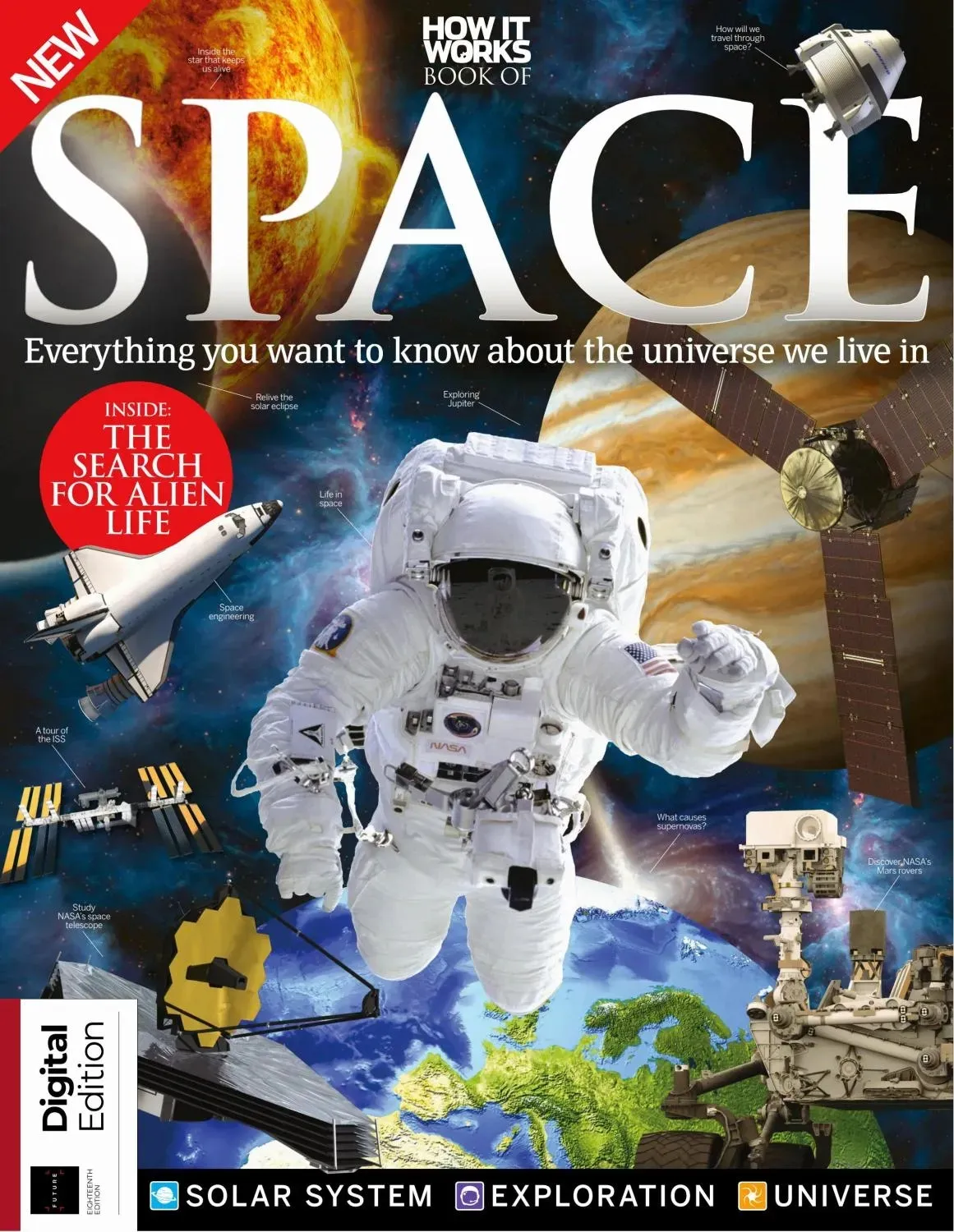
How It Works Book of Space — 18th Edition (3 September 2026, Future Publishing) covers the universe in 140-odd pages across three sections: Solar System (19 entries from Earth from space to asteroids), Exploration (16 entries from alien Earths to space tourism) and Universe (12 entries from the Big Bang to the search for alien life). Digital Edition format.
The Solar System section opens with Earth from space (p.10) and runs through each planet, plus Pluto, Europa, Titan, dwarf planets, auroras, planetary colours and asteroids. The Exploration section covers astronaut training (p.60), the ISS interior (p.68), Curiosity's discoveries (p.72), rocket science (p.76), mega-rockets (p.80), Orion spacecraft (p.84), space tourism (p.86), the Voyager probes (p.92), the James Webb Space Telescope (p.94) and the Extremely Large Telescope (p.95). The Universe section addresses the Big Bang (p.104), star formation (p.112), extreme cosmic temperatures (p.114), parallel universes (p.116), dark matter (p.120), active galaxies (p.126), galaxy classification (p.128), supernovas (p.130) and the A-Z of the galaxy (p.138).
—————
Content Guide
▸ Solar System
p.10 · Earth from Space
Satellite imagery of Earth's most dramatic features: the aurora borealis from the International Space Station, the Great Barrier Reef from orbit, the Nile River's green corridor against the Sahara, and the Himalayan mountain range. The article explains how satellite orbits determine what kind of images they return — polar orbits for mapping, geostationary for weather. The ISS orbits Earth every 90 minutes — that is 16 sunrises and sunsets per day.
p.28 · Mars
The geology and exploration history of the Red Planet. Mars has the tallest mountain in the Solar System (Olympus Mons, 21.9 kilometres) and the longest canyon (Valles Marineris, 4,000 kilometres). The Perseverance rover has collected 23 rock samples as of 2026, each stored in a titanium tube for future return to Earth. A human standing on Olympus Mons would see the peak curving beyond the horizon due to the mountain's 600-kilometre base.
p.40 · Europa
Jupiter's ice moon may harbour a liquid ocean beneath its 15-kilometre-thick ice crust. The Europa Clipper mission (launched 2024, arriving 2030) will perform 45 flybys to analyse the moon's subsurface water. Tidal heating from Jupiter's gravity keeps the ocean liquid. The article estimates the ocean's volume at twice that of all Earth's oceans combined.
▸ Exploration
p.68 · International Space Station
The ISS orbits at 400 kilometres above Earth, travelling at 28,000 kilometres per hour — fast enough to circle the planet in 90 minutes. The station's solar arrays span 109 metres and produce 120 kilowatts of power. The article includes a cutaway diagram of the habitable modules: Zvezda (Russian service module), Destiny (US laboratory), Kibo (Japanese laboratory) and Columbus (European laboratory). Astronauts exercise 2.5 hours daily to counteract bone density loss at zero gravity.
p.86 · Space Tourism
Virgin Galactic's SpaceShipTwo and Blue Origin's New Shepard have flown 57 commercial passengers as of mid-2026. SpaceX's Starship is projected to begin orbital tourism flights by 2028. The article compares the three vehicles by altitude reached, passenger capacity and price point: SpaceShipTwo at 90km (4 passengers, $450,000), New Shepard at 107km (6 passengers, $475,000), Starship at orbital altitude (100 passengers, projected $500,000).
p.94 · James Webb Space Telescope
Launched December 2021, Webb observes in infrared from the L2 Lagrange point 1.5 million kilometres from Earth. Its 6.5-metre segmented mirror collects 6 times more light than Hubble. Webb has imaged galaxies 13.5 billion light-years away — light that left those stars before Earth formed. The telescope's 5-layer sunshield is the size of a tennis court.
▸ Universe
p.104 · The Big Bang
The universe began 13.8 billion years ago as a singularity smaller than an atom. Within 10^-32 seconds, it expanded faster than light during inflation. The cosmic microwave background radiation — the afterglow of the Big Bang — was discovered accidentally in 1965 by Arno Penzias and Robert Wilson, who thought their radio antenna was picking up interference from pigeon droppings.
p.120 · Mystery of Dark Matter
Dark matter constitutes 27% of the universe's mass-energy but cannot be seen or detected directly. The article explains how Vera Rubin's 1970s galaxy rotation curves proved its existence: stars at the edges of galaxies orbit just as fast as stars at the centre, which is only possible if invisible mass surrounds the galaxy. The LUX-ZEPLIN experiment in South Dakota uses 10 tonnes of liquid xenon to detect dark matter particles passing through Earth.
p.130 · Supernovas
A supernova occurs when a massive star collapses — the explosion outshines an entire galaxy for weeks. The Crab Nebula supernova of 1054 was recorded by Chinese astronomers and was visible during daylight for 23 days. The article explains that the iron in your blood and the calcium in your bones were forged inside a supernova — you are literally made of exploded stars.
—————
Editor's Take
How It Works Book of Space 18th Edition is the most accessible space primer in this batch — the three-section structure (Solar System, Exploration, Universe) allows readers to enter at any point without reading sequentially. The Earth from Space satellite-orbit explanation (p.10) and the ISS cutaway diagram (p.68) are the edition's best-designed spreads, each conveying complex spatial information in a single page. The Space Tourism price comparison (p.86) — $450,000 versus $475,000 versus $500,000 — is the kind of practical detail that the Mysteries of Space book lacks. The weakness is the 18th-edition formula: the content has been iterated so many times that some entries (Mercury, Venus, Neptune) read as template updates rather than fresh writing. The "A-Z of the Galaxy" (p.138) is a lazy close-out — two pages of one-sentence definitions that add nothing to the rest of the book. The Digital Edition format means no ads, which improves the reading experience.
Strengths
• ISS cutaway diagram shows habitable modules, solar arrays and orbital mechanics on one spread
• Space Tourism price comparison ($450K-$500K) is the edition's most practical data point
• Three-section structure allows non-sequential reading without losing context
Weaknesses
• 18th-edition formula produces template-quality writing for Mercury, Venus and Neptune entries
• A-Z of the Galaxy close-out is two pages of dictionary definitions with no editorial value
Verdict: Recommended — The most accessible space primer in the batch; the ISS and Space Tourism spreads are worth the price. (17 words)
