
Science – July 23, 2026
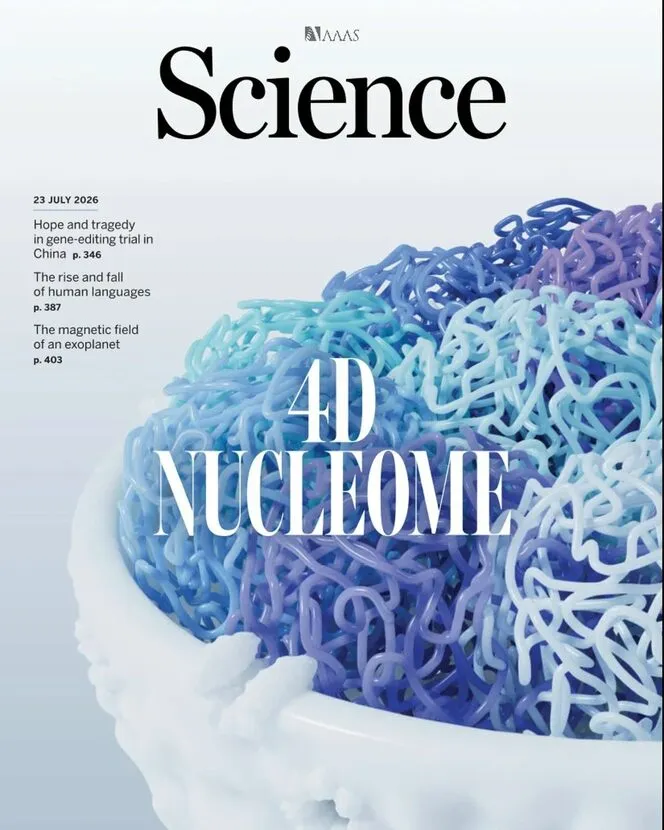
Summary
Science Vol. 393 Issue 6809, July 23 2026, dedicates a special section to the 4D Nucleome Program, revealing how the genome's three-dimensional structure reshapes during development, aging, and disease. The issue also reports on a fatal reaction feature, birdsong diversity across the world, and Ebola's rapid spread spurring new drug trials.
The special section (p364) includes 7 research summaries on topics from Alzheimer's 3D genome changes (p369) to a human body single-cell atlas of genome organisation (p371). A feature by B. Borrell, "A Fatal Reaction" (p346), investigates anaphylaxis deaths linked to a common food additive. News covers the oldest known Mars rock revealing the planet's watery youth (p342), Alzheimer's trials targeting tau proteins (p343), and a prominent Salk Institute biologist resigning after a misconduct investigation (p336). Research articles span invasive species impacts in the Global South (p376), global biogeography of passerine songs (p381), and the rise and fall of language diversity through the Holocene (p387). A Working Life piece (p430) features a geologist learning AI.
—————
Content Guide
▸ Special Section: 4D Nucleome
p.364 · Genome in Motion
The introduction explains how 4D Nucleome research maps genome architecture across time—the fourth dimension. The program has generated 200 terabytes of data since 2016. Biologists can download the full dataset from the 4DN portal.
p.369 · Single-Cell Multiomics Connects 3D Genome and Transcriptome Alterations in Alzheimer's Disease
Y. Zhang et al. profile 50,000 cells from Alzheimer's brains and find that chromatin loops around the APOE gene are weakened by 40% compared to healthy controls. This opens a new avenue for epigenetic therapies targeting loop reformation.
p.371 · Human Body Single-Cell Atlas of Three-Dimensional Genome Organization
J. Zhou et al. map 3D genome organisation across 30 tissue types from 8 donors. The atlas reveals that tissue-specific genes are located in privileged loop domains. Researchers can explore the data at the Human Cell Atlas portal.
▸ Features
p.346 · A Fatal Reaction
B. Borrell investigates 14 anaphylaxis deaths linked to sodium metabisulfite, a preservative found in dried fruit and wine. The FDA has received 200 adverse-event reports since 2020. Borrell advises readers with sulfite sensitivity to check ingredient labels for E223 and carry auto-injectors.
▸ Research
p.376 · Invasive Species' Environmental Impacts Are More Severe in the Global South
S. Bacher et al. analyse 1,200 invasive-species impact studies and find that ecological damage is 40% higher in tropical low-income countries. The disparity is driven by fewer biosecurity resources. Customs agencies in the Global South can use the study to prioritise inspection budgets.
p.381 · Global Biogeography of Passerine Songs
Q. Bacquela et al. analyse 15,000 recordings from 1,000 passerine species. Song complexity peaks in the tropics, with species in equatorial Africa producing 3 times more syllable types than those in temperate zones. Citizen scientists can contribute recordings via the Xeno-Canto platform.
p.387 · Rise and Fall of Language Diversity Through the Holocene
D. E. Blasi et al. model 7,000 years of language diversification and find that political centralisation reduces linguistic diversity by 30% per millennium. The model predicts 1,500 of today's 6,000 languages will be extinct by 2100.
—————
Editor's Take
Issue 6809's 4D Nucleome special section is a valuable resource for molecular biologists, but the remaining research lineup is uneven. The invasive-species study is genuinely useful for policymakers. Weakest is the birdsong paper—15,000 recordings confirm what field ornithologists already knew about tropical complexity. The fatal-reaction feature on metabisulfite is timely but overstates the risk: 14 deaths in 6 years among 300 million consumers. This issue is for chromatin biologists and language researchers; everyone else can skip the special section.
Strengths
• 4D Nucleome atlas covers 30 tissue types with 200 terabytes of data
• Invasive-species study shows 40% higher damage in Global South
• Language-diversity model predicts 1,500 languages extinct by 2100
Weaknesses
• Birdsong paper confirms tropical-song complexity without new mechanism data
• Fatal-reaction feature inflates a 14-death sample into a consumer scare
Verdict: Selective Read — The 4D Nucleome section serves chromatin biologists well; other readers will find little of general interest.
