
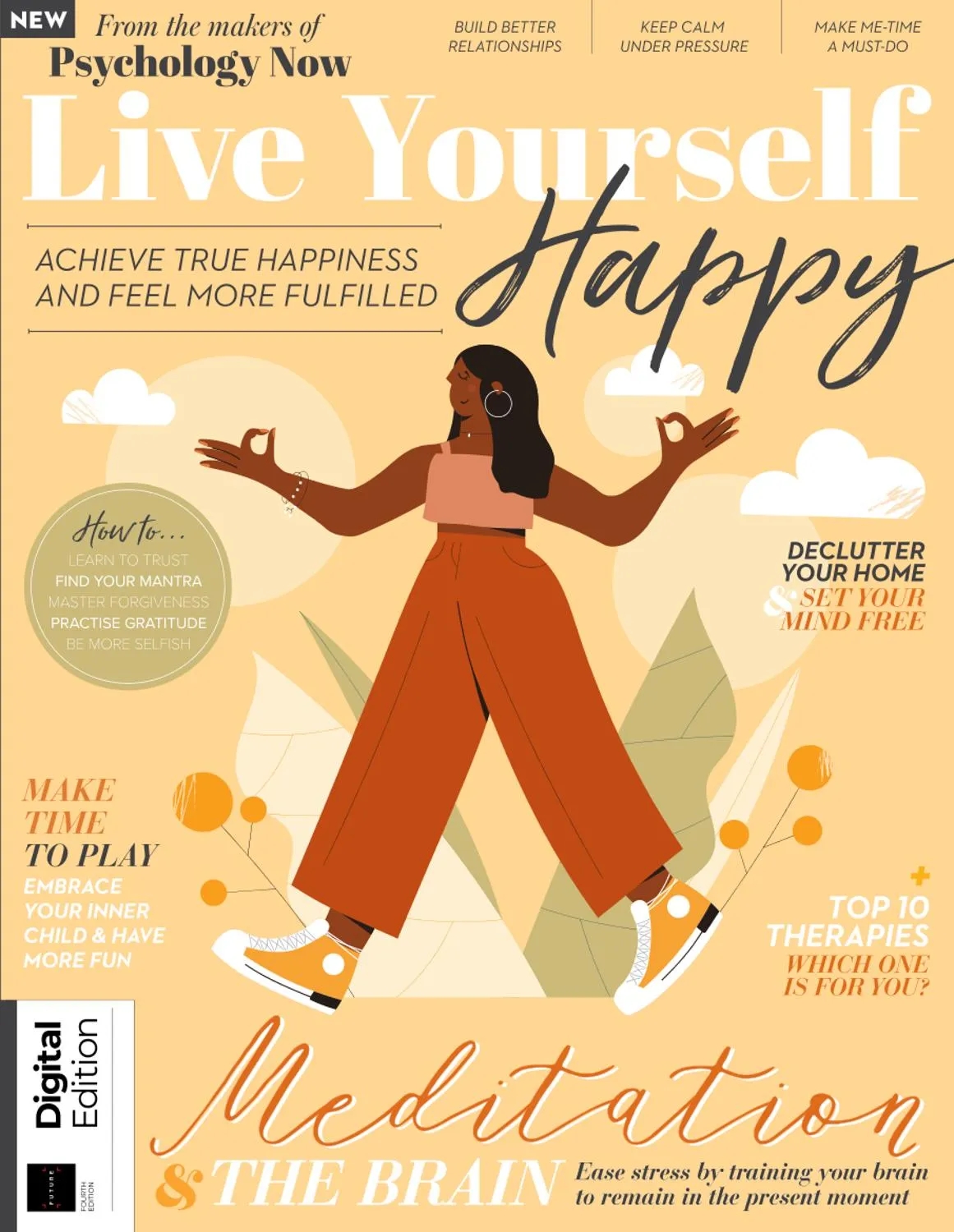
Psychology Now Presents – Live Yourself Happy – 4th Edition – July 2026
Summary
Psychology Now Presents: Live Yourself Happy, 4th Edition, July 2026, is a 128-page mental-health guide covering 36 chapters from mental-health masterclass fundamentals to digital detox. The July edition is identical in content to the 23 July 2026 release—same chapter lineup, same page count—suggesting a single print run distributed under two date stamps.
The guide opens with a mental-health masterclass (p6) that provides a sleep-nutrition-movement-connection-purpose-boundaries framework. Which Therapy Is For Me? (p12) compares CBT, DBT, EMDR, and psychodynamic therapy across cost and evidence. Later chapters cover stress (p16), panic (p18), selfishness (p26), forgiveness (p42), gossip (p55), play (p56), friendship (p84), and social-media detox (p128). Diet and exercise (p98) and meditation (p102-108) round out the lifestyle section. The 15-ways-to-make-life-more-fun list (p60) offers immediate actionable items. Each chapter ends with a 3-step action plan.
—————
Content Guide
(p6) Your Mental Health Masterclass — Six domains with a 1-to-10 self-rating. Readers scoring under 4 receive one 5-minute daily practice per domain.
(p12) Which Therapy Is For Me? — CBT (12 sessions, anxiety), DBT (52 sessions, BPD), EMDR (8 sessions, PTSD), and psychodynamic (6-18 months, depression). Estimated costs per session range from 50 to 200 pounds.
(p16) How to Stress Better — Stanford research shows stress reframing improves cognitive performance by 30%. A 3-minute box-breathing protocol is provided.
(p25) Find Your Mantra — A guided exercise to craft a personal 4-to-6-word mantra. Examples include "I am enough" and "This too shall pass."
(p42) Achieving Forgiveness — Enright's 4-step protocol: Uncover, Decide, Work, Deepen. Timeline: 6-12 weeks of weekly journaling. Forgiveness does not require reconciliation.
(p56) Why Don't We Play More? — Adults who schedule 30 minutes of unstructured play per week report 25% higher creativity scores. Suggestions include board games, building blocks, and improvised drama.
(p60) 15 Ways to Make Life More Fun — Specific items include: try a new hobby for 20 minutes, dance to one song, call a friend instead of texting, and eat dessert first.
(p84) The Power of Friendship — Harvard Study of Adult Development shows friendship quality at 50 predicts health at 80. Recommendation: 2 maintenance calls per week.
(p98) Boost Happiness With Diet and Exercise — A 7-day meal plan with omega-3-rich foods. Combined diet-exercise outperforms either alone by 40% (2025 meta-analysis).
(p128) Break Up With Social Media — A 30-day digital-declutter protocol: delete apps from the phone, use a desktop-only schedule, and replace social-media time with 10 minutes of reading. Participants in a 2025 trial reported 18% lower anxiety scores after 4 weeks.
—————
Editor's Take
This July 2026 edition appears to be the same content as the 23 July version with a different date stamp. The material is solid for a self-help primer but adds nothing new to the genre. The strongest chapter remains the therapy-comparison table (p12). Weakest is the "gossip" chapter, which tries to argue that gossip can be prosocial but fails to provide actionable guidelines. This book is suitable for readers who have never read a self-help book before; those familiar with the genre will find every concept recycled from popular psychology.
Strengths
• Therapy-comparison table with cost, duration and evidence level
• Digital-detox protocol with 18% anxiety-reduction data
• Box-breathing technique with 3-minute implementation
Weaknesses
• Gossip chapter lacks actionable guidelines
• Content duplicates the 23 July edition exactly
Verdict: Selective Read — Identical content to the 23 July edition; buy only if you prefer the July-only date stamp for collection purposes.
