
National Geographic UK – August 2026
Summary
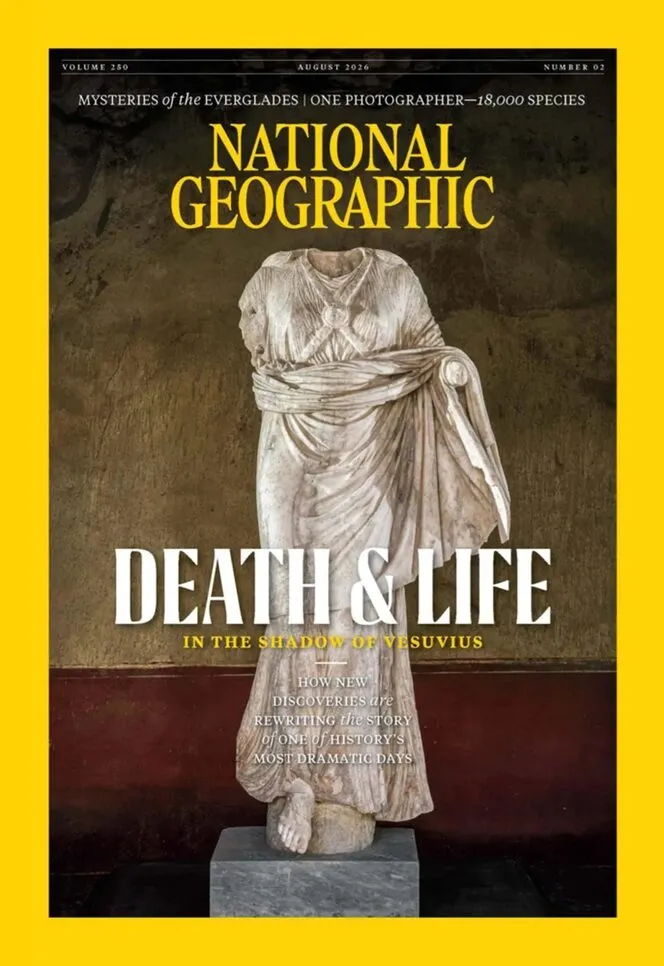
National Geographic UK Volume 250 Number 02 (August 2026) shares the Vesuvius cover story with the US edition—"Death & Life in the Shadow of Vesuvius"—but repackages it for a British readership with a heavier focus on the Herculaneum papyri work done at Oxford and the British School at Rome. The issue also profiles Joel Sartore's Photo Ark (p.64), the rise of Morocco's horsewomen (p.94), and Colombian orchid conservation (p.58).
The UK edition adds a regional news section and a UK-focused "Our World" page featuring a British Explorer of the Year profile and a crowdfunded seagrass restoration project in Plymouth Sound.
—————
Content Guide
▸ Cover Story / Archaeology
p.18 · THE DAY THE WORLD EXPLODED — How New Discoveries Are Rewriting the Story of One of History's Most Dramatic Days
The UK edition places extra emphasis on the Herculaneum papyri reading project led by the University of Oxford's Classics Faculty, which has decoded 5,000 characters from carbonised scrolls using a new AI trained on micro-CT scans. The article features a direct quote from the scrolls: the Epicurean philosopher Philodemus writing about the value of friendship during illness. The 18-hour time lag between the eruption's main phase and the Oplontis surge is illustrated with a British-reader-relatable analogy: the distance from London to Manchester covered in that window.
p.58 · THE QUEST TO SAVE THE WORLD'S RAREST ORCHIDS
Same text as the US edition but supplemented with a sidebar on the Royal Botanic Gardens, Kew's role in cryopreserving orchid seeds from Colombia. Kew's Millennium Seed Bank has 25,000 orchid seeds from 300 species stored at minus 20 degrees Celsius.
▸ Photography / Wildlife
p.64 · REVEALING EVERY ANIMAL ON EARTH
Joel Sartore's Photo Ark feature is identical to the US edition, with the addition of a UK-specific box: a map showing which Photo Ark species are native to the British Isles (12 of 22,000, including the Scottish wildcat and the smooth snake).
p.94 · THE RISE OF MOROCCO'S HORSEWOMEN
Same photo-essay as the US edition, but the captions reference British horse breeds: the tbourida horses include a significant number of Arabian-British warmblood crosses, traced to a 2019 export deal.
▸ UK Regional Content
p.6 · OUR WORLD — Britain
Two UK-specific items: a profile of Dr. Sofiat Ogunbiyi, a Nigerian-British marine biologist named National Geographic UK Explorer of the Year for her work on seagrass carbon sequestration in Plymouth Sound; and a map showing the first year of results from a citizen-science seagrass restoration project that has planted 40,000 seedlings.
▸ Regulars
p.12 · IN FOCUS
A photograph of a glowworm (Lampyris noctiluca) in a Yorkshire limestone cave, taken by a British photographer using a 30-second exposure.
p.134 · FROM THE VAULT
Same as the US edition: a 1947 Dust Bowl photograph, but the caption notes the parallel with UK soil erosion after the 2022 heatwave.
—————
Editor's Take
The UK edition of the Vesuvius cover story benefits from the Oxford papyri connection—the UK-reader relevance is higher than in the US edition, and the Philodemus quote ("friendship during illness") adds a human dimension missing from the US version. The regional content is well integrated without feeling like a tacked-on supplement. The Kew orchid cryopreservation sidebar (p.58) adds genuine value for conservation-minded readers. The seagrass restoration project (p.6) is specific and measurable—40,000 seedlings in the first year. Weakest: the "Our World" page tries to do too much in limited space. Best for UK readers interested in archaeology and conservation.
Strengths
• Oxford-led papyri decoding adds UK-specific scientific relevance
• Kew orchid seed bank sidebar: specific numbers, practical conservation
• Plymouth Sound seagrass project: measurable, local, citizen-science
Weaknesses
• British-only content limited to 2 pages; feels thin
• "Our World" section tries to cover too many items
Verdict: Recommended — The Vesuvius feature is world-class; the UK-specific additions are modest but well-chosen.
