
New Scientist Australian Edition – 4 July 2026
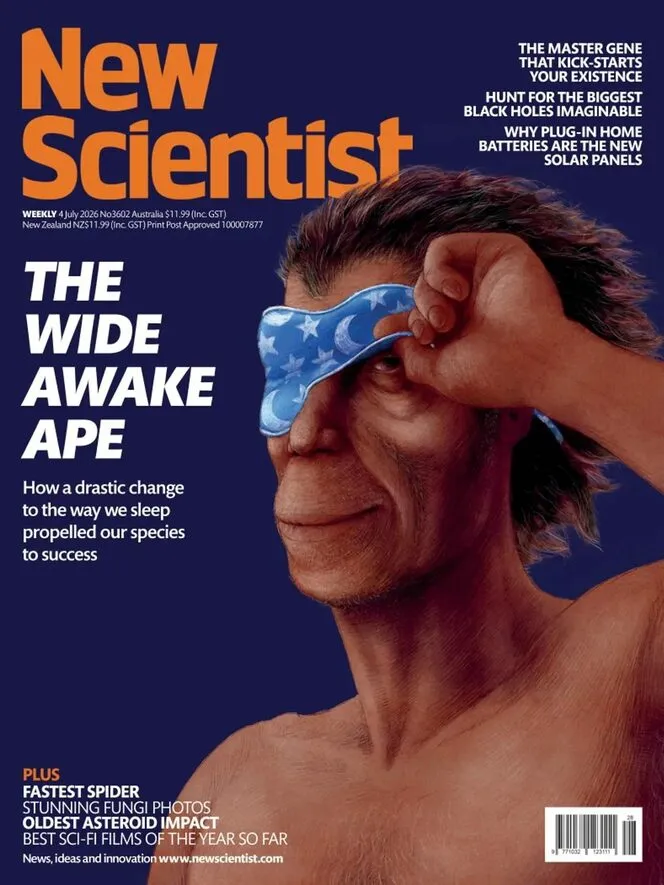
Summary
New Scientist Australian Edition No 3602 (4 July 2026) shares the "The wide awake ape" cover with the International Edition—the argument that a drastic change in human sleep propelled our species to success—but adds an Australian sleep-science sidebar from the Woolcock Institute in Sydney. The issue also reports on the Thwaites glacier collapse risk (p.36), stupendous black holes (p.41), and Roman scrolls deciphered by AI (p.15).
Content is largely identical to the International Edition. The Australian-specific addition is a sidebar noting that the Woolcock Institute's sleep clinic has found that Australians average 7.2 hours per night, slightly above the global mean of 6.8, but that 33 percent of Australian adults report insufficient sleep.
The back pages include the same puzzles and regulars.
—————
Content Guide
▸ Cover Story / Evolution
p.30 · The sleepless ape — Humans' unusual and daring sleep habits could be the secret to our success
Same core article as the International Edition. The Australian edition adds a Woolcock Institute sidebar: Australian Aboriginal sleep patterns in remote communities show a biphasic structure (6 hours at night plus a 30-minute afternoon nap) that closely mirrors the ancestral pattern described in the feature.
p.36 · Doomsday glacier — Thwaites glacier is collapsing
Same as International Edition.
p.41 · Stupendous black holes — The search is on for black holes bigger than galaxies
Same as International Edition.
▸ Regulars
p.45 · Puzzles
Same as International Edition.
p.46 · Almost the last word
Same moon-food question as the International Edition.
—————
Editor's Take
The Australian edition offers a thin local layer over the International Edition—the Woolcock sleep data is interesting but adds only one sidebar. The International Edition's features (sleep evolution, Thwaites, black holes) are strong enough to carry the issue regardless. Best for Australian readers who subscribe to the local edition for convenience rather than content differences.
Strengths
• Woolcock Institute sleep data: Australians average 7.2 hours, 33 percent report insufficiency
• Aboriginal biphasic sleep pattern from remote communities
Weaknesses
• Only one sidebar of Australian-specific content
• Otherwise identical to the International Edition
Verdict: Selective read — Same content as the International Edition; buy only if you want the Australian cover date.
