
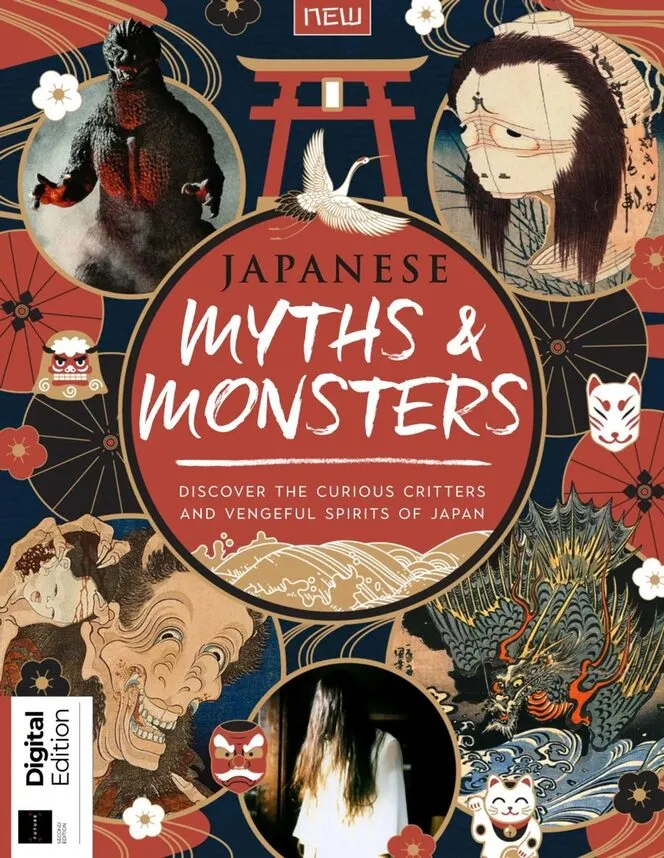
All About History Japanese Myths Monsters – 2nd Edition – March 2026
Summary
Philip S Kay opens All About History's Japanese Myths and Monsters 2nd Edition, March 2026, with a survey of 8 million kami, yokai spirits, and vengeful ghosts that populate Japan's folklore from the Kojiki to Studio Ghibli films. The 128-page edition covers Shinto deities, shapeshifting foxes, the kanabo-wielding oni, and kappa river demons across 30 chapters.
The volume begins with the Shinto belief system — "Million Gods" (p.108) catalogues the kami of the natural world, "The Household Kami" (p.16) covers ancestor veneration, and "The Seven Gods of Luck" (p.18) traces the 1,000-year-old embodiments of fortune. Yokai coverage includes "Kitsune: The Fox Spirits of Japan" (p.50), "The Mischievous Tengu" (p.52), "Kappa: The Demigod in a Shell" (p.54), "Japanese Dragons" (p.56), and "Tsukumogami: When Household Tools Awaken" (p.62). Yurei — spirits of the dead — are covered on p.64. Studio Ghibli's folklore borrowings appear in "Soot Gremlins and Forest Spirits" (p.44), tracing My Neighbour Totoro and Spirited Away back to rural folk beliefs.
Modern chapters cover "Magic and Superstition in Japan" (p.74), "Shaped by the Samurai" (p.94), ninja mythology in theatre (p.98), kaiju film history (p.102), the nuclear shadow over Japanese storytelling from Little Boy to Astro Boy (p.108), and folk horror cinema (p.116). Gaming's role in globalising Japanese myth closes the edition (p.122).
—————
Content Guide
▸ Shinto & Kami
p.108 · Million Gods
The Shinto concept of yaoyorozu no kami — eight million deities — is explained through the creation myth of Izanagi and Izanami from the Kojiki records. The article includes a chart of major kami groupings: natural, ancestral, and imperial. Use the chart to understand why Shinto has no single founder or central scripture.
p.16 · The Household Kami
Ancestor veneration in the Japanese home is documented through the kamidana household shrine, daily offerings of rice and sake, and the annual Obon festival. The article reproduces a typical kamidana layout with the positions of the ofuda talismans. The layout instructions are precise enough to set up your own home shrine.
p.18 · The Seven Gods of Luck
The seven shichifukujin — Ebisu, Daikokuten, Bishamonten, Benzaiten, Fukurokuju, Jurojin, and Hotei — are profiled with their identifying attributes and origins in Hindu, Buddhist, and Taoist traditions. The attribute table shows which god to pray to for specific fortune types. Hotei is the model for the modern "laughing Buddha" figurine.
▸ Yokai & Monsters
p.50 · Kitsune: The Fox Spirits of Japan
Kitsune folklore is traced from Inari shrine messengers to the nine-tailed fox of Chinese origin. The article grades foxes by number of tails — the nine-tailed kitsune gains cosmic knowledge but loses its physical form. The regional map shows which prefectures still hold annual fox festivals. Visit Fushimi Inari-taisha in Kyoto for the most concentrated kitsune iconography.
p.52 · The Mischievous Tengu
Tengu — the long-nosed, winged mountain spirits — evolved from Buddhist enemy to protector of the wilderness and martial arts. The article reproduces a 17th-century scroll showing tengu training samurai in swordsmanship. The scroll demonstrates why tengu are now associated with martial prowess rather than malice.
p.54 · Kappa: The Demigod in a Shell
The kappa — a turtle-like water demon that drags victims into rivers — is documented through Edo-period woodblock prints and modern sighting reports. The article explains the kappa's one weakness: a deep bow spills the water from its head-plate, draining its strength. The weakness detail is useful for understanding how Japanese folklore builds rules into supernatural threats.
p.62 · Tsukumogami: When Household Tools Awaken
Tsukumogami are everyday objects — umbrellas, sandals, tea kettles — that gain spirits after 100 years of use. The article reproduces a 19th-century tsukumogami emaki scroll showing a night parade of animated objects. The scroll proves the concept predates Disney's Beauty and the Beast by two centuries.
▸ Modern Mythology
p.44 · Soot Gremlins and Forest Spirits
The article traces Studio Ghibli's creatures — the susuwatari soot spirits in Spirited Away, the kodama forest spirits in Princess Mononoke, and Totoro itself — back to rural yokai folk traditions documented in Yanagita Kunio's Tono Monogatari. The side-by-side comparison of Ghibli frames and 19th-century yokai prints shows direct visual borrowing.
p.108 · Little Boy to Astro Boy
The nuclear bombings of Hiroshima and Nagasaki shaped post-war Japanese myth-making from Godzilla to Astro Boy. The article traces the atomic shadow through Osamu Tezuka's Astro Boy (born from a scientist's dead son) and the irradiated monsters of 1950s kaiju film. The timeline of nuclear-themed Japanese media shows how trauma was processed through fantasy.
—————
Editor's Take
Japanese Myths and Monsters 2nd Edition is the strongest single-volume English introduction to the subject currently available at this price. The Ghibli-to-folklore mapping and the Little Boy-to-Astro Boy chapter offer genuinely original connections. Weakest parts: the kaiju chapter is too shallow, listing films without analysing their mythic structure, and the "Lore-full Locations" travel guide is a listicle with no practical visitor information. This edition suits the anime fan who wants the folkloric origins of the creatures they already know from screens.
Strengths
• Studio Ghibli creature origins traced to 19th-century yokai prints
• Nuclear trauma narrative from Hiroshima to Godzilla to Astro Boy
• Tsukumogami emaki scroll reproduced in full
Weaknesses
• Kaiju chapter lacks mythic-structure analysis
• Locations chapter is a superficial listicle
Verdict: Recommended — Best English primer on Japanese myth for Ghibli and anime fans.
