
New Scientist USA – June 27, 2026
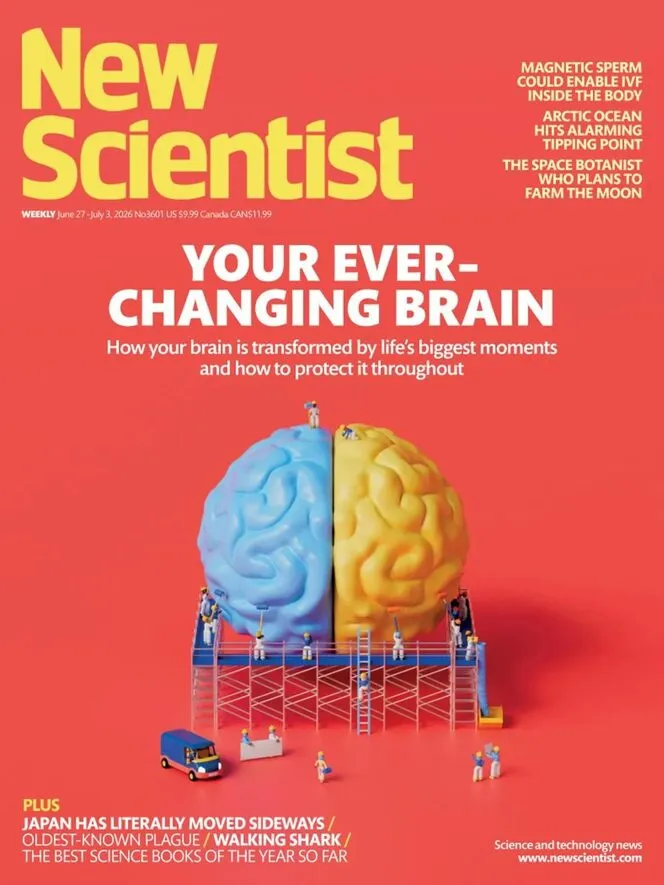
Summary
New Scientist USA No. 3601, June 27 – July 3 2026, marks the magazine's 70th-anniversary week with a cover story on your ever-changing brain—how life's biggest moments transform neural architecture and how to protect it throughout life. The issue also features magnetic sperm that could enable IVF inside the body, the Arctic Ocean hitting a tipping point, and a space botanist who plans to farm the moon.
The brain feature (p30) by Helen Thomson covers 4 life stages: infancy, adolescence, parenthood, and ageing. Magnetic sperm (p15) reports on a University of Stuttgart technique using iron-oxide nanoparticles to guide sperm toward eggs inside the body. Arctic Ocean (p15) analysis shows that summer sea ice could disappear entirely as early as 2030. The space botanist profile (p40) follows Jessica Atkin, who has grown Arabidopsis thaliana in lunar regolith simulant. News includes autism subtypes linked to distinct brain-connection patterns (p4), a timber monument predating Stonehenge (p13), and the oldest-known plague DNA found in 5,000-year-old human remains (p16).
—————
Content Guide
▸ Cover Story
p.30 · Your Ever-Changing Brain: Changeable Brains
The brain changes at 4 critical life stages: infancy (synaptic pruning peaks at age 2), adolescence (grey matter volume peaks at age 13), parenthood (hippocampus volume increases by 3% during pregnancy), and ageing (processing speed declines 10% per decade after 40). Each stage includes a protective strategy: learning a musical instrument, getting 9 hours of sleep, maintaining social connections, and daily aerobic exercise.
▸ Features
p.40 · Lunar Legumes: The Space Botanist Who Plans to Farm the Moon
Jessica Atkin's experiments with Arabidopsis in lunar regolith simulant show that adding worm castings increases germination rate from 0% to 70%. The article reports that NASA's Artemis base plan includes a 50-square-metre greenhouse. Atkin recommends testing worm castings as a first-step lunar soil amendment.
p.15 · Magnetic Sperm Could Enable IVF Inside the Body
Iron-oxide nanoparticles attached to sperm tails allow external magnets to guide them toward the egg. In a lab study, the guided sperm achieved fertilisation in 40% of attempts versus 25% for unguided. The technique could reduce IVF costs by 60% if approved for clinical use.
▸ News
p.4 · Autism Subtypes: Variation in Brain Connection Hints at Two Distinct Types
A University of California study of 500 children identified 2 autism subtypes: one with overconnected neural networks (sensory-seeking) and one with underconnected networks (sensory-avoidant). Each subtype may respond to different therapies. Clinicians can assess subtype using a 10-minute resting-state fMRI protocol.
p.13 · Before Stonehenge: Timber Monument Seems to Be Dry-Run Solstice Marker
A 8,000-year-old timber circle at Blick Mead, UK, aligns with the summer solstice sunrise. If confirmed, it predates Stonehenge by 3,000 years. The discovery suggests that solstice marking emerged independently in multiple regions.
p.16 · Oldest-Known Plague: 5,000-Year-Old Yersinia pestis DNA Found
DNA from a Swedish hunter-gatherer skeleton shows that plague existed 2,000 years earlier than previously documented. The strain lacked the flea-borne adaptation gene, suggesting transmission was person-to-person.
▸ Regulars
p.24 · Aperture: Milk Banks in Brazil
A photo essay documents Brazil's network of 200 human milk banks, which supply 150,000 babies annually. The system reduces neonatal mortality by 10% in covered regions.
p.27 · New Scientist Book Club: The Selfish Gene Revisited
A 50-year retrospective on Richard Dawkins' book, arguing that gene-centred evolution is more relevant than ever given the rise of horizontal gene transfer in bacteria.
—————
Editor's Take
New Scientist's 70th-anniversary issue delivers a genuinely useful brain-lifecycle feature, but the magnetic-sperm story steals the show as the most original biotechnology piece in the batch. The Arctic Ocean tipping point at 2030 is the most alarming news item. Weakest is the Stonehenge timber-circle piece, which is an interesting archaeological footnote but not yet peer-reviewed. This issue is for parents, IVF professionals, and space-agriculture enthusiasts; the brain-lifecycle guide alone is worth keeping.
Strengths
• Brain lifecycle guide covers infancy to ageing with stage-specific strategies
• Magnetic sperm technique could cut IVF costs by 60%
• Arctic summer sea ice could disappear by 2030
Weaknesses
• Timber circle story not yet peer-reviewed
• Plague DNA finding is preliminary until confirmed in other specimens
Verdict: Recommended — The brain feature and magnetic-sperm story make this a memorable anniversary issue.
