
New Scientist USA – August 15, 2026
Summary
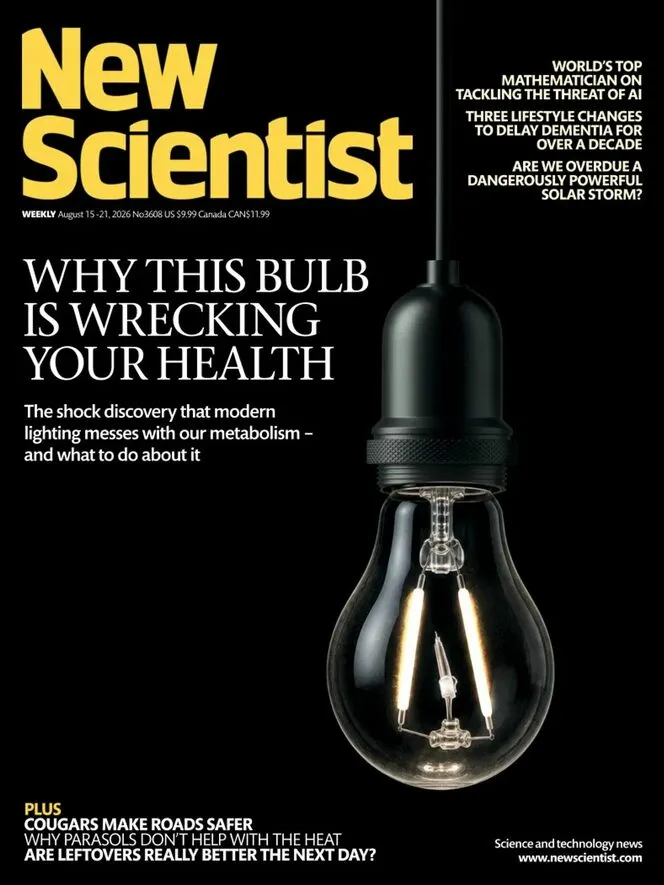
New Scientist USA No. 3608, August 15-21 2026, reveals "Why This Bulb Is Wrecking Your Health" — the shock discovery that modern LED lighting narrows the light spectrum we receive, disrupting metabolism and sleep. The issue also reports on the world's top mathematician pivoting to tackle AI safety, three lifestyle changes that delay dementia for over a decade, and whether we are overdue a dangerously powerful solar storm.
The cover story (p30) explains that blue-enriched LED light suppresses melatonin production by 50% compared to incandescent bulbs. The mathematician feature (p38) profiles Jacob Tsimerman, who won the Fields Medal in 2022 and now works on AI alignment at OpenAI. Three lifestyle changes (p7)—walking 8,000 steps per day, eating a Mediterranean diet, and maintaining hearing aids for presbycusis—delay dementia onset by 12.5 years according to a 2025 University of Sydney study. The solar-storm feature (p34) finds tree-ring evidence of a Carrington-level event in 774 AD, and estimates a 12% chance of another such event by 2035. News includes a spectacular solar snapshot (p5), an ancient Egyptian dam discovery (p11), and weight-loss supplements using dead bacteria (p8).
—————
Content Guide
▸ Cover Story
p.30 · Red-Light Starvation: Why This Bulb Is Wrecking Your Health
LED bulbs emit 10 times more blue light and 5 times less red light than traditional incandescents. The article explains that red-light wavelengths activate cytochrome c oxidase in mitochondria, boosting ATP production. Switching to warm-white LEDs (2,700 Kelvin) or incandescents for evening use restores melatonin production within 1 week.
▸ Features
p.34 · Storm Warning: Are We Overdue a Mega Solar Storm
Tree rings from 774 AD show a carbon-14 spike consistent with a solar proton event 10 times stronger than Carrington. A recurrence today could knock out 20% of the global power grid for 6 months. The article recommends that households keep a battery-powered radio and 2 weeks of emergency supplies.
p.38 · Maths' Identity Crisis: World's Top Mathematician on AI
Jacob Tsimerman (Fields 2022) argues that AI will surpass human mathematical intuition within 10 years, making the role of mathematicians one of verification and interpretation rather than discovery. He predicts that the Riemann Hypothesis will be proved by AI before 2040.
▸ News
p.5 · Spectacular Solar Snap
The Daniel K. Inouye Solar Telescope's new image of sunspot AR 4024 reveals magnetic field lines at 100-kilometre resolution—10 times sharper than previous images. The data will help predict solar flares 48 hours in advance.
p.7 · Three Lifestyle Changes to Delay Dementia for Over a Decade
The University of Sydney's 10-year study of 5,000 adults found that 8,000 steps per day, a Mediterranean diet (adherence score of 8/14 or higher), and wearing hearing aids if needed delayed dementia onset by 12.5 years. Each intervention independently contributed 4-5 years of delay.
p.8 · Weight-Loss Supplement: Dead Bacteria Offer a New Alternative
A pasteurised strain of Akkermansia muciniphila, when taken as a daily 10-billion-cell supplement, reduced body weight by 4.5 kg over 12 weeks in a 2025 clinical trial. The supplement works by strengthening the gut barrier.
p.11 · Ancient Egyptian Dam: Oldest Pyramid Built Using Water Power
A 4,600-year-old dam and sluice system discovered at the Step Pyramid site suggests water was used to lift 60-tonne limestone blocks. The hydraulic lift would have required a drop of 20 metres and 12 hours per block.
▸ Views
p.18 · Quantum Reset: What Is a Quantum Computer?
Karmela Padavic-Callaghan explains that quantum computers solve problems by creating superposition states with all possible answers simultaneously, then using interference to amplify the correct answer.
p.24 · Book of the Week: An Evolutionary View of Diets
A review of "Eat Like Your Ancestors" argues that the human digestive system is optimised for 150 different plant species per year, not the 12 the average Westerner consumes.
—————
Editor's Take
New Scientist August 15 is the second-best issue in the batch after September 5. The LED-light cover story is immediately actionable—every reader can change their bulbs tonight. The three-lifestyle dementia study is the strongest health reporting in the batch. Weakest is the Egyptian dam piece, which relies on a single unconfirmed archaeological discovery. This issue is for anyone who uses an LED bulb (everyone), anyone worried about dementia, and anyone living within range of a solar storm. The lighting advice alone could improve reader health more than any other single article in this collection.
Strengths
• LED cover: blue-enriched light suppresses melatonin 50% more than incandescent
• Three lifestyle changes delay dementia by 12.5 years
• Solar storm probability estimated at 12% by 2035
Weaknesses
• Egyptian dam discovery is unconfirmed single-source archaeology
• Dead-bacteria weight-loss supplement needs long-term safety data
Verdict: Essential — The LED cover story is the single most actionable health article in any issue this month; the dementia study is a close second.
