
Science News – September 2026
Summary
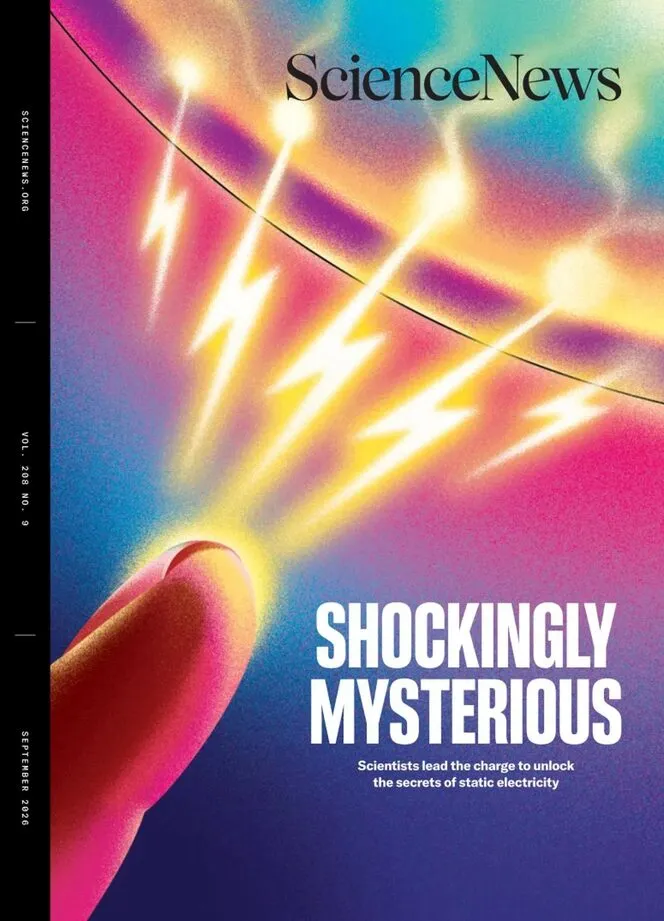
Science News' September 2026 issue (Vol. 208 No. 9) puts static electricity on the cover — a phenomenon people have studied for centuries but still do not understand. Emily Conover reports from the Electrostatic Society of America meeting on the quirky group of physicists, chemists and engineers working on triboelectricity, which is a hazard for circuit-board assembly, refuelling airplanes, and Mars rover wheels. Michael Marshall reveals why Epstein-Barr is the "everything" virus — linked to mononucleosis, certain cancers, and multiple sclerosis.
Marshall's feature on page 42 documents how virtually all people carry Epstein-Barr virus, but an unlucky few develop lasting illness. New research shows how the virus evades the immune system, and several vaccine candidates aim to prevent infection or stop reactivation in people already carrying the virus. Ana Elisa Sotelo on page 50 reports from Peru's Punta San Juan Reserve, where Humboldt penguins face bird flu and a powerful El Niño simultaneously.
The News section includes lab-made cells that grow and divide but are not alive, a Mars rover detecting organic carbon, and research showing many US teens underestimate fentanyl's lethality. Other briefs cover beefalo genetics, plugged-in pickles that glow, and the undercounting of insect species. The Review section covers one new book and one film.
—————
Content Guide
▸ Cover Story / Virology / Wildlife / Advances / Reviews
p.12 · Lab-Made Cells Grow and Divide But Aren't Alive
Scientists have built synthetic cells that can grow and divide, but the daughter cells lack the machinery for sustained metabolism. The achievement is a tool for studying minimal life, not artificial life. Use the protocol to test which genes are truly essential for division.
p.14 · Many US Teens Underestimate Fentanyl's Lethality
A survey of 3,000 US teens finds that fewer than 40 percent believe a single fentanyl-laced pill can be fatal. Public-health campaigns that focus on appearance — pills that look like prescription drugs — have not shifted perceived risk.
p.34 · The Sticky Science of Static Electricity
Emily Conover reports on the Electrostatic Society of America's annual meeting, where researchers presented data showing that static charge depends on surface chemistry, contact pressure, and humidity. One group demonstrated that peeling tape in a vacuum chamber generates X-rays — a finding with implications for clean-room manufacturing.
p.42 · Why Epstein-Barr Is the "Everything" Virus
Michael Marshall tracks Epstein-Barr virus from mononucleosis through multiple sclerosis to certain stomach cancers. The virus infects 95 percent of adults globally. New mRNA vaccine candidates, modelled on the COVID-19 platform, target the gp350 protein to prevent infection.
p.50 · Birds on the Brink
Ana Elisa Sotelo documents the Humboldt penguin colony at Peru's Punta San Juan Reserve, where bird flu and El Niño have killed an estimated 30 percent of the population since early 2023. Reserve staff use decoy penguin replicas to encourage breeding on safer higher ground.
p.84 · Being Human: Why We Feel What We Feel
The column examines how emotions evolved as survival mechanisms rather than cultural inventions. The facial-feedback hypothesis — smiling can make you feel happier — is supported by new electromyography data from 500 participants.
p.86 · Technically Fiction: The Science Behind Plugged-In Pickles
Why a dill pickle glows when electrified: the saltwater electrolyte inside the pickle conducts current, and the sodium ions emit yellow-orange light when excited. The same physics powers sodium-vapour street lamps.
—————
Editor's Take
This issue's greatest asset is Emily Conover's static-electricity feature — she makes a genuinely obscure, century-old puzzle feel urgent by connecting it to Mars rover failures and airplane-refuelling explosions. Marshall's Epstein-Barr piece is thorough but covers ground that has been well trodden in other science outlets this year. The News section is the issue's weakest link: 16 items across 18 pages, none longer than a column, which gives the front half a scattershot feel. Best suited for readers who prefer depth on two topics over breadth across twenty.
Strengths
• Static electricity feature is the most original cover story this month
• Humboldt penguin reporting brings rare on-the-ground field work
• Synthetic cells brief is well-timed and well-sourced
Weaknesses
• News section is overcrowded with one-paragraph items
• Reviews section lists only two entries
Verdict: Recommended — Two strong features, but the news density wears thin by page 30.
