
New Scientist International Edition – 1 August 2026
Summary
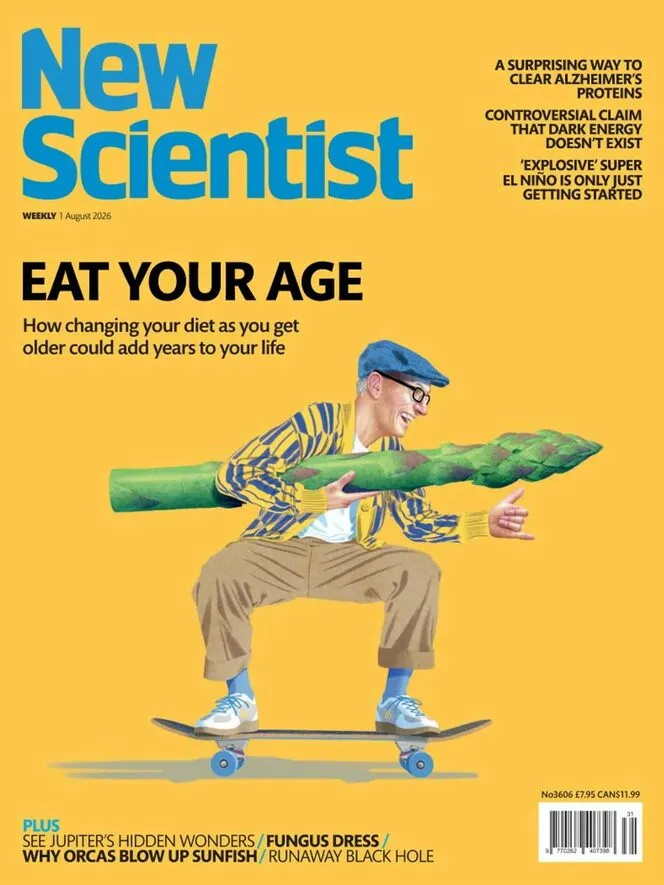
New Scientist Vol 271 No 3606 (1 August 2026) puts "Eat your age" on the cover—a feature arguing that switching up your diet as you get older could add years to your life, backed by emerging research on age-specific nutritional interventions. The issue also reports a surprising way to clear Alzheimer's proteins using intermittent CO2 inhalation (p.4), a controversial claim that dark energy doesn't exist (p.6), and why orcas blow up sunfish (p.11).
Three features run: the age-diet cover (p.30), a rat-eradication project on a sensitive island ecosystem (p.36), and Jupiter's hidden wonders from an unexpected source (p.40). News leads with the super El Niño that is "only just getting started" (p.5), AI cracking an 87-year-old maths conjecture (p.12), and mysterious hominin footprints in Kenya (p.9). Graham Lawton writes on anti-ageing supplements (p.18).
The back pages ask what would happen as the moon moves away from Earth, and Feedback dives into the social science of long fingernails.
—————
Content Guide
▸ Cover Story / Nutrition
p.30 · Eat your age — Why switching up your diet could add years to your life
The feature synthesises cohort studies showing that protein requirements rise after age 65 (1.2 g per kg body weight vs 0.8 g for younger adults), while caloric needs drop. It prescribes specific shifts: increase leucine-rich protein at breakfast after age 60; reduce iron intake after menopause; increase fibre to 30 g per day after 50. A pull-out table lists optimal daily nutrient targets by decade (30s, 50s, 70s+).
p.4 · A surprising way to clear Alzheimer's proteins
Intermittent inhalation of 5 percent CO2 for 20 minutes twice daily increased glymphatic clearance of amyloid-beta in mouse models by 35 percent. The mechanism: CO2 dilates cerebral blood vessels and boosts CSF flow. The article warns against DIY use—the study used medical-grade gas under supervision. Human trials are recruiting.
p.5 · 'Explosive' super El Nino is only just getting started
Sea-surface temperature anomalies in the central Pacific have reached 3.2 degrees Celsius above the 30-year mean, exceeding the 2015-16 event at the same stage. Forecasters project a 90 percent chance that this El Nino peaks in December 2026.
▸ Environment
p.36 · Death in paradise — Rats plague sensitive island ecosystems, but one project shows how to eradicate them
A rat-eradication campaign on a sub-Antarctic island used a helicopter-baiting operation covering 12,000 hectares in a single winter. The project achieved 99.7 percent knockdown in the first phase. The article explains why island rodent eradication is the single most effective conservation intervention available. A map shows the 15 priority islands for future campaigns.
p.11 · Why orcas blow up sunfish
New footage shows orcas ramming ocean sunfish at speed, puncturing the fish's body cavity and causing it to deflate and sink. The behaviour appears to be a learned hunting technique specific to a pod off the Iberian coast.
▸ Space
p.40 · See Jupiter's hidden wonders
Amateur-processed images from Juno's JIRAM instrument reveal thermal structures in Jupiter's atmosphere that professional pipeline processing had smoothed over. The feature is a gallery of citizen-scientist contributions that resolved a 30-year debate about whether cyclones at Jupiter's poles are stable.
p.12 · AI cracks maths puzzle — AI has seemingly disproven an 87-year-old maths conjecture
An AI system found a counterexample to a longstanding conjecture in combinatorial number theory, constructing an integer set that violates the expected density bound. The proof is machine-checkable.
▸ Regulars
p.45 · Puzzles — Try our crossword, puzzle and quick quiz
The quick quiz asks readers to calculate the protein intake recommendation from the cover feature for a 70-kg 70-year-old (84 grams per day).
p.46 · Almost the last word — What changes will occur on Earth as the moon moves away from us?
The moon recedes at 3.8 cm per year. In 200 million years, total solar eclipses will no longer be possible—the moon's apparent diameter will be too small to cover the sun.
—————
Editor's Take
"Eat your age" is the most directly useful feature of the August New Scientist issues—the decade-by-decade nutrient table is something readers will tear out and stick on the fridge. The island rat-eradication piece (p.36) is a model of conservation reporting: specific, quantitative, and honest about the challenges. Weakest item: "Age defying" (p.18) by Graham Lawton is essentially a blog-post-length complaint about supplement marketing, not the evidence review the topic needs. The AI-maths-cracking news (p.12) is buried at one page despite being one of the more consequential results of the month. Best for readers aged 40-plus who want to adjust their diet with evidence; skip the supplements column.
Strengths
• "Eat your age" decade-by-decade nutrient table is genuinely useful
• Rat-eradication campaign: specific, quantitative, conservation gold
• Juno citizen-science gallery: stunning images, novel science
Weaknesses
• "Age defying" is a complaint, not a review
• AI-maths news deserves feature treatment, not a single page
Verdict: Recommended — The age-diet cover justifies the cover price; the conservation feature is a bonus.
