
All About History Book of Witchcraft – 10th Edition – 17 September 2026
Summary
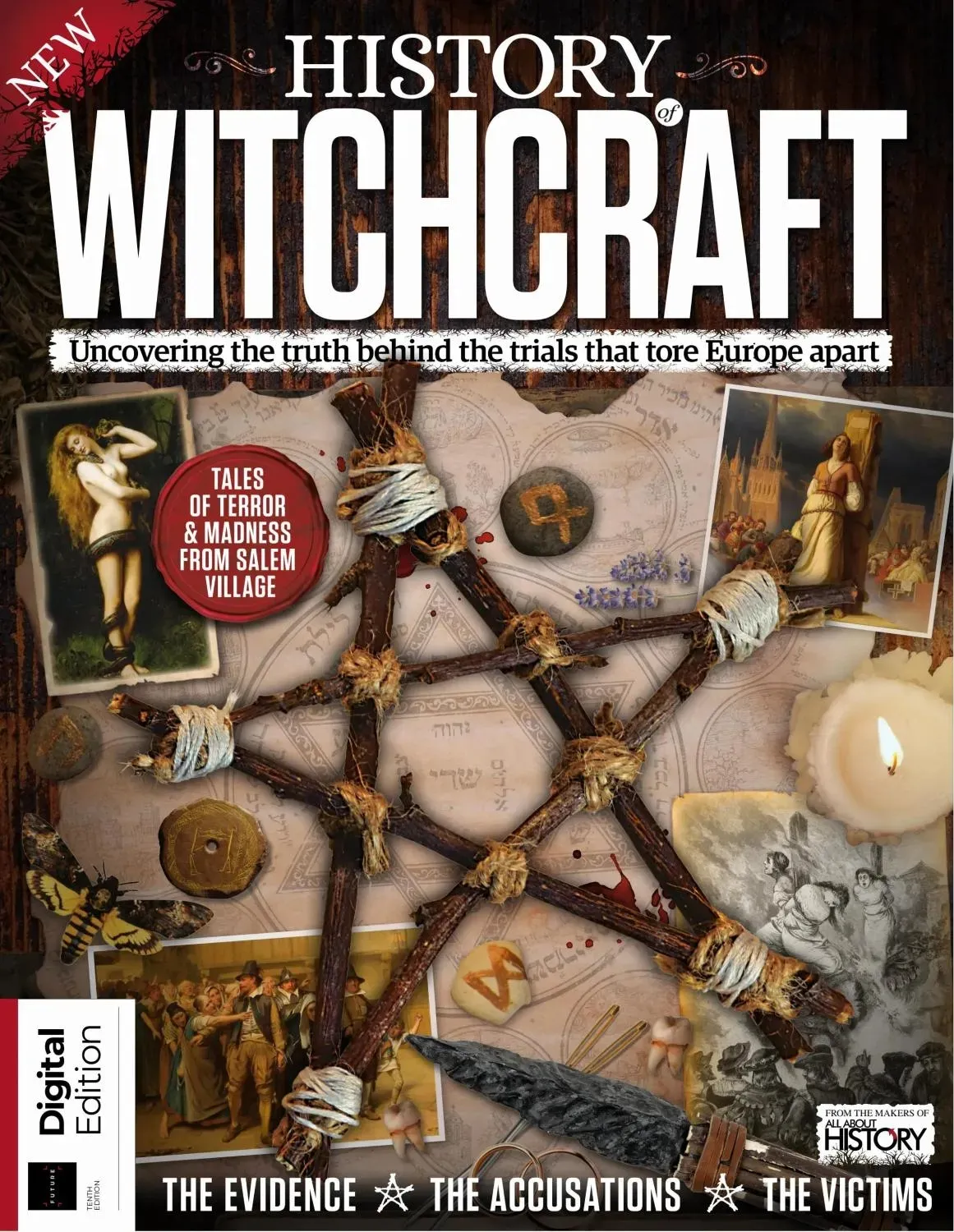
Salem Village, Pendle Hill, and the Basque witch trials frame All About History's Book of Witchcraft 10th Edition, 17 September 2026, tracing the persecution from ancient beliefs through the 18th-century decline. The 124-page volume covers notorious witches, the Witchfinder General, torture protocols, and the legal history that allowed 50,000 executions across Europe.
The volume opens with "Witch Hunting" (p.6), defining the social and legal mechanisms of persecution. "The Dawn of the Witch" (p.12) traces ancient magical beliefs into the early modern danger zone. "15 Notorious Witches" (p.18) profiles key figures from Agnes Waterhouse to Isobel Gowdie. "Lighting the Pyre" (p.26) covers the 15th-century transition from folk magic to heresy prosecution. Gunnhild, Mother of Kings (p.30) marks the blur between fact and fantasy. Joan of Navarre (p.36) and the Betrayal of the Knights Templar (p.40) document royal witchcraft accusations.
German witch trials are covered in "The Unholy Roman Empire" (p.82) and "The Wurzburg Trials" (p.110). "Terror on Pendle Hill" (p.72) covers the 1612 Lancashire case. "The Dark Charisma of Matthew Hopkins" (p.88) follows the Witchfinder General's 1645-1647 campaign through East Anglia. "The Witch Hunter's Handbook" (p.96) reproduces the identification tests used by professional witch-finders. "The Witch's Spell Book" (p.100) presents period grimoire texts. "The Salem Witch Trials" (p.112) reconstructs the 1692 Massachusetts hysteria with trial transcripts. "The End of Witchcraft" (p.124) traces the legal and intellectual shift that stopped mass persecution.
—————
Content Guide
▸ Origins & Methods
p.6 · Witch Hunting
The social and legal mechanisms of witch-hunting — accusation patterns, gender targeting, and the legal procedures that allowed torture — are mapped across European jurisdictions. The article reproduces the 1486 Malleus Maleficarum woodcut showing witches being tortured. The woodcut was used as a procedural manual by inquisitors for 200 years.
p.12 · The Dawn of the Witch
Ancient magical practices from Greek binding spells to Roman curse tablets are traced into the early modern period when folk magic was reclassified as heresy. The article reproduces a 4th-century BC Greek defixio lead tablet. The transition from beneficial magic to diabolical pact occurred between 1450 and 1486, driven by the Malleus Maleficarum publication.
p.96 · The Witch Hunter's Handbook
Professional witch-finding techniques — the swimming test, pricking for the devil's mark, and sleep deprivation — are documented through English legal manuals and Matthew Hopkins's 1647 book The Discovery of Witches. The article reproduces Hopkins's pamphlet cover with the woodcut of witches feeding their imps. The pamphlet was a self-authored marketing tool for his services.
▸ Major Trials
p.72 · Terror on Pendle Hill
The 1612 Lancashire witch trials are reconstructed through Thomas Potts's court clerk transcript. The article reproduces Potts's original 1613 book The Wonderfull Discoverie of Witches in the Countie of Lancaster. The trial centered on the Demdike and Chattox families, whose land dispute escalated into accusations that hanged 10 people.
p.88 · The Dark Charisma of Matthew Hopkins
Hopkins's 1645-1647 campaign as Witchfinder General in East Anglia resulted in 300 executions — more than the entire Spanish Inquisition's witch-related deaths. The article reproduces his "pricking" needle that retracted into the handle to fake a painless insertion. The needle is preserved at the Museum of Witchcraft in Boscastle, Cornwall.
p.112 · The Salem Witch Trials
The 1692 Massachusetts outbreak that executed 20 people is reconstructed through the court records preserved at the Essex County Archives. The article reproduces the examination transcript of Bridget Bishop, the first executed. The transcript shows that spectral evidence — testimony about the accused's spirit form — was the primary admissible proof.
▸ Europe
p.82 · The Unholy Roman Empire
The German states executed an estimated 25,000 people for witchcraft between 1550 and 1700 — half of all European executions. The article reproduces the Bamberg witch trial records showing the torture protocols applied to 12-year-old children. The map of execution density shows that witch-hunting was most intense in Catholic prince-bishoprics, not Protestant territories.
p.104 · The Basque Witch Trials
The 1609-1614 Basque witch trials conducted by the Spanish Inquisitor Alonso de Salazar Frias are documented through his final report to the Suprema. Salazar concluded that the confessions were unreliable and recommended ending the use of torture. His report is the first official document by a senior Inquisitor arguing that witchcraft persecution was based on delusion.
—————
Editor's Take
All About History's Book of Witchcraft 10th Edition is the strongest single-volume survey available for the price. The Matthew Hopkins trick-needle and the Basque Inquisitor's sceptical report are genuinely uncommon material. Weakest parts: the "15 Notorious Witches" chapter is too compressed — each profile averages less than a page. The Pendle Hill chapter covers ground already well treated in the 9th Edition without new research. This edition suits the undergraduate history student and the Salem tourist who wants pre-visit context.
Strengths
• Hopkins retractable pricking needle preserved at Boscastle
• Basque Inquisitor Salazar's 1614 report arguing persecution was delusion
• German execution map showing Catholic states led witch-hunting
Weaknesses
• "15 Notorious Witches" profiles too brief for each subject
• Pendle Hill chapter lacks new research vs prior edition
Verdict: Recommended — Best value single-volume witchcraft survey for students.
