
All About History History of Christmas – 5th Edition – 3 September 2026
Summary
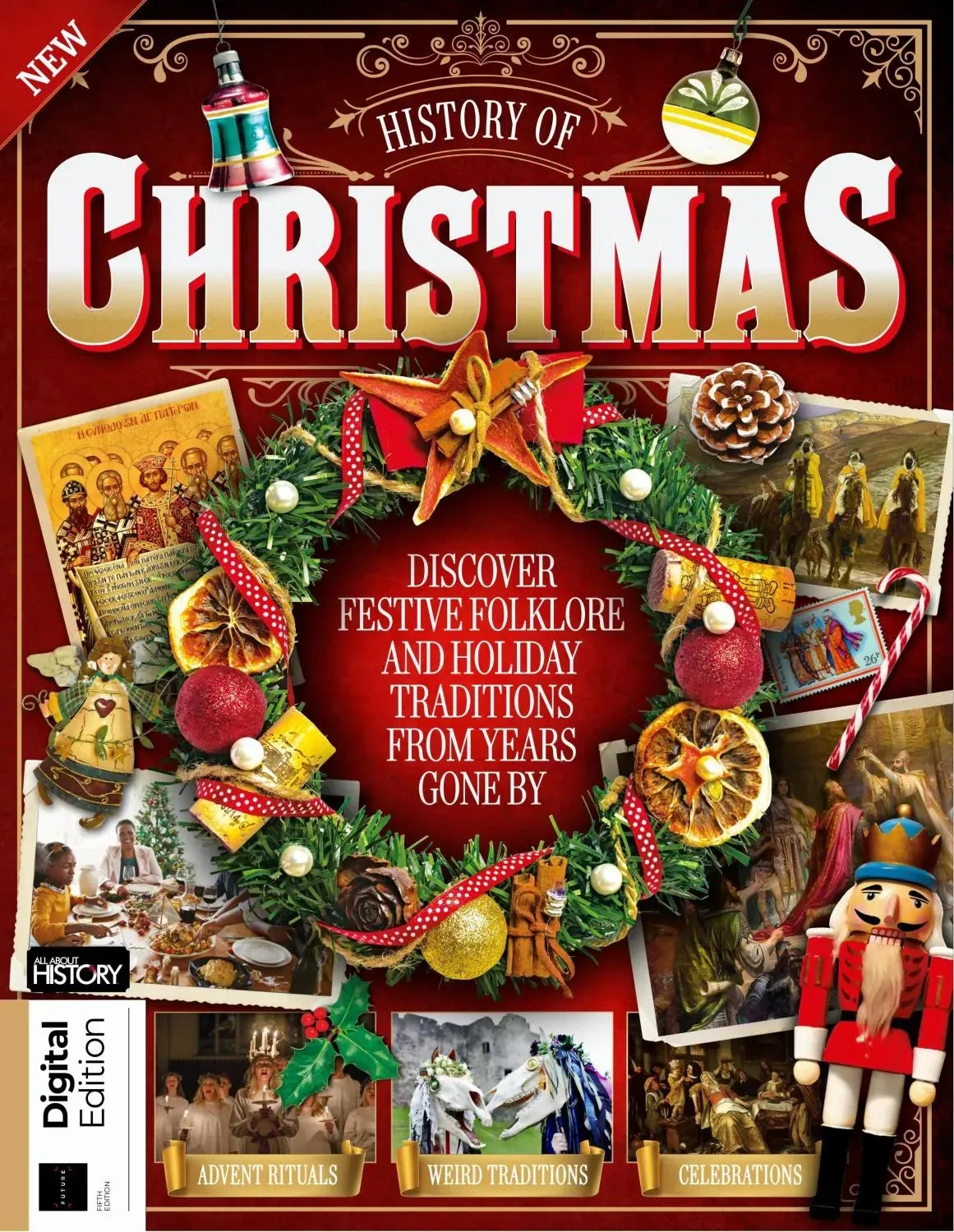
April Madden's edited volume traces Christmas from pagan solstice rites through the Victorian invention of the modern holiday in All About History's History of Christmas 5th Edition, 3 September 2026. The 128-page edition covers pagan origins, nativity history, global folklore, festive traditions, and the strangest celebrations around the world.
The History section opens with "Pagan Origins" (p.16), linking Roman Saturnalia and Germanic Yule to Christmas timing. "In the Bleak Midwinter" (p.22) examines the debate over Jesus's actual birth date. "How Dickens Made a Modern Christmas" (p.38) traces the Victorian transformation through A Christmas Carol and Prince Albert's German Christmas tree tradition. Folklore covers the Three Kings (p.44), holly and ivy (p.48), the Glastonbury Thorn (p.52), wassailing (p.54), the Mari Lwyd (p.56), Ireland's Wren Day (p.60), La Befana (p.68), the Wild Hunt (p.70), and festive frights from around the world (p.72).
Traditions include Advent calendars (p.80), St Lucia's Day (p.82), Christmas trees (p.86), lights (p.90), cards (p.92), carols (p.98), the evolution of St Nicholas to Santa (p.102), Christmas dinners (p.112), the Yule log (p.110), and the King of Crackers (p.116). International coverage spans Ethiopia's Genna (p.122), the Caribbean Junkanoo (p.118), the Spanish Good Night (p.94), and Ukrainian pavuchky spiders-web baubles (p.64).
—————
Content Guide
▸ History
p.16 · Pagan Origins
The pre-Christian roots of winter festivities — Roman Saturnalia's gift-giving, Germanic Yule's log-burning, and the Dies Natalis Solis Invicti — are presented with archaeological and literary evidence. The calendar conversion chart shows how these dates converged on December 25. The chart demonstrates that Christmas timing was a political compromise, not a historical birth date.
p.22 · In the Bleak Midwinter
The question of when Jesus was born is examined through the gospel of Luke's census reference and the Star of Bethlehem astronomical theories. The article weighs the 6 BC Jupiter-Saturn conjunction against the 5 BC comet hypothesis. The astronomical table lets you test each theory against your own planetarium software.
p.38 · How Dickens Made a Modern Christmas
Charles Dickens's A Christmas Carol (1843) is credited with inventing the modern Christmas values of charity, family gathering, and festive feasting. The article reproduces the original John Leech illustrations from the first edition. The illustrations show that the "Victorian Christmas" was largely a Dickensian invention.
▸ Folklore
p.56 · The Mari Lwyd
The ancient Welsh tradition — a horse skull carried door-to-door during wassailing season — is documented through 19th-century folklorist accounts and contemporary revival photographs. The article includes the Welsh-language rhyming challenge that participants must exchange before entering a home. The rhyme is still performed in Llangynwyd each January.
p.64 · The Legend of the Pavuchky
Ukrainian Christmas spider-web ornaments are traced to a folk tale about a poor family whose tree was decorated by spiders on Christmas morning, turning their threads into silver and gold. The article reproduces 19th-century Ukrainian pavuchky in wire and straw. The tradition predates tinsel by at least 200 years.
p.68 · La Befana
Italy's Epiphany gift-bringer — an old woman who rides a broomstick down the chimney — is documented through regional variations across the Italian peninsula. The article maps the distribution of Befana festivals from Urbania to the Sicilian interior. Urbania's annual Befana festival attracts 30,000 visitors each January 6.
▸ Traditions
p.86 · Christmas Trees
The German Tannenbaum tradition popularised by Prince Albert at Windsor Castle in 1841 is traced through 16th-century guild records from Freiburg showing tree tax payments. The article reproduces the Illustrated London News engraving of the 1848 Royal Family around the tree. That engraving created the Victorian Christmas tree craze in a single publication cycle.
p.102 · From St Nicholas to Santa Claus
The transformation of the 4th-century Bishop of Myra into the modern Coca-Cola Santa is traced through Dutch Sinterklaas, Washington Irving's Knickerbocker History, Clement Moore's 1823 "A Visit from St Nicholas," and Thomas Nast's 19th-century Harper's illustrations. The Nast drawings established the red suit and North Pole workshop before any commercial use.
p.112 · Christmas Dinners
The evolution of the Christmas feast from medieval boar's head to Victorian turkey is documented through household accounts and cookery books. The article reproduces Mrs Beeton's 1861 turkey-roasting instructions. Beeton's recipe — stuffed with forcemeat, roasted for 3 hours at moderate heat — is still the standard British Christmas method.
—————
Editor's Take
All About History's History of Christmas 5th Edition is the most thorough seasonal reference work available in a single volume. The Mari Lwyd and Ukrainian pavuchky chapters offer genuinely unfamiliar material even for Christmas-enthusiast readers. Weakest parts: the "Strangest Ways to Celebrate Christmas" chapter at the end is a filler listicle with no depth, and the "What I Want for Christmas" presents chapter adds nothing to the volume. This edition suits the primary-school teacher or the parent who needs answers to children's Christmas questions.
Strengths
• Mari Lwyd Welsh horse-skull tradition with rhyming challenge reproduced
• Christmas tree evolution from German guild taxes to Windsor Castle
• Ukrainian pavuchky pre-dating commercial tinsel by 200 years
Weaknesses
• "Strangest Ways" listicle adds no depth
• Christmas presents chapter is filler
Verdict: Recommended — Essential seasonal reference for families and teachers.
