
Psychologies UK – September 2026
Summary
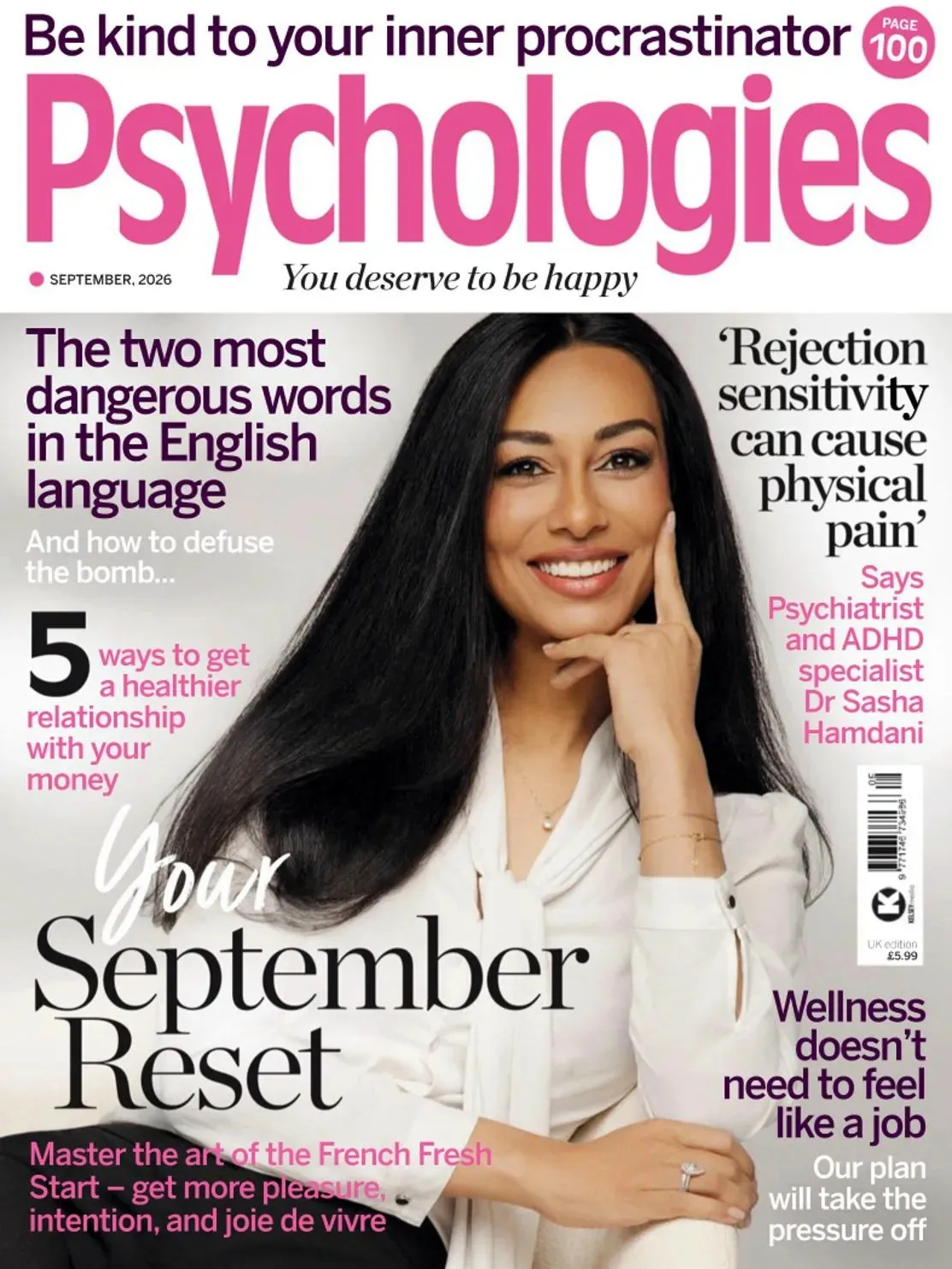
Psychologies UK September 2026, priced at 5.99 pounds, leads with "You deserve to be happy" and features psychiatrist Dr Sasha Hamdani on rejection sensitivity causing physical pain. The 130-page issue covers financial purpose, style DNA, inner procrastination, and a French-inspired fresh-start reset.
Dr Hamdani's interview (p22) explains that rejection sensitivity activates the same brain regions as physical pain—the anterior cingulate cortex and insula. The Two Most Dangerous Words (p50) argues that "should" and "must" are the primary drivers of anxiety. Five Ways to Build a Healthier Relationship With Your Money (p46) features John Coleman on financial purpose. The September Reset dossier (p71) includes a gentle start (p74), getting organised (p76), and the art of creativity (p80). Other articles cover coming home after travel (p60), the HSP label (p112), and wellness that doesn't feel like a job (p120). Recipes (p126) feature bold, bright summer dishes. The Barefoot Blogger column (p124) explores loneliness in leadership.
—————
Content Guide
▸ Cover Features
p.22 · Rejection Sensitivity Can Cause Physical Pain
Dr Sasha Hamdani, a psychiatrist and ADHD specialist, describes how the brain's pain matrix activates during social rejection. She recommends a 3-step protocol: name the feeling, breathe for 10 seconds, and ask "Is this threat real or perceived?" Readers with ADHD may experience rejection sensitivity at double the typical intensity.
p.50 · The Two Most Dangerous Words in the English Language
The article argues that "should" and "must" create cognitive rigidity. A 2025 University of Toronto study found that replacing "should" with "could" reduces anxiety scores by 20% after 2 weeks of practice. Readers are given a 7-day thought-logging exercise.
▸ Practical Living
p.46 · Five Ways to Build a Healthier Relationship With Your Money
Financial psychologist John Coleman presents 5 questions: What does money mean to you? What did your parents teach you about money? What is your financial purpose? What is your fear around money? What would you do if money were not a concern? Readers can complete the 5 questions in 30 minutes.
p.56 · Understand Your Style DNA and Never Have Nothing to Wear
A 4-step wardrobe audit: colour season, body shape, lifestyle needs, and signature pieces. The article cites a 2024 University of Kent study showing that wardrobe satisfaction reduces morning stress by 15 minutes per day.
p.102 · Be Kind to Your Inner Procrastinator
The article reframes procrastination as a protective mechanism, not a character flaw. A 2025 University of Sheffield study shows that self-compassion reduces procrastination by 30% over 8 weeks compared to self-criticism. The recommended intervention is a 5-minute "procrastination log" tracking the emotion behind the delay.
▸ Dossier: Your September Reset
p.74 · A Gentle Start
A 7-day plan for easing into autumn: 10 minutes of morning stretch, 15 minutes of planning, and 1 digital-free hour before bed. Each day has a specific theme: Monday for gratitude, Tuesday for learning, Wednesday for connection.
p.80 · The Art of Creativity
The dossier argues that creativity is a muscle requiring 20 minutes of deliberate practice per day. A 2025 University of London study shows that daily creative practice increases problem-solving ability by 25% after 4 weeks.
▸ Regulars
p.112 · Was the HSP Label a Stepping Stone?
The article questions whether the Highly Sensitive Person label is helpful or limiting. It cites a 2025 University of Amsterdam study showing that self-labelling as HSP increases sensitivity perception by 40% but does not change actual physiological response.
p.126 · Recipes: Bold, Bright and Beautiful
Three summer recipes: grilled peach and halloumi salad, harissa-roasted aubergine, and no-churn raspberry sorbet. Each recipe takes under 30 minutes and contains fewer than 400 calories per serving.
—————
Editor's Take
Psychologies September 2026 is a solid midlife-women's lifestyle title with a strong cover anchor in Dr Hamdani's rejection-sensitivity piece—the brain-pain connection is genuinely informative. The two-dangerous-words article is the issue's most actionable feature. Weakest is the style-DNA piece, which recycles a 2024 wardrobe-audit study as 4 pages of filler. The magazine carries 12 pages of advertising (skincare, supplements, coaching) that interrupt the reading flow. This issue suits women aged 35-55 who are new to therapy concepts; experienced self-help readers will find only the Hamdani interview and the "should" exercise new.
Strengths
• Dr Hamdani names anterior cingulate cortex as rejection-pain site
• "Should" to "could" substitution reduces anxiety by 20%
• September Reset dossier offers a concrete 7-day plan
Weaknesses
• Style-DNA piece recycles a 2024 study as filler
• 12 pages of ad content disrupts reading flow
Verdict: Selective Read — The Hamdani interview is strong, but 12 ad pages and a thin style piece lower the issue's density.
