
All About History Dark Science – 1st Edition – July 2026
Summary
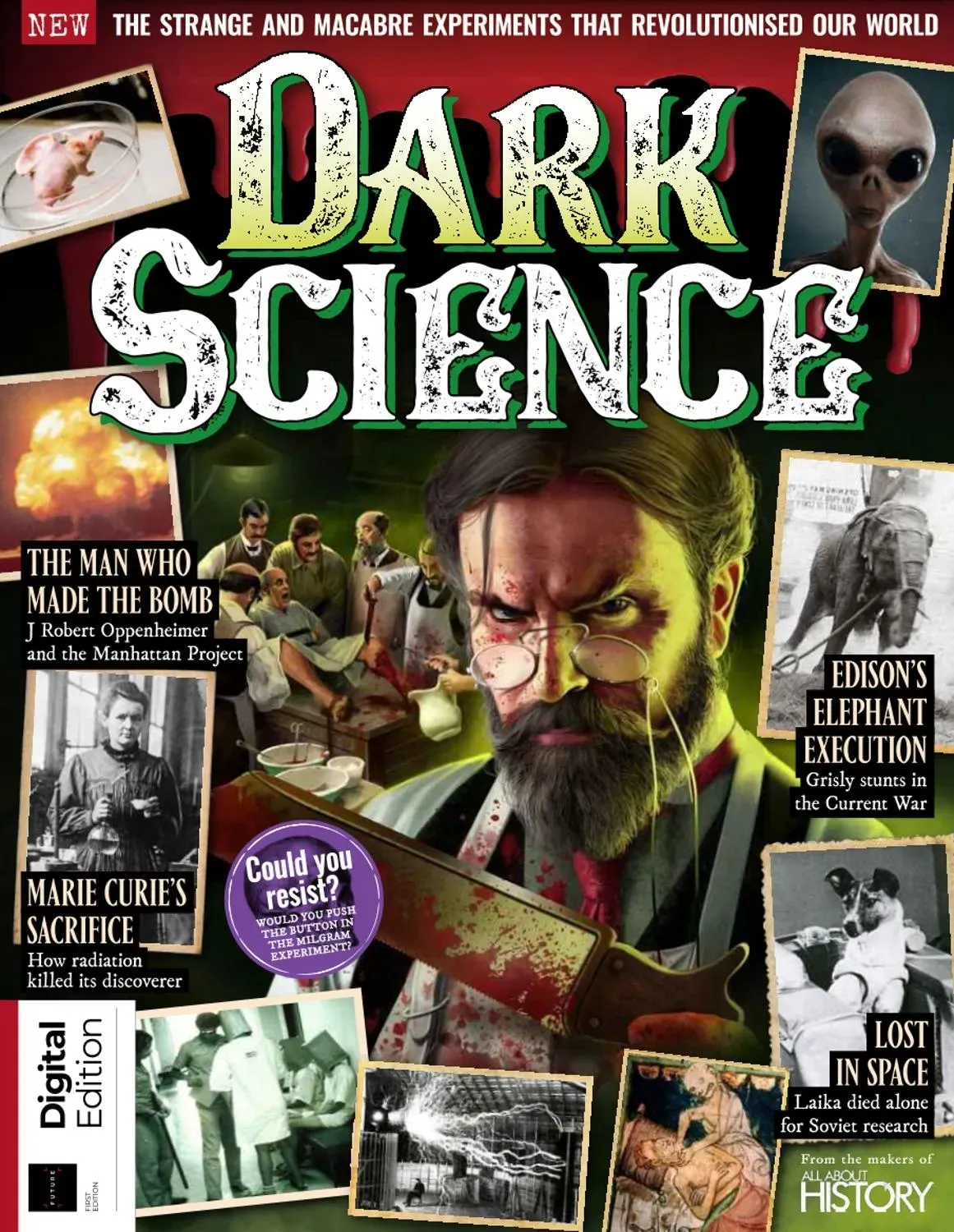
Herophilus's alleged live dissections, the Tuskegee Syphilis Study, and the Manhattan Project's radioactive legacy structure All About History's Dark Science 1st Edition, July 2026. Ben Gazur opens with whether ancient Greek physicians cut open living criminals, and the volume proceeds through body-snatching, Nazi atrocities, the Milgram experiments, and the ghosts of Chernobyl.
The 128-page survey covers medicine in the Middle Ages (p.8), the rise of the body snatchers (p.12), persecuted pioneers from Semmelweis to Ignaz (p.18), and human zoos (p.26). Victorian medicine (p.28) covers surgery before anaesthesia. The Current War between Edison and Tesla (p.38) documents Edison's elephant electrocution stunt. Marie Curie's death from radiation exposure (p.44) is presented through her laboratory notebooks that remain radioactive today. The Little Albert Experiment (p.50) and the thalidomide disaster (p.52) cover 20th-century research ethics failures. Nazi atrocities (p.68) documents Josef Mengele's twin experiments and the Dachau hypothermia studies. J Robert Oppenheimer's Manhattan Project (p.72) leads into the snake scientist who wrote up his own death (p.80) and Laika's solo space flight (p.82). John B Calhoun's rodent universe experiments (p.84), the Milgram shock experiments (p.98), MKUltra (p.102), the Chernobyl disaster (p.118), and the "ear mouse" (p.124) close the volume.
Each chapter pairs the scientific advance with its human cost, arguing that progress and exploitation have been inseparable throughout history.
—————
Content Guide
▸ Ancient & Medieval
p.6 · Did Herophilus dissect people alive?
Ben Gazur examines the claim that 3rd-century BC Greek physician Herophilus performed vivisection on condemned criminals in Alexandria. The article weighs the evidence from Celsus's De Medicina and Tertullian's condemnatory writings. The primary-source excerpts show that the vivisection claim rests entirely on later writers who had political motives to discredit the Alexandrian school.
p.8 · Medicine in the Middle Ages
Medieval medical practice is presented on its own terms rather than as a "dark age" of ignorance — humoural theory, monastic herb gardens, and surgical manuals from the School of Salerno. The article reproduces a 14th-century bloodletting chart showing the zodiac correspondences. The chart demonstrates that medieval medicine was systematic, even if its premises were wrong.
p.12 · Rise of the body snatchers
The 19th-century trade in cadavers for anatomical dissection is traced through the Burke and Hare murders in Edinburgh (1828) and the London Boroughs gang. The article reproduces the anatomy-act pricing table showing how much surgeons paid per body. The table shows that a fresh adult corpse was worth three weeks' wages for a labourer.
▸ 19th & 20th Century
p.38 · The Current War
Edison's campaign to discredit Tesla's alternating current included the 1903 electrocution of Topsy the elephant at Luna Park. The article reproduces the Thomas Edison film of the execution. The film is the earliest known evidence of a corporation killing an animal specifically to damage a competitor's technology.
p.44 · How Marie Curie died for science
Curie's death from aplastic anaemia in 1934 is linked to her 30-year exposure to radium without protective equipment. The article reproduces her laboratory notebooks from 1899-1902, which remain radioactive and are stored in lead-lined boxes at the Bibliotheque Nationale. The notebook pages have a half-life of 1,600 years — they will be dangerous for longer than the Pyramids have stood.
p.50 · The Little Albert Experiment
John B Watson's 1920 conditioning of an 11-month-old infant to fear a white rat is documented through his film footage and laboratory notes. The article reproduces the raw data sheets showing Albert's distress responses. The experiment was never reversed — Albert left the hospital before Watson could decondition him.
p.52 · They said it was safe
The thalidomide disaster (1957-1961) and the 1937 Elixir Sulfanilamide tragedy are documented through FDA records and victim testimonies. The article reproduces the 1937 telegram from the AMA to the FDA that triggered the first federal drug-safety legislation. The timeline from disaster to regulation shows that each major reform followed a specific body count.
▸ Modern Atrocities
p.72 · I am become Death
J Robert Oppenheimer's Manhattan Project leadership is documented through Los Alamos security files and the 1965 NBC interview where he said the famous Bhagavad Gita line. The article reproduces the Trinity test observer report signed by Oppenheimer. The report's clinical language — "the light was blinding" — contrasts with the post-war campaign to ban nuclear testing.
p.82 · Laika come home
The Soviet space dog's 1957 flight is documented through the declassified telemetry showing her heart rate tripled at launch. The article reproduces the 2002 Memoirs of Soviet scientist Dmitri Malashenkov confirming that Laika died from overheating after four hours, not the previously reported one week. The memoir admission was the first official acknowledgment of the cover-up.
p.98 · Would you push the button?
Stanley Milgram's 1961-1963 obedience experiments at Yale are reconstructed using the original audio recordings. The article reproduces the experimental prods — "Please continue," "The experiment requires that you continue," "You have no other choice, you must go on." The full prod sequence shows how authority escalates from polite request to direct command.
p.118 · Ghosts of Chernobyl
The 1986 nuclear disaster is documented through the 2006 Chernobyl Forum report and the dosimeter readings from the exclusion zone. The article reproduces the radiation map showing cesium-137 deposition across Europe. The map demonstrates that the contamination ignored political borders entirely.
—————
Editor's Take
All About History's Dark Science 1st Edition is the most ethically coherent science-history volume in the series. The Curie-notebook radiation data and the Laika telemetry admission are genuinely fresh material. Weakest parts: the "human zoos" chapter is too short for a subject that deserves a dedicated volume, and the "Crows with a grudge" closing chapter is a curiosity rather than a dark-science story. This edition suits the undergraduate bioethics student who needs case studies for research-ethics coursework.
Strengths
• Marie Curie notebook radiation levels with 1,600-year half-life data
• Laika telemetry proving four-hour survival, not one week
• Milgram experimental-prod sequence from original audio recordings
Weaknesses
• Human zoos chapter compressed to 2 pages
• Crow vengeance chapter irrelevant to dark-science theme
Verdict: Recommended — Strongest research-ethics case-study collection available in a single volume.
