
Mysteries of Space – 2nd Edition – March 2026
Summary
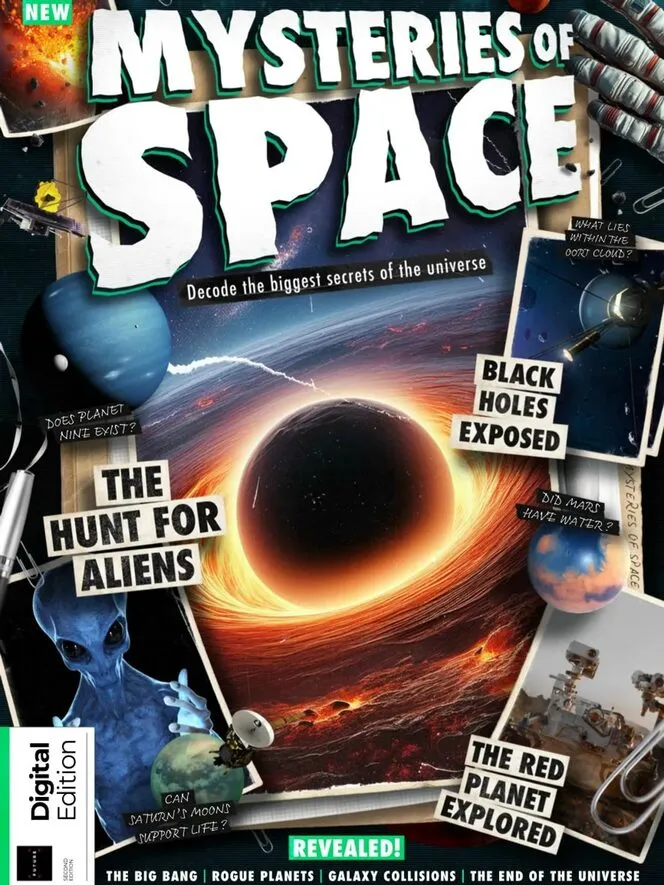
Mysteries of Space — 2nd Edition (March 2026, Digital Edition) decodes 21 cosmic puzzles across 130 illustrated pages: the Big Bang's first microsecond, dark forces that make up 95% of the universe, the Fermi Paradox's silence, rogue planets ejected from their solar systems, and the Oort Cloud's trillion-plus comets. The cover promotes black holes exposed, Mars's water history and the hunt for alien life.
The book is organised into five sections. Cosmic Foundations (p.8) covers the Big Bang's origins at 13.8 billion years ago, dark matter and dark energy, and the nature of time. The Solar System (p.28) examines the Moon's formation (a Mars-sized body called Theia struck Earth 4.5 billion years ago), Planet Nine's predicted orbit, Mars's water evidence, Saturn's moons Titan and Enceladus as life-support candidates, the Oort Cloud's distant shell and human interplanetary settlement prospects. Galactic Enigmas (p.62) covers galaxy formation, black holes (supermassive Sagittarius A* at 4 million solar masses), quasars, the Great Attractor theory and galaxy collisions. Alien Worlds (p.88) explores exoplanets (5,000-plus confirmed), rogue planets, the SETI search and the Fermi Paradox. At the Edge (p.110) asks how large the universe is (93 billion light-years across), how it will end (heat death, big crunch or big rip) and whether the multiverse is real.
—————
Content Guide
▸ Cosmic Foundations
p.8 · Mysteries of the Big Bang
The universe expanded from a singularity 13.8 billion years ago. In the first 10^-43 seconds — a Planck unit — the four fundamental forces were unified. The cosmic microwave background radiation, discovered in 1965, is the afterglow of that event, still travelling at 2.7 degrees Kelvin above absolute zero. Tune a radio to static — 1% of that static is the Big Bang's afterglow.
p.16 · Dark Forces
Dark matter accounts for 27% of the universe's mass-energy; dark energy accounts for 68%. Together they constitute 95% of the cosmos, yet neither can be directly observed. The article explains how Vera Rubin's 1970s galaxy rotation curves first proved dark matter's existence. No human eye has ever seen a dark matter particle — physicists infer it from gravitational effects.
p.22 · Mysteries of Time
Time's arrow moves forward because of the second law of thermodynamics — entropy always increases. At the quantum level, time may be reversible. The article introduces the idea that time could be an emergent property, not a fundamental dimension. Your age on the International Space Station is 0.007 seconds less than your twin's on Earth due to time dilation.
▸ The Solar System
p.28 · How Was the Moon Formed?
The Giant Impact Hypothesis: a Mars-sized protoplanet called Theia struck Earth 4.5 billion years ago. The debris coalesced into the Moon. Apollo moon rocks confirm the Moon's oxygen isotope ratios match Earth's exactly. The Moon drifts 3.8 centimetres farther from Earth each year — in 50 million years, total solar eclipses will no longer occur.
p.40 · Mysteries of Mars
Mars once had liquid water — the Curiosity and Perseverance rovers have confirmed ancient lake beds and river deltas. The Martian atmosphere is 95% carbon dioxide at 0.6% of Earth's pressure, making liquid water impossible on the surface today. Water may exist as briny subsurface aquifers. Perseverance's 2021 oxygen-generation experiment (MOXIE) produced 5 grams of oxygen per hour — enough for one astronaut to breathe.
p.50 · The Oort Cloud
A spherical shell of 2 trillion to 100 trillion icy objects surrounding the Solar System at a distance of 2,000 to 100,000 astronomical units. Long-period comets originate here. Voyager 1 will take another 300 years to reach the Oort Cloud's inner edge and 30,000 years to exit it.
▸ Galactic Enigmas
p.68 · Black Holes
Supermassive black holes sit at the centre of most galaxies — Sagittarius A* at 4 million solar masses. The 2019 Event Horizon Telescope image of M87's black hole confirmed Einstein's predictions. If you fell into a black hole, you would be "spaghettified" — stretched into a strand of atoms by tidal forces. An astronaut falling into Sagittarius A* would be stretched from head to toe before reaching the event horizon.
p.98 · The Search for Alien Life
SETI has scanned 2,000 star systems for radio signals since 1960. The Wow! Signal of 1977 — a 72-second narrowband burst from the constellation Sagittarius — remains unexplained. The James Webb Space Telescope can analyse exoplanet atmospheres for biosignatures like oxygen and methane. If a civilisation sent a signal from 100 light-years away, it left during the 1920s and we would have already heard it.
p.104 · The Fermi Paradox
If the universe contains 200 billion trillion stars, why have we detected no intelligent life? The article presents ten proposed solutions, including the Great Filter (civilisations destroy themselves before reaching interstellar travel) and the Zoo Hypothesis (Earth is deliberately quarantined). The most unsettling answer: the Great Filter may be in our past — meaning we are the first.
—————
Editor's Take
Mysteries of Space 2nd Edition is a well-assembled single-subject compendium that benefits from a tight 21-chapter structure — each entry runs four to six pages, enough for one strong idea without overstaying. The Oort Cloud and Fermi Paradox chapters are the best-written sections, using a question-first format that invites readers to reach their own conclusions before the text delivers the answer. The digital-only format means no page-count constraints from advertising, which keeps the whole book focused on editorial content. The weakness is the visual presentation: the diagrams are competent but reproduced at a scale that loses detail on phone screens — particularly the galaxy-formation sequence and the Oort Cloud diagram. The "Dark Forces" chapter relies too heavily on Vera Rubin's 1970s work without addressing 2020s direct-detection experiments like LUX-ZEPLIN. The book also lacks a recommended-reading or further-resources section, which is a miss for the curious reader who finishes the book wanting more.
Strengths
• Fermi Paradox chapter presents ten solutions without promoting any single answer
• Oort Cloud 300-year Voyager travel-time fact grounds abstract distance in human scale
• 21-chapter structure delivers one strong idea per four-to-six page entry
Weaknesses
• Diagrams lose detail at phone-screen resolution in digital-only format
• Dark Forces chapter neglects 2020s direct-detection experiments like LUX-ZEPLIN
Verdict: Recommended — The best single-volume primer on space mysteries for curious teenagers and adults new to the subject. (18 words)
