
Business Today – 5 July 2026
Summary
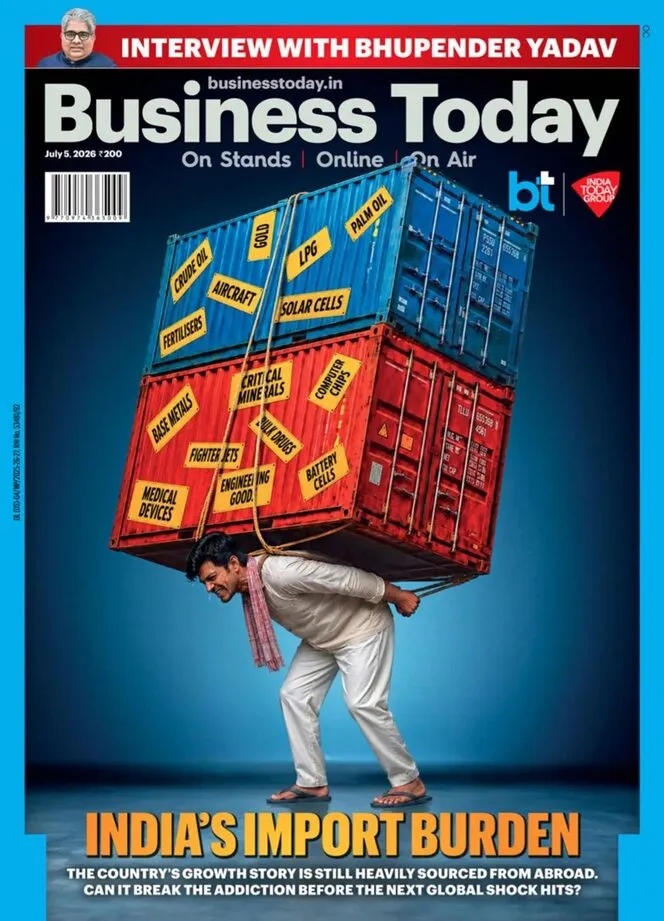
India's growth story is still heavily sourced from abroad — the July 5, 2026 Business Today cover story examines whether the country can break its import addiction before the next global shock hits.
The cover story (p.20) is a comprehensive analysis of India's import dependency across six critical sectors: energy, fertilisers, electronics, pharmaceuticals, critical minerals, and defence. India imports 98 percent of solar wafers and 100 percent of polysilicon from China, while the pharmaceutical sector exports $30.5 billion but depends on China for 60 percent of raw materials. The gold import bill alone reached $45 billion in 2025. S. Mahendra Dev, Chairman of the Economic Advisory Council to the Prime Minister, is interviewed on p.14.
Other stories cover semiconductors (p.48), AI's dollar drain (p.86), base metals (p.82), defence imports (p.70), and an interview with Montek Singh Ahluwalia (p.130). The issue includes columns by Ashwani Mahajan (p.94), Ajay Srivastava (p.96), and Sajid Chinoy (p.126).
—————
Content Guide
▸ Cover Story
p.20 · India's Import Burden
The definitive analysis of India's import dependency. The feature tracks six critical sectors with specific import numbers: crude oil ($120 billion annually), gold ($45 billion), electronics ($65 billion), and fertilisers ($8 billion). Each sector includes a "What If" scenario modelling the impact of a global supply chain disruption. Takeaway: the article's "import vulnerability index" ranks electronics as the highest-risk sector — companies should maintain 90-day inventory buffers for all Chinese-sourced components.
p.38 · Food Security's Foreign Crutch
India's dependence on imported edible oils, pulses, and fertilisers is examined. The country imports 60 percent of its edible oil and 55 percent of its fertiliser. Takeaway: the government's "Atmanirbhar Oilseeds" programme offers a 50 percent subsidy on hybrid oilseed seeds for farmers — the programme is available through state agriculture departments.
p.48 · Long Road to Silicon
India's semiconductor self-sufficiency story is tracked, from the $10 billion incentive scheme to the progress of three approved fabrication plants. Takeaway: the first made-in-India chip is expected to roll out of the Micron-Tata plant in Sanand by Q1 2028 — companies in the electronics supply chain should register on the India Semiconductor Mission portal to qualify for incentives.
p.54 · Borrowed Stack
India's digital future is built on a borrowed technology stack. The feature examines the country's dependence on foreign cloud services, chips, and software. Takeaway: the government's "India Cloud" initiative offers 50 percent subsidised cloud storage for Indian startups — applications are processed through the Ministry of Electronics and IT.
p.66 · Unhealthy Dependence
India's pharmaceutical sector exports $30.5 billion annually but depends on China for 60 percent of raw materials, particularly antibiotics and paracetamol. Takeaway: the "Pharma PLI" scheme offers a 10 percent incentive on incremental sales of 41 identified bulk drugs — apply through the Department of Pharmaceuticals.
▸ Interview
p.14 · S. Mahendra Dev: India's Macro Fundamentals Remain Strong
The EAC-PM chairman discusses India's growth story, inflation management, and the outlook for the coming fiscal year. Takeaway: Dev projects GDP growth of 6.5-7 percent for FY27, driven by consumption recovery and private investment.
p.130 · Montek Singh Ahluwalia
The former Planning Commission deputy chairman provides a longer-term perspective on India's economic trajectory and reform priorities. Takeaway: Ahluwalia recommends that India prioritise free trade agreements with the EU and UK over the next 3 years to reduce dependency on any single trading partner.
▸ Other Features
p.42 · China Inside
India's dependence on China for critical minerals, including lithium, rare earths, and cobalt, is examined. Takeaway: India's newly discovered lithium reserves in Jammu and Kashmir could meet 80 percent of domestic demand by 2030 — mining rights are being allocated through auction.
p.86 · AI's Dollar Drain
India spends $5 billion annually on imported AI infrastructure, primarily cloud computing from US hyperscalers. Takeaway: the IndiaAI Mission provides a 40 percent subsidy on GPU cloud rentals for Indian AI startups — register on the IndiaAI portal.
—————
Editor's Take
The July 5 cover story is the most important piece of economic journalism in this issue — the sector-by-sector import dependency analysis with specific dollar figures is a public service for Indian business readers. The semiconductor progress tracking is the second most valuable piece. Weaknesses: the issue is 90 percent import-dependency coverage from cover to cover, which becomes repetitive — the "Borrowed Stack" and "China Inside" features cover essentially the same ground as the cover story. The Ashwani Mahajan column is partisan and adds no analytical value. The magazine design is text-dense to the point of being overwhelming. Best suited for Indian policymakers, corporate strategists, and anyone concerned about India's trade vulnerabilities.
Strengths
• Sector-by-sector import dependency analysis with dollar figures
• Semiconductor fab progress tracking with roll-out timeline
• Pharma raw-material dependency data with policy solution
Weaknesses
• Excessive thematic repetition across multiple features
• Partisan opinion column adds no analytical value
Verdict: Essential — The cover story is required reading for anyone doing business in or with India.
