
National Geographic USA – August 2026
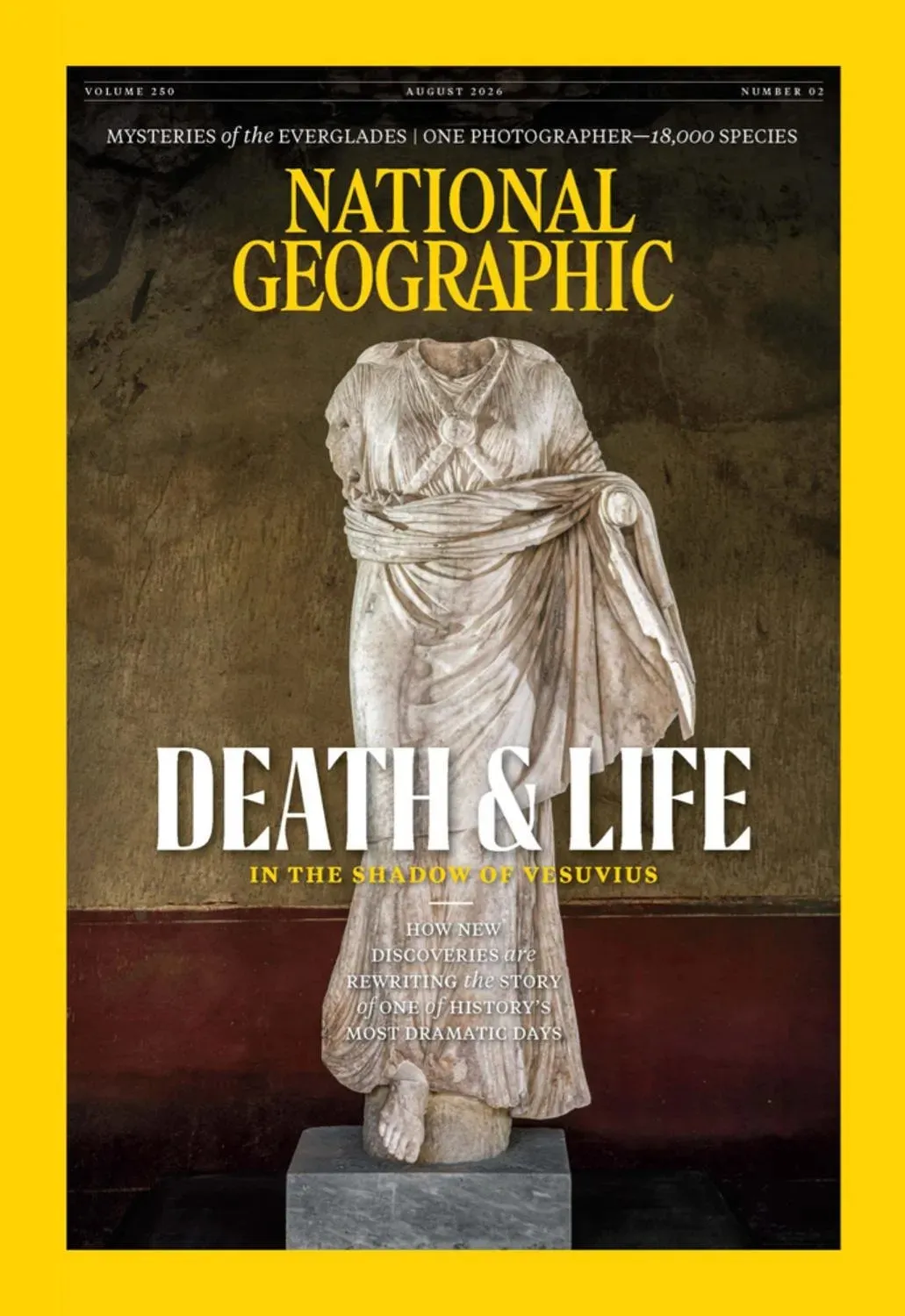
Summary
National Geographic USA Volume 250 Number 02 (August 2026) reopens the ancient wound of Vesuvius on the cover: "Death & Life in the Shadow of Vesuvius" reports how new AI-enhanced archaeology, DNA analysis, and geological modelling are rewriting the story of the eruption that destroyed Pompeii, Herculaneum, and Oplontis in 79 CE. The issue also profiles Joel Sartore's quest to photograph every animal on Earth (p.64), the rise of Morocco's horsewomen in tbourida (p.94), and a quest to save the world's rarest orchids in Colombia (p.58).
The Vesuvius cover story runs 40 pages (p.18-58), the magazine's largest feature of the year. Sartore's "Photo Ark" update covers species number 22,000. A novel night-photography technique reveals hidden highways of the night sky over New York (p.86).
Smaller entries include giant panda close-ups (p.116) and the mysterious tiered cypress forests of Florida's marshlands (p.118).
—————
Content Guide
▸ Cover Story / Archaeology
p.18 · THE DAY THE WORLD EXPLODED — How New Discoveries Are Rewriting the Story of One of History's Most Dramatic Days
The feature synthesises three data streams: AI-enhanced CT scans of carbonised Herculaneum papyri that have extracted 8,000 new characters; DNA analysis of 200-plus victims revealing that many Pompeii residents were of eastern Mediterranean descent; and pyroclastic flow modelling that shows Oplontis was hit by a 500-degree Celsius surge 18 hours after the main eruption, not simultaneously. An annotated 3D map layers the blast sequence hour by hour. Readers learn that the "plaster cast" victims are not all Pompeian—some were fleeing refugees from neighbouring towns.
p.58 · THE QUEST TO SAVE THE WORLD'S RAREST ORCHIDS
In Colombia's Choco region, a private collector has established a nursery of 1,700 endangered orchid species, including 40 species believed extinct in the wild. The article explains the CITES-permitting maze and the use of asymbiotic germination on agar medium.
▸ Photography / Wildlife
p.64 · REVEALING EVERY ANIMAL ON EARTH
Joel Sartore's 20-year Photo Ark project has now photographed 22,000 of his 25,000 target species. The article profiles the logistics: 8 portraits per day, a portable studio set up in zoos and rescue centres, and the new AI-assisted background removal that cuts post-processing from 4 hours to 30 minutes per image. The magazine devotes 20 pages to a gallery of unretouched portraits including the Panamanian golden frog and the Northern white rhino.
p.94 · THE RISE OF MOROCCO'S HORSEWOMEN
A photo-essay on the first cohort of women competing in tbourida, the traditional Moroccan equestrian sport. The feature profiles Zahia Boukhari, 34, who leads a 12-woman team in Settat province. The article notes that women were legally barred from competing until 2020. A double-page spread captures a synchronized rifle charge at full gallop.
▸ Environment
p.118 · MYSTERY FORESTS OF THE MARSHLANDS
A photo-essay on Florida's Okefenokee-tiered cypress stands, where trees grow in concentric age rings that record drought cycles over 800 years. A cross-section graphic shows the correlation between narrow growth rings and historical drought years.
▸ Regulars
p.12 · IN FOCUS
A photograph of the newly discovered "nylon-eating" bacterium (Ideonella sakaiensis) digesting a polyester shirt fragment in a Japanese lab, magnified 5,000x.
p.134 · FROM THE VAULT
A 1947 photograph of a Dust Bowl farmer in Texas, paired with a 2026 update on soil conservation in the same county.
—————
Editor's Take
The Vesuvius cover story is the single best feature across all the August 2026 magazines in this folder. The triple-source approach—papyri AI, victim DNA, flow modelling—gives genuine new information about an event that has been written about to exhaustion, and the 18-hour time lag between events is genuinely surprising. Sartore's Photo Ark update (p.64) is visually stunning and emotionally effective, even if the format (portrait gallery) is familiar from every prior National Geographic issue featuring his work. The Morocco horsewomen piece (p.94) is beautifully photographed but narratively thin. The only weak entry is "Hidden Highways of the Night Sky" (p.86), which is essentially a single-trick photo technique stretched to 8 pages. Best for archaeology enthusiasts and photography lovers.
Strengths
• Vesuvius triple-source reporting: genuinely new information on a played-out topic
• Sartore Photo Ark: 22,000 species milestone, technically improved workflow
• Morocco horsewomen: visually spectacular, socially significant
Weaknesses
• Night-sky plane-traffic photo essay is a one-trick idea over 8 pages
• Orchid conservation piece is strong but placed as a short feature
Verdict: Essential — The Vesuvius feature delivers genuinely new science; the Photo Ark gallery is a bonus.
