
Natural History – May 2026
Summary
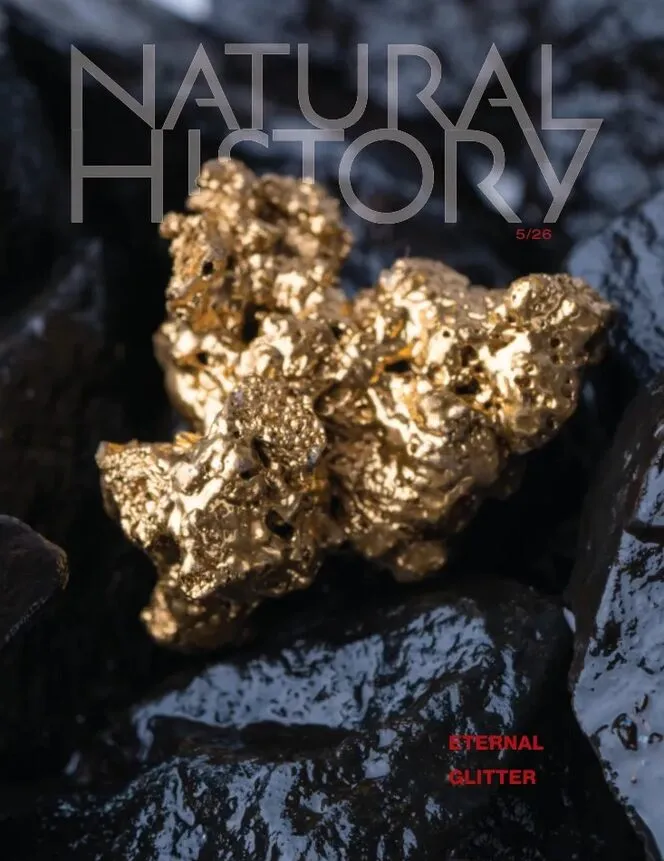
Natural History Volume 134 Number 5 (May 2026) puts gold on the cover—"Eternal Glitter"—reporting that the gold atoms in your jewellery formed in the sun's parent molecular cloud 4.6 billion years ago, and the same element still circulates through Earth's crust today. The issue also traces how birds survived the Chicxulub impact and diversified (p.22), examines the aesthetic of control in Amazon land management (p.28), and presents a graphic-record of the Trinity atomic bomb test (p.34).
Four features anchor the 48-page issue, supported by regular departments including Field Notes on deforestation drivers, a Skylog on Argo Navis, and an Endpaper on soil ecology.
—————
Content Guide
▸ Cover Story / Earth Science
p.16 · GOLD — Cover Story
Dominic Frisby traces the element's journey from stellar nucleosynthesis in a supernova 4.6 billion years ago to the Witwatersrand Basin deposits that supply 40 percent of the world's gold. The article explains why gold is inert: its 6s electron orbital is fully filled, making it resistant to oxidation. A global map shows the 12 major gold-producing regions. Readers learn that all the gold ever mined (200,000 tonnes) would fit into a cube 21 metres per side.
p.22 · THE STORY OF BIRDS — How They Survived Chicxulub and Flourished
Steve Brusatte (author of The Rise and Fall of the Dinosaurs) argues that birds survived the K-Pg extinction because of three traits: a high-metabolism generalist diet, burrowing or ground-nesting behaviour, and a rapidly maturing skeleton that allowed quick reproduction in post-impact environments. The earliest modern bird fossil, Asteriornis maastrichtensis, is dated to 66.7 million years ago—just before the impact.
p.28 · CULTIVATED — Amazon Land Management and the Aesthetic of Control
Jeffrey Hoelle critiques the Western assumption that the Amazon is "untouched wilderness," presenting evidence that pre-Columbian societies managed 12 percent of the basin through terra preta soil enrichment, selective tree cultivation, and fish weirs. The article argues that modern conservation policy errs by excluding human presence from protected area planning.
p.34 · TRINITY — The First Atomic Bomb, a Graphic Record
Emily Seyl presents a visual history of the Trinity test on 16 July 1945, using Los Alamos archive photographs and declassified radiation maps. The article includes the original 1.5-page field notebook entry from Kenneth Bainbridge ("Now we are all sons of bitches") and a diagram of the Gadget's tamper-and-pit assembly.
▸ Regulars
p.6 · SAMPLINGS
Short items: a new species of deep-sea anglerfish (Lasiognathus regalis) from the Gulf of Mexico; the discovery that dogs can detect seizures via changes in isoprene concentration in human breath; and a 500-year-old spruce tree in Norway whose growth rings show the Little Ice Age began abruptly in 1565.
p.9 · FIELD NOTES — Drivers of Deforestation
Chandrakant Singh and Martin Persson use satellite data to show that 70 percent of deforestation in the Brazilian Amazon since 2019 is attributable to cattle ranching, with soy cultivation accounting for 12 percent. The data is presented as a proportional pie chart.
p.12 · CULTURES IN CONTACT — Common Scents
Samuel M. Wilson surveys cross-cultural attitudes toward flatulence across 14 societies, from the Kaluli of Papua New Guinea (who consider it a sign of approval after a meal) to Victorian England (where it was pathologised as "pyrosis").
p.45 · SKYLOG — The Lost Ship Argo
Joe Rao traces the history of the constellation Argo Navis, which was broken into three parts (Carina, Puppis, Vela) in 1930 by the IAU because it had become too large for practical navigation.
p.46 · BOOKSHELF
Reviews of three books: The Heat Will Kill You First by Jeff Goodell; The Exceptions: Nancy Hopkins and the Fight for Women in Science by Kate Zernike; and Otherlands by Thomas Halliday.
—————
Editor's Take
The gold cover story is a model of popular earth-science writing—specific, historical, and visually supported by the global mining map. The Brusatte birds-after-Chicxulub piece (p.22) is the strongest feature: the three-trait survival argument is crisp and memorable. The Trinity graphic record (p.34) gives an emotional punch through primary sources, especially the Bainbridge diary entry. Weakest: "Cultivated" (p.28) recycles an academic argument (Amazon-as-garden) that has been made extensively in the past 10 years, and the article lacks new reporting from the region. The magazine is beautifully printed on heavy matte stock—a tactile pleasure. Best for readers who want scientifically rigorous natural history writing with minimal advertising.
Strengths
• Gold origin story: specific, global, visually supported
• Brusatte's three-trait bird-survival thesis: crisp and memorable
• Trinity graphic record: primary-source punch, restrained editorial treatment
Weaknesses
• "Cultivated" recycles a well-worn academic argument without new reporting
• No feature-length piece on current field research
Verdict: Recommended — The gold and bird features are excellent; a quiet, well-made issue for serious natural-history readers.
