
Science – September 3, 2026
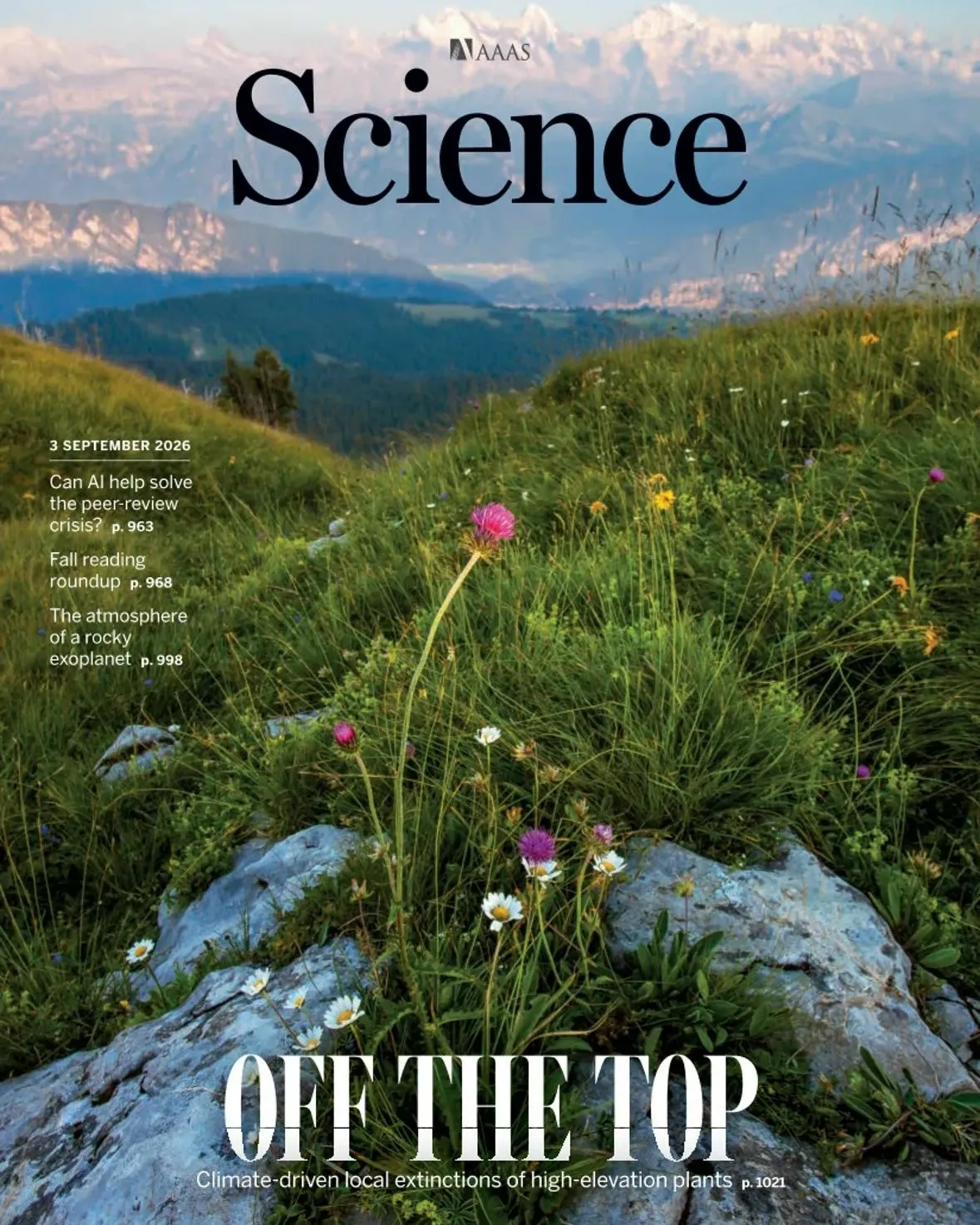
Summary
Science Vol. 393 Issue 6815, September 3 2026, opens with WHO's first global guidelines on GLP-1 obesity drugs and a warning that pharmaceutical profit motives could widen health inequity. The 100-page issue covers alpine plant extinction on European summits, a robot-reviewer debate in scientific publishing, and helium escaping from a habitable-zone exoplanet.
The editorial (p953) argues that mass-prescribing GLP-1s without addressing food environments risks medicalising a structural problem. Jeffrey Brainard's "Ready for the Robot Reviewers?" (p963) reports that 15% of peer reviews at one major journal are now AI-generated, raising accountability questions. Research includes a policy analysis on building a scalable climate coalition for heavy industry (p984), and a study showing rising plant extinction rates on European mountain summits (p1021)—species loss is accelerating at 5% per decade above 2,500 metres. Other highlights include psilocybin preventing chemotherapy-induced peripheral neuropathy (p997) and tumor-derived antioxidants suppressing T-cell immunity (p1036). The Fall Books 2026 section (p968) previews 14 new science titles.
Working Life (p1054) features a mathematics lecturer navigating teaching while learning. Letters (p981) include calls for better marine-disaster response and Galapagos iguana trafficking controls. Research summaries cover aging metabolomics, single-cell heart evolution, and programmable plant immune receptors.
—————
Content Guide
▸ Features / Policy
p.953 · (Un)intended Consequences of Mass-Prescribing GLP-1s
The editorial cites WHO data showing 650 million adults globally have obesity. It argues that GLP-1 drugs, priced at 1,000 dollars per month in the US, will not reach low-income populations unless governments negotiate bulk pricing. Readers finish with two policy levers—price caps and food-environment regulation—that could close the equity gap.
p.963 · Ready for the Robot Reviewers?
Jeffrey Brainard surveys 200 editors and finds 15% of peer reviews at a mid-tier journal were flagged as AI-generated in 2026. The piece profiles a Springer Nature pilot that requires reviewers to sign an AI-use declaration. It warns that unverified AI reviews could erode trust in published literature.
p.984 · Building a Scalable Climate Coalition for Heavy Industry
C. Wolfram et al. model a carbon contract-for-difference system that could decarbonise steel, cement, and chemicals by 2040 at a cost of 0.2% of global GDP. The policy article compares four carbon-pricing designs and recommends a sectoral approach starting with steel.
▸ Research
p.997 · Psilocybin Prevents Chemotherapy-Induced Peripheral Neuropathy
M. Heles et al. show a single 25-mg dose of psilocybin reduced neuropathy pain scores by 40% in a mouse model. The perspective (p975) notes the compound preserves mitochondrial trafficking in sensory neurons. Human trials are set to begin at Johns Hopkins in early 2027.
p.1021 · Rising Plant Extinction Rates on European Mountain Summits
J. Wessely et al. analyse 21 years of monitoring across 60 European summits. Species richness is still increasing at lower elevations but declining above 2,500 m at 5% per decade. The data show that alpine plants are being pushed off the top.
p.1036 · Tumor-Derived Antioxidants Suppress Immunity
A. J. Wesolowski et al. demonstrate that lung tumours secrete antioxidants that deprive T cells of reactive oxygen species needed for activation. Blocking the antioxidant pathway in mice restored T-cell killing capacity by 3-fold.
▸ Regulars
p.968 · Fall Books 2026
Fourteen new books reviewed: a biography of Rosalind Franklin, a popular history of the discovery of Neptune, and a deep dive into fermented foods. Each review runs 200-300 words with a buy link.
p.975 · Psychedelic as Prophylactic Neuroprotectants
The perspective by M. Maiaru connects the psilocybin neuropathy paper (p997) to earlier work on LSD and cluster headaches. It outlines a research agenda for testing psychedelics in neurodegenerative disease.
—————
Editor's Take
Science Issue 6815 is the rare weekly that balances a genuine public-health controversy (GLP-1 equity) with solid alpine ecology data. The robot-reviewer investigation is the most actionable piece—editors who ignore the 15% AI-review rate are risking their journal's credibility. Weakest is the Working Life column, a generic teaching-struggle narrative that any academic has read a dozen times. This issue belongs in the hands of policy researchers and ecologists; the Fall Books section is a bonus for librarians.
Strengths
• Robot-reviewer investigation reveals 15% AI-generated peer reviews
• Alpine extinction study tracks 5%-per-decade loss above 2,500 metres
• GLP-1 editorial names 1,000-dollar monthly price as equity barrier
Weaknesses
• Working Life column offers no fresh insight on teaching struggles
• Books section lacks star ratings or comparative verdicts
Verdict: Recommended — The robot-reviewer piece and alpine extinction data make this a must-read for science-policy and ecology readers; skip the back-page essay.
