
History Extra Collection – The Story of the Napoleonic Wars, 2026
Summary
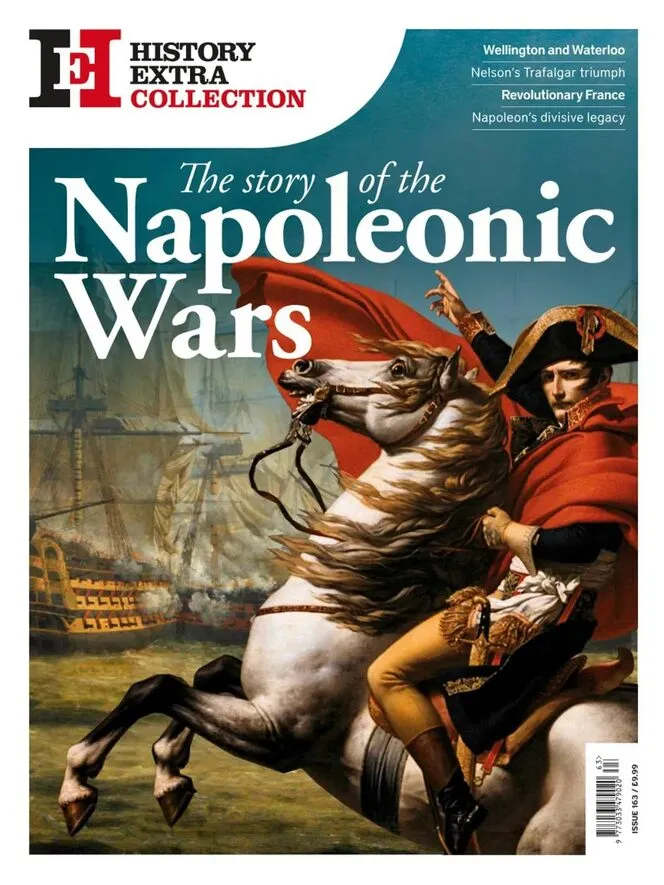
The story of the Napoleonic Wars runs from revolutionary France through Nelson's Trafalgar triumph in 1805 to Napoleon's final defeat at Waterloo in 1815. History Extra Collection The Story of the Napoleonic Wars 2026 maps the conflict across its full arc with contributions from leading historians.
The collection opens with a Napoleonic Wars map and timeline of the conflict spanning 1793-1815. Section 1 War and Revolution covers the French Revolution and its aftermath Napoleon's invasion threat to Britain and Victory at Trafalgar followed by Nelson The Legend. Section 2 The Battle for Europe tackles Austerlitz the Peninsular War the Russian campaign and Britain's year of fear. The final section Waterloo and Beyond examines the 10 factors leading to Waterloo Wellington's mastery and the Congress of Vienna that redrew Europe's borders. The historians' verdict on Napoleon's legacy closes the volume.
—————
Content Guide
▸ War and Revolution
p.16 · The French Revolution and Its Aftermath
The upheaval that began in 1789 created the conditions for Napoleon's rise. The article identifies the key events from the storming of the Bastille through the Reign of Terror. The political vacuum that allowed a Corsican artillery officer to seize power is explained.
p.22 · Napoleon Is Coming
The invasion threat that terrified Britain in 1804-05 is reconstructed. The article details the Camp of Boulogne where Napoleon assembled 200,000 troops. The Royal Navy's blockade that made the invasion impossible is described.
p.28 · Victory at Trafalgar
Why the naval victory was so crucial to Britain's survival is explained with specific ship counts. The article names the 27 British ships of the line that faced the 33 French and Spanish vessels. Nelson's tactical signal and his death are placed within the battle timeline.
p.38 · Nelson The Legend
The rise of Horatio Nelson from Norfolk parson's son to national hero is charted. The article names his key victories: the Nile Copenhagen and Trafalgar. His affair with Emma Hamilton is contextualised within the social codes of the era.
▸ The Battle for Europe
p.48 · The Battle of Austerlitz
Napoleon's greatest tactical victory is broken down with troop movements and force ratios. The article identifies the specific feint that deceived the Austro-Russian army. Casualty figures for both sides are stated.
p.54 · The Peninsular Problem
How the Peninsular War drained French resources over six years. The article names Wellington's key victories: Talavera Salamanca and Vitoria. The guerrilla warfare that tied down 300,000 French troops is quantified.
p.64 · The Road to Moscow
It was not just the weather that made Napoleon fail in Russia. The article examines the supply chain breakdown the Russian scorched-earth tactics and the terrible losses of the retreat. The Grande Armee's strength of 600,000 men is compared to the 25,000 who returned.
▸ Waterloo and Beyond
p.84 · 10 Events That Decided Waterloo's Winner
The 10 factors that determined the outcome of the 1815 battle are listed each with a dedicated analysis. The article names the Prussian arrival at Plancenoit as the pivotal moment. Wellington's chosen defensive position the ridge of Mont-Saint-Jean is described.
p.94 · Wellington's Mastery
Wellington's brilliance both on and off the battlefield is examined. The article identifies his key tactical principles and their application at Waterloo. His political career after Waterloo is traced including his service as Prime Minister.
p.104 · The Global Impact of the Napoleonic Wars
How the conflict reshaped Europe and the world is assessed. The article maps the territorial changes the spread of nationalism and the end of the Holy Roman Empire. The specific borders redrawn by the Congress of Vienna are identified.
—————
Editor's Take
This collection succeeds as a single-volume survey of the Napoleonic Wars with strong contributions from a roster of named historians. The 10 events leading to Waterloo format gives the climactic battle the analytical weight it deserves. The Nelson legend chapter is well-paired with the Trafalgar battle account. The volume lacks dedicated coverage of the Egyptian campaign and the naval war beyond Trafalgar. This title suits the reader looking for a narrative overview rather than specialist scholarship.
Strengths
• Historian-driven chapters with named expert contributors
• 10 factors leading to Waterloo provides clear analytical structure
• Nelson Trafalgar to Waterloo narrative arc is well-paced
Weaknesses
• Egyptian campaign omitted from the timeline
• Naval war beyond Trafalgar barely covered
Verdict: Recommended — a well-structured single-volume Napoleonic survey.
