
Science – August 27, 2026
Summary
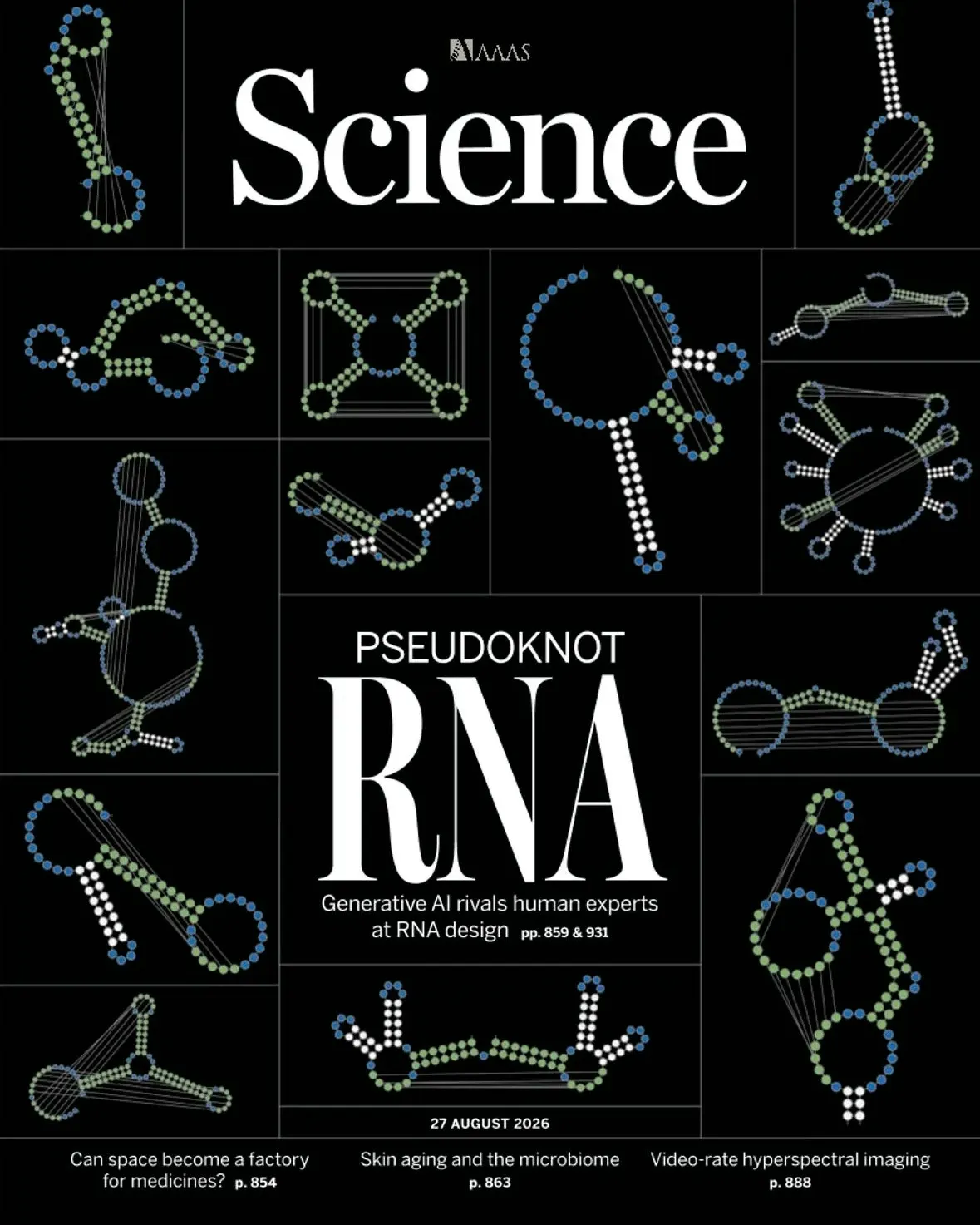
Science Vol. 393 Issue 6814, August 27 2026, features a deep-learning-designed RNA pseudoknot on its cover, with research showing that generative AI rivals human experts at RNA design (p931). The issue also reports that coral records suggest global warming is strengthening El Nino (p846) and that a deadly tick-borne virus is gaining ground in Europe (p848).
The RNA design study (p931) by J. Townley et al. used a generative neural network to create RNA pseudoknots that fold in vitro with 90% success rate—comparable to expert-designed controls. Orbital Alchemy (p854) by M. Greshko reports on space-based pharmaceutical manufacturing, where microgravity enables protein crystal growth that is impossible on Earth. Research includes iron-catalysed cyclopropanation (p910), high-efficiency lead-free perovskite LEDs (p882), and an on-chip hyperspectral microsystem for video-rate imaging (p888). The policy article (p869) corrects the logic behind the 2026 US vehicle emissions standard rollback. The Working Life column (p946) explores caring for oneself while caring for others. A perspective on skin aging and the microbiome (p863) connects microbial diversity to wrinkle depth.
—————
Content Guide
▸ Cover Story
p.931 · De Novo Design of RNA Pseudoknots with Deep Learning
J. Townley et al. train a generative model on 5,000 known RNA structures. The AI-designed pseudoknots achieved 90% correct folding versus 88% for human experts. RNA-therapeutics companies can adopt the model to accelerate aptamer and ribozyme design pipelines.
▸ Features
p.854 · Orbital Alchemy
M. Greshko reports on 4 pharmaceutical companies now manufacturing in low-Earth orbit. Microgravity-grown protein crystals diffract at 1.5-angstrom resolution versus 2.5 angstroms on Earth. The first orbital-produced drug—a monoclonal antibody for rheumatoid arthritis—is scheduled for phase 1 trials in 2027.
p.846 · Coral Records Suggest Global Warming Is Strengthening El Nino
J. Vaz analyses 400 years of coral growth bands from the central Pacific. El Nino events have increased in intensity by 25% since 1950. Climate modellers can use the coral record to validate their next-generation ENSO predictions.
▸ Research
p.882 · High-Efficiency, Long-Lived Lead-Free Perovskite LEDs
W. Bai et al. achieve 18% external quantum efficiency in tin-based perovskite LEDs with a half-life of 2,000 hours at 100 candelas per square metre. The device operates without toxic lead. Display manufacturers now have a RoHS-compliant alternative for next-generation screens.
p.888 · Hypervision: On-Chip Hyperspectral Microsystem for Video-Rate Imaging
L. Bian et al. integrate 64 spectral bands into a 3-millimetre-squared chip that captures 30 frames per second. The camera distinguishes 20 different materials in real time. Quality-control engineers can deploy the chip on existing machine-vision lines.
p.910 · Iron-Catalysed [1+1+1] Cyclopropanation
L. Kong et al. use an Earth-abundant iron catalyst to assemble cyclopropane rings from three separate carbon sources. The yield reaches 85% at room temperature. Medicinal chemists can replace expensive palladium catalysts with this method for drug-library synthesis.
▸ Commentary
p.863 · Beyond Wrinkles
S. Jalili and J. Oh review 30 studies linking skin microbiome diversity to wrinkle depth. Individuals with 20% higher microbial diversity showed 1.5-fold less periorbital wrinkling. The perspective recommends topical prebiotics, not just probiotics, to support native skin bacteria.
—————
Editor's Take
Issue 6814 is the strongest Science weekly in this collection for translational potential: the RNA pseudoknot paper and the orbital pharma feature both point to real products within 3 years. The coral-El Nino data are a sobering read for climate scientists. Weakest is the US vehicle emissions policy piece, which reads more like a legal brief than a policy analysis. This issue is essential for RNA researchers, pharma executives, and climate modelers; the hyperspectral chip is a bonus for hardware engineers.
Strengths
• AI-designed RNA pseudoknots fold at 90% success rate
• Orbital pharma delivers protein crystals at 1.5-angstrom resolution
• Coral record shows El Nino intensity up 25% since 1950
Weaknesses
• Vehicle emissions policy piece is dense and lawyerly
• Microbiome-wrinkle review confirms correlation but not causation
Verdict: Essential — The RNA-AI and orbital pharma work are genuinely groundbreaking; this issue will be cited for years.
