
All About History Book of Ancient Greece – 10th Edition – May 2026
Summary
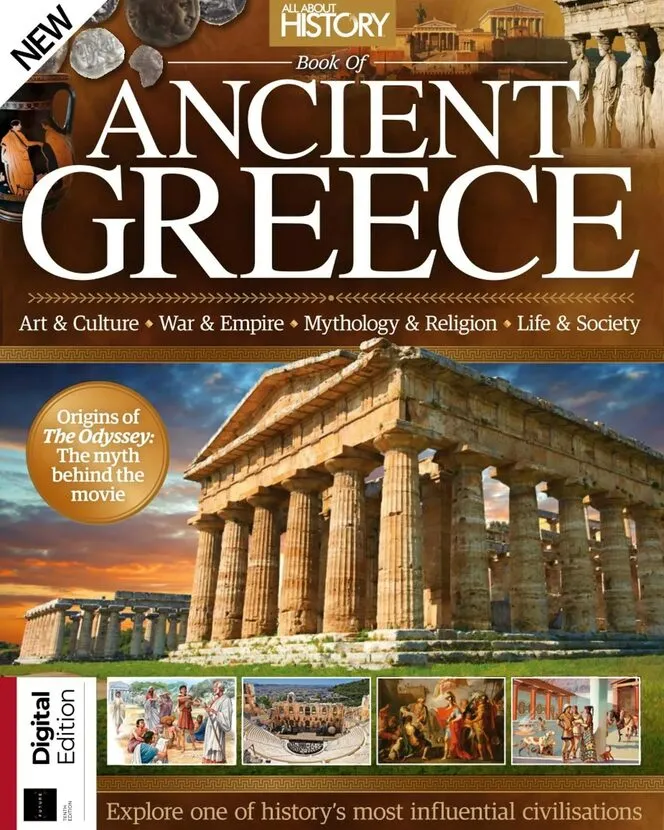
The Odyssey movie origins and the truth behind the Trojan War anchor All About History's Book of Ancient Greece 10th Edition, May 2026, spanning city-states, democracy, philosophy, the Olympics, and Alexander the Great's empire across 140 pages. The volume is organised into Life and Society, Art and Culture, War and Empire, and Mythology and Religion.
Life and Society covers the Greek city-states from Athens to Sparta (p.18), everyday life including diet, housing, and family structure (p.24), and the birth of democracy in 5th-century Athens (p.34). Art and Culture profiles the greatest minds — Socrates, Plato, Aristotle, Pythagoras, Hippocrates (p.42), the philosophical schools (p.50), the Ancient Olympics from 776 BC (p.54), Greek theatre (p.64), architecture and the classical orders (p.66), the Parthenon and Greek temples (p.70), and the mathematical revolution (p.72). War and Empire covers hoplite warfare and the phalanx (p.76), trireme warships (p.80), the Trojan War archaeological evidence (p.82), the Spartan state as a military machine (p.88), the Peloponnesian War (p.94), Alexander the Great's campaigns from Macedon to India (p.104), and the Hellenistic eclipse (p.114). Mythology and Religion covers Greek religious practice (p.122), the Olympian gods from Zeus to Hades (p.126), myths and monsters including the Labours of Heracles (p.134), and the Oracle at Delphi's geological secrets (p.140).
Each chapter includes maps, timeline, and artefact photography. The volume opens with a map of Ancient Greece (p.6) and a timeline of key periods (p.8).
—————
Content Guide
▸ Life & Society
p.18 · The Greek city-states
The polis system from Athens' radical democracy to Sparta's military oligarchy to Corinth's commercial economy is mapped with population estimates for each major state. The article includes a governance-comparison table showing citizen rights across 12 city-states. The table demonstrates that "Greek democracy" applied to fewer than 15 percent of the Greek population — women, slaves, and metics were excluded everywhere.
p.24 · Everyday life in Ancient Greece
Daily routines from dawn-to-dusk are reconstructed through household inventories, vase paintings, and the Oeconomicus of Xenophon. The diet table shows the average Athenian consumed 2 litres of wine per day, diluted 3:1 with water. The dilution ratio explains why Greek wine drinking did not produce the social problems associated with modern consumption.
p.34 · How democracy was born
Cleisthenes' 508 BC reforms that created demes, the boule, and ostracism are documented through the Aristotelian Constitution of the Athenians. The article reproduces surviving ostraka — pottery sherds used to vote for exile — bearing the name Themistocles. The ostraka prove that ostracism was used against precisely the most popular politicians.
▸ Art & Culture
p.42 · The greatest minds of Ancient Greece
Socrates, Plato, Aristotle, Pythagoras, Hippocrates, and Euclid are profiled with their key contributions and surviving texts. The article includes a timeline showing that Aristotle's career overlapped with the founding of Alexandria — his student Alexander funded both. The overlapping dates show how Macedonian patronage enabled the Hellenistic intellectual explosion.
p.54 · The Ancient Olympics
The 776 BC origins through the 292nd Olympiad in AD 393 are documented with the event programme, training regimen, and prize values. The article reproduces the bronze victor's discus from the 5th century BC. The prize for winning the stadion race was a crown of olive leaves — but returning athletes received lifetime pensions from their home cities.
p.64 · Ancient Greek theatres
The architecture of the Theatre of Dionysus in Athens and Epidaurus is analysed for acoustics and seating capacity. Epidaurus holds 14,000 spectators and transmits sound from the orchestra to the top row without amplification. The acoustic diagram shows how the circular orchestra shape projects voice more efficiently than a Roman half-circle.
▸ War & Empire
p.82 · The truth behind the Trojan War
Heinrich Schliemann's excavations at Hisarlik (Troy VII) and the Hittite diplomatic tablets mentioning Wilusa are presented as evidence that a historical war occurred around 1180 BC. The article reproduces the Hittite-Alaksandu treaty that names a king of Wilusa. The treaty provides the closest contemporary written reference to a Trojan state.
p.88 · Sparta: Barrier State
The Spartan military system — agoge from age 7, syssitia mess halls, the Helot population outnumbering Spartans 7 to 1 — is documented through Xenophon's Lacedaimonion Politeia. The population-ratio table shows how the entire Spartan social structure was a response to demographic paranoia. Every aspect of Spartan life was designed to prevent a Helot revolt.
p.104 · Alexander the Great
Alexander's 11-year campaign from Macedon to India is mapped with his major battles — Granicus, Issus, Gaugamela, Hydaspes — and the cities he founded. The article reproduces the Alexander Mosaic from Pompeii showing Darius III at Issus. The mosaic demonstrates that Alexander's personal appearance in battle — without a helmet — was a deliberate psychological tactic.
p.114 · Ancient Greece in eclipse
The Hellenistic period after Alexander's death is traced through the successor kingdoms, the Achaean and Aetolian Leagues, and the Roman conquest of Greece in 146 BC. The timeline shows that Greek culture continued to dominate the Eastern Mediterranean for 300 years after Greek military power collapsed.
▸ Mythology & Religion
p.126 · The gods themselves
The Olympian pantheon — Zeus, Hera, Poseidon, Athena, Apollo, Artemis, Ares, Aphrodite, Demeter, Hephaestus, Hermes, and Hestia — is catalogued with their attributes, sacred animals, and surviving temple sites. The family tree on page 128 shows the complex genealogy. The tree is essential for understanding why Greek myths involve so many intra-family conflicts.
p.140 · Secrets of the Oracle
The Oracle at Delphi's prophetic trance is explained through 2001 geological research tracing ethylene gas seepage from the underlying limestone fault. The article reproduces the gas-analysis chart from the 2001 Geology paper. The chart proves that the Pythia's visions had a physical cause — ethylene produces a trance state consistent with the historical accounts.
—————
Editor's Take
All About History's Book of Ancient Greece 10th Edition is a solid textbook-level survey that covers the canonical syllabus without surprises. The Delphi ethylene-gas chapter and the Hittite-Troy treaty connection offer genuinely fresh material. Weakest parts: the "Greek maths revolution" chapter is too technical for the general reader and too brief for the maths student. The "greatest minds" chapter treats each philosopher in a single page — insufficient for any of them. This edition suits the GCSE or first-year undergraduate who needs a single-volume companion to a lecture course.
Strengths
• Delphi ethylene-gas analysis from 2001 Geology paper
• Hittite treaty naming Wilusa as Trojan state
• Spartan Helot-to-Spartiate population ratio of 7 to 1
Weaknesses
• Maths chapter neither fish nor fowl
• Philosopher profiles too brief for any single figure
Verdict: Recommended — Ideal classroom companion, nothing for specialist readers.
