
National Geographic Kids Australia – Issue 139 2026
Summary
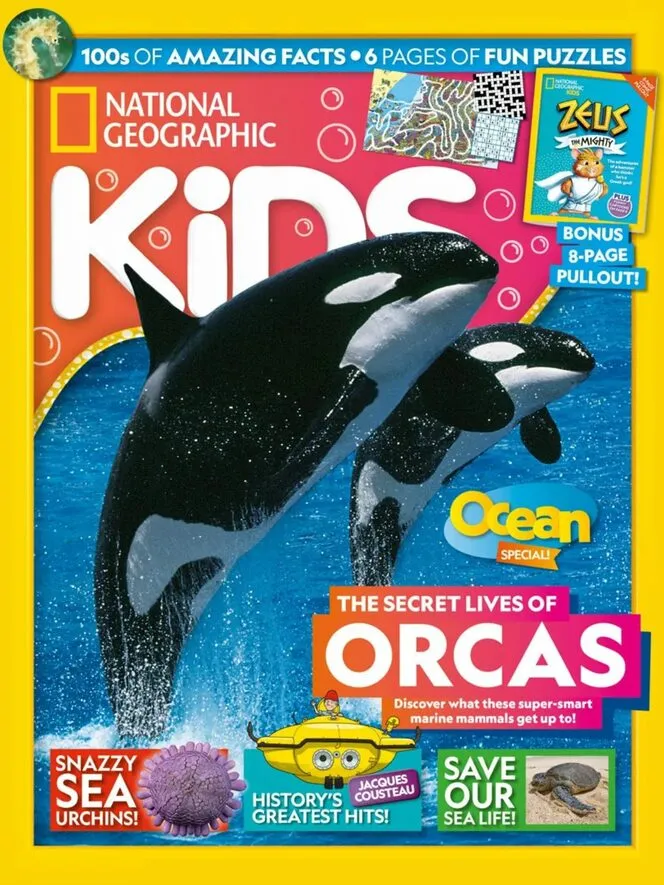
National Geographic Kids Australia Issue 139 (2026) runs an Ocean SPECIAL with "THE SECRET LIVES OF ORCAS" on the cover — seven stories about orca play, teamwork and cross-pod language learning. Inside, Save the Ocean (p.14), Snazzy Sea Urchins (p.16), Undersea Explorer Jacques Cousteau (p.26), World Cup Football Facts (p.28) and four pull-out posters fill 44 pages.
The orca feature (p.6) follows the same syndicated content as the UK Issue 258: different pods speak distinct dialects, calves learn calls from their mothers and grandmothers lead hunting strategies. Save the Ocean (p.14) lists four child-friendly actions: cut plastic rings, avoid balloons, choose sustainable fish and join a beach clean. Snazzy Sea Urchins (p.16) profiles five species with their defence mechanisms — the fire urchin's venom-tipped spines can cause pain for hours. Undersea Explorer (p.26) covers Jacques Cousteau's Aqua-Lung invention in 1943 and his son Philippe's 30-day underwater living experiment. Football Facts (p.28) recaps World Cup records: fastest goal in 11 seconds (Hakan Sukur, 2002), most goals in one tournament (Just Fontaine, 13 in 1958) and Pele's youngest-scorer record at 17. The issue closes with Junior Explorers' Club (p.32), Fun Stuff puzzles (p.34), Make It (p.40) and Puzzle Answers (p.42). Four cool posters are bundled inside.
—————
Content Guide
▸ Cover Story / Features
p.6 · Orca Secrets
Orca pods pass down hunting techniques across generations — grandmothers teach calves how to beach themselves to catch sea lions and how to create waves to wash seals off ice floes. Each pod uses a unique dialect that changes slowly over time. The pod off New Zealand's coast has its own "accent" that differs from those in Norway. Find a recording of orca calls online and compare the whistles — the clicks are for echolocation, the whistles are for conversation.
p.14 · Save the Ocean
Four steps children can take: refuse plastic straws and bags, always cut the rings on six-pack holders, choose MSC-labelled seafood and participate in a local clean-up day. The article states that plastic never fully decomposes — it breaks into microplastics that fish eat. Put a plastic bottle in your recycling bin and write today's date on a calendar — it will still exist in 450 years.
p.16 · Snazzy Sea Urchins
The fire urchin's spines deliver venom that causes immediate pain and swelling. The slate pencil urchin has thick, blunt spines that look like pencils. Urchins move using hundreds of tube feet that work like suction cups. Gently touch a starfish's underside — those tiny tube feet are the same mechanism urchins use to crawl across rocks.
p.26 · Undersea Explorer
Jacques Cousteau's Aqua-Lung was the first device that allowed divers to breathe compressed air without being tethered to the surface. He produced more than 120 television documentaries and won three Oscars. His team discovered that humpback whales sing songs that last up to 30 minutes. Measure 30 minutes on a clock — that is one whale song from start to finish.
▸ Regulars
p.3 · Wacky World
Sock-wearing donkeys in Devon, UK, where farmers dress their donkeys in patterned socks to protect their legs from brambles. Another entry: a musical highway in Japan where grooves cut into the road surface play a melody when cars drive over them at 45 kilometres per hour.
p.4 · Cool News
A 14-year-old Australian girl designed a floating boom made from recycled milk bottles that traps plastic waste in rivers before it reaches the ocean. The boom collects up to 200 kilograms of plastic per month. Repurpose an old milk bottle as a floating plant pot — poke holes in the lid for drainage and watch roots grow through the neck.
p.28 · Football Facts
World Cup trivia: the fastest goal scored was 11 seconds into a match (Hakan Sukur, Turkey vs South Korea, 2002). The largest World Cup win was Hungary 9-0 South Korea in 1954. The youngest player ever to appear in a World Cup is Norman Whiteside of Northern Ireland, aged 17 years and 41 days in 1982. Count to 11 slowly — that is how fast Sukur scored from kick-off.
p.34 · Fun Stuff
Puzzles include a marine-life word search, a code-breaker using whale symbols and a coral-reef spot-the-difference. The code-breaker uses a substitution cipher where each sea creature represents a letter of the alphabet. Write your name in the same cipher and test it on a friend.
—————
Editor's Take
National Geographic Kids Australia Issue 139 is a near-identical reprint of the UK Issue 258 Ocean Special, with the same orca, urchin, Cousteau and football features. The Australia-specific difference appears in the Cool News entry (14-year-old Australian girl's river boom) and the Wacky World sock-donkey entry. The four posters, QR codes and pull-out format give it stronger physical value than the UK edition's poster set. The editorial duplication across editions means Australian children reading this get the same content as UK subscribers — the only localisation is a single Cool News paragraph and the editor's letter signed by Georgia. The football facts page remains disconnected from the ocean theme. The Fun Stuff puzzles are well-designed for the 7-12 age range.
Strengths
• Four pull-out posters and QR codes for bonus online content
• Cool News profiles a 14-year-old Australian's river-boom plastic trap
• Orca dialect and grandmother-hunting-strategy facts are strong school-yard material
Weaknesses
• Near-identical reprint of UK Issue 258 with minimal localisation
• Football Facts page has no connection to the Ocean SPECIAL theme
Verdict: Recommended — Same strong orca content as the UK edition, with one local Cool News entry differentiating it. (17 words)
