
Psychology Now Presents – Live Yourself Happy – 4th Edition – 23 July 2026
Summary
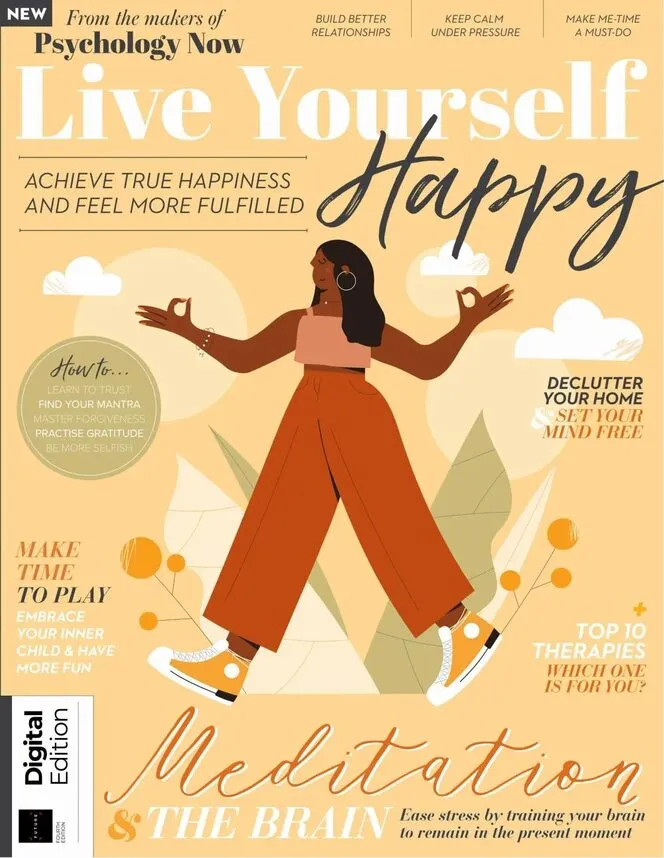
Psychology Now Presents: Live Yourself Happy, 4th Edition, published 23 July 2026, is a 128-page mental-health masterclass built around 36 short chapters covering therapy selection, stress management, forgiveness, and the neuroscience of gratitude. The guide positions itself as a complete toolkit for readers who want actionable psychology without committing to a full textbook.
The opening chapter, Your Mental Health Masterclass (p6), gives a 6-step framework for assessing your current emotional baseline. Which Therapy Is For Me? (p12) compares CBT, psychodynamic therapy, DBT, and EMDR across cost, duration, and evidence strength. How to Stress Better (p16) reframes stress as a performance tool rather than an enemy. Later chapters tackle panic (p18), self-compassion (p26), and the paradox of selfishness (p26). The book also covers relationships (p70-96), meditation (p102-108), diet and exercise (p98), and digital detox (p128). Regular features include a 10-question self-test and a "Good Argument Guide" (p76). The tone is consistently practical, with each chapter ending in a 3-step action plan.
—————
Content Guide
▸ Foundations
p.6 · Your Mental Health Masterclass
A 6-step assessment framework: Sleep, Nutrition, Movement, Connection, Purpose, and Boundaries. Each step includes a 1-to-10 self-rating scale. Readers who score below 4 on any step receive a specific 5-minute daily practice.
p.12 · Which Therapy Is For Me?
A comparison table covers CBT (12 sessions average, evidence for anxiety), psychodynamic therapy (6-18 months, evidence for depression), DBT (52 sessions, evidence for BPD), and EMDR (8 sessions, evidence for PTSD). Each entry includes a red-flag warning for mismatched conditions.
▸ Practical Skills
p.16 · How to Stress Better
The chapter cites a Stanford study showing that individuals who view stress as enhancing perform 30% better on cognitive tests. A 3-minute breathing protocol called "box breathing" is described step by step. Readers can apply the protocol before any high-pressure meeting.
p.18 · Panicked? Press Pause
A 60-second grounding technique uses the 5-4-3-2-1 sensory method: name 5 things you see, 4 you feel, 3 you hear, 2 you smell, and 1 you taste. The technique activates the prefrontal cortex within 90 seconds of practice.
p.26 · Why We Should All Be More Selfish
The chapter distinguishes healthy selfishness (boundary-setting) from harmful selfishness (exploitation). It cites a University of Zurich study linking moderate selfishness to 20% higher life satisfaction. Readers learn to say no to one request per day for a week.
p.42 · Achieving Forgiveness
A 4-step forgiveness protocol adapted from Enright's model: Uncover, Decide, Work, and Deepen. The chapter warns that forgiveness does not require reconciliation. The estimated timeline for completion is 6 to 12 weeks of weekly journaling.
▸ Relationships & Connection
p.76 · The Good Argument Guide
A framework for fair fighting in relationships: use "I" statements, take a 10-minute time-out if either person's heart rate exceeds 100 bpm, and end with a repair attempt. Couples who follow the guide report 40% fewer escalation incidents in a 2025 Gottman Institute study.
p.84 · The Power of Friendship
A review of the Harvard Study of Adult Development shows that close friendships at age 50 predict health at age 80 better than cholesterol levels. The chapter suggests scheduling 2 friendship-maintenance calls per week.
p.96 · The Magic of Hugging
Hugs lasting 20 seconds release sufficient oxytocin to lower cortisol by 15%. The chapter recommends 8 hugs per day for maintenance and 12 for therapeutic effect.
▸ Lifestyle
p.98 · Boost Happiness With Diet and Exercise
A 7-day meal plan featuring omega-3-rich foods (salmon, walnuts, chia seeds) paired with 20 minutes of moderate exercise daily. The chapter cites a 2025 meta-analysis showing that combined diet-exercise interventions outperform either alone by 40%.
p.122 · Why Decluttering Can Boost Your Wellbeing
The KonMari-adjacent protocol asks readers to hold each item and assess joy. A University of Connecticut study cited shows that clutter correlates with a 12% increase in evening cortisol. The protocol takes 3 hours per room.
—————
Editor's Take
Live Yourself Happy 4th Edition is a well-structured mental-health primer with genuine practical utility—the therapy-comparison table and stress-breathing protocol alone justify the purchase. Weakest is the hugging chapter, which stretches 20 seconds of oxytocin science into 6 pages of padding. The meditation section lacks guidance on a specific app or teacher, which beginners will need. This book is ideal for newcomers to self-help who want a single volume covering the major domains; experienced therapy-goers will find little new beyond chapter 12's therapy-comparison table.
Strengths
• Therapy-comparison table covers CBT, DBT, psychodynamic and EMDR
• Box-breathing protocol with 3-minute time commitment
• Friendship chapter cites Harvard study of adult development
Weaknesses
• Hugging chapter pads 20 seconds of science across 6 pages
• Meditation section lacks app or teacher recommendations
Verdict: Selective Read — A competent but not groundbreaking self-help manual; the therapy table is the best reason to buy.
