
Bringing History to Life – Total War Part 2, 2026
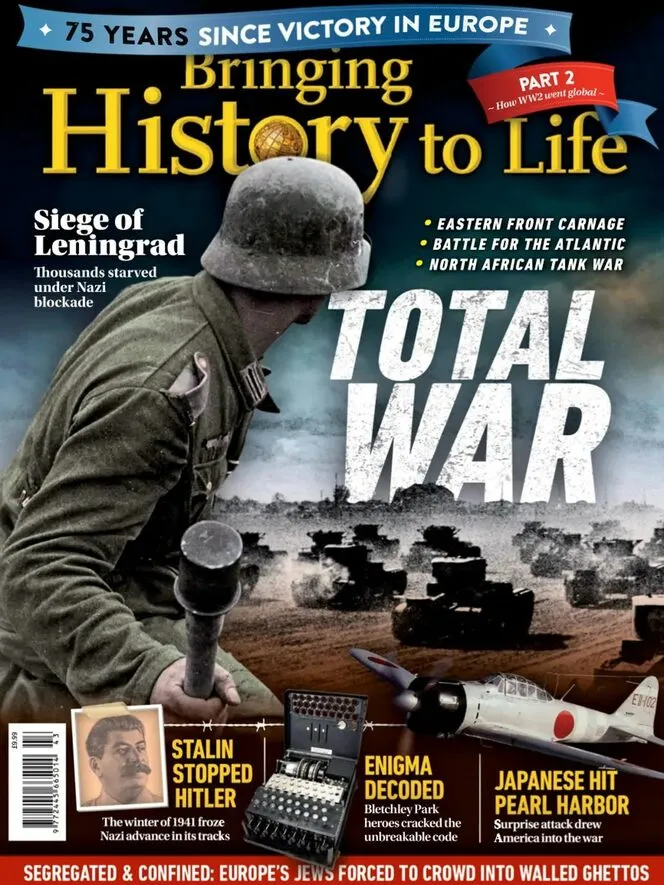
Summary
At 03.14 on 22 June 1941 3.7 million German soldiers stormed into the Soviet Union along an 1,800 kilometre front from the Baltic Sea to Romania. Bringing History to Life Total War Part 2 2026 covers the moment when the Axis advance seemed unstoppable from Rommel's Afrika Korps through the Balkans the Bismarck hunt and the siege of Leningrad.
The volume opens with Rommel forcing the Allies out of Libya before covering the Blitzkrieg in the Balkans where the Axis captured the entire peninsula in under a month. The Enigma code section explains how a secret mission helped crack German encrypted messages. The Bismarck is hunted in the Atlantic after threatening Allied convoys. The net tightens around the news as Jews in German-occupied Europe are forced into ghettos. The largest section covers Operation Barbarossa where 3.7 million soldiers stormed into the Soviet Union. The German ring of steel chokes Leningrad as Hitler demands the city's inhabitants are starved to death. The Blitzkrieg freezes on the Eastern Front a few kilometres from Moscow. U-boats force Britain to its knees sinking thousands of supply ships.
—————
Content Guide
▸ Axis Expansion 1941
p.12 · Afrika Korps Saves the Italians
General Rommel forces the Allies out of Libya in 1941. The article identifies Rommel's tactical innovations in desert warfare. The specific units under his command are named. The strategic importance of Tobruk is explained.
p.20 · Blitzkrieg in the Balkans
In under a month the Axis powers captured the entire peninsula. The article names the specific countries invaded: Yugoslavia and Greece. The airborne assault on Crete is described.
p.30 · Enigma Codes Are Headache for British
A secret mission helps crack the Germans' encrypted messages. The article explains the Enigma machine's operation and the daily key changes. The Polish contribution to the codebreaking effort is acknowledged.
p.36 · Bismarck Is Hunted in the Atlantic
The German battleship threatens the Allies' convoys before being hunted down. The article identifies the British naval forces committed to the chase. The specific damage that crippled Bismarck is described.
▸ Operation Barbarossa
p.54 · Hitler Triumphs Over Red Army
3.7 million German soldiers storm into the Soviet Union on 22 June 1941. The article names the three army groups and their objectives: Leningrad Moscow and Kiev. The initial Blitzkrieg success is documented.
p.68 · German Ring of Steel Chokes Leningrad
Hitler demands the city's inhabitants are starved to death. The article describes the siege that lasted 872 days. The specific food rations during the worst period are quantified. The number of civilian deaths is estimated.
p.86 · The Blitzkrieg Freezes
War on the Eastern Front halts a few kilometres from Moscow. The article identifies the weather conditions that stopped the German advance. The Soviet counter-offensive under General Zhukov is documented.
▸ The Atlantic
p.94 · U-boats Force Britain to Its Knees
Hitler's most feared weapon sinks thousands of supply ships. The article describes the wolfpack tactics and the monthly tonnage sunk. The Allied convoy system and its effectiveness are explained.
—————
Editor's Take
Total War Part 2 covers the critical year of 1941 when the war became truly global. The Barbarossa section with its 3.7 million troop number and three army group structure provides clear military history. The U-boat coverage balances the land campaign with the war at sea. The ghetto section shifts from military to civil history effectively. The volume's simplified presentation suits its target audience of younger readers. This title works best for classroom use and for readers new to WWII history who need a clear chronological framework.
Strengths
• Barbarossa section with precise troop numbers and army group objectives
• U-boat campaign provides balance to the land-war emphasis
• Leningrad siege with 872-day duration and starvation ration data
Weaknesses
• Oversimplified for readers with basic WWII knowledge
• No coverage of the Pacific theatre despite the total war title
Verdict: Selective read — clear 1941 chronology for new readers but too basic for enthusiasts.
