
Astronomy – October 2026
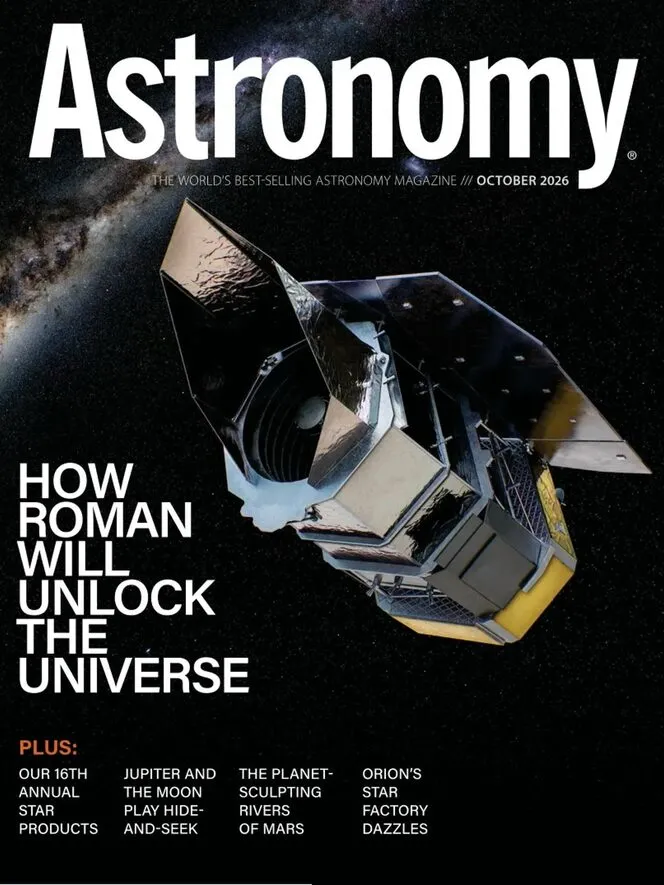
Summary
NASA's Nancy Grace Roman Space Telescope will scan the cosmos with Hubble-class resolution across a 200x wider infrared field starting in 2027, reports Astronomy October 2026. The 16th annual Star Products guide tests 35 new scopes, mounts, and eyepieces, while Joe Rao explains how Jupiter and the Moon stage a daylight hide-and-seek visible without any optics.
Alison Klesman's cover story (p.14) explains how Roman's 18-detector array and coronagraph instrument will tackle dark energy, exoplanet atmospheres, and galactic archaeology in a single survey programme. Ashley Balzer Vigil traces Mars' largest river systems (p.24), using HiRISE imagery to show how outflow channels shaped the northern lowlands. Phil Harrington's Star Products roundup (p.42) spans 35 items from budget beginner kits to premium apochromatic refractors, each with a clear verdict and comparable price point. Richard Talcott takes readers inside Orion's star factory (p.36), where JWST has resolved proto-stellar jets in the molecular cloud.
Regulars include Martin Ratcliffe and Alister Ling's Sky This Month centred on Saturn at opposition, Molly Wakeling's Observing Basics on lunar sketching, and Ask Astro on how sunspot cycles affect Earth. News covers a hidden supercluster and Mars' dust-devil tracks. The Breakthrough page closes with a single-author discovery image.
—————
Content Guide
▸ Cover Story
p.14 · How Roman will unlock the universe
Alison Klesman lays out the Nancy Grace Roman Space Telescope's mission architecture: an 18-detector infrared array, a coronagraph for direct exoplanet imaging, and a survey speed 200 times faster than Hubble. Roman will map dark-energy distribution across a billion galaxies and image exoplanet atmospheres in a single programme. Bookmark the mission-timeline infographic — Roman's 2027 launch window matters for any grant or observation proposal you are planning.
▸ Features
p.24 · How Mars' largest rivers shaped the planet
Ashley Balzer Vigil uses HiRISE stereo imagery to reconstruct the Kasei Valles and outflow channels that once carried 100 times the water of Earth's Amazon. The evidence points to catastrophic flooding rather than slow erosion, reshaping the timeline of when the planet could have supported life. The annotated elevation map shows exactly where future rover missions should look for sedimentary biomarkers.
p.36 · Orion's star factory
Richard Talcott presents JWST's resolved view of proto-stellar jets and Herbig-Haro objects within the Orion molecular cloud, revealing star formation in its earliest detectable instant. The image comparison between Hubble and JWST of the same region shows six new outflow sources invisible at optical wavelengths. Print the annotated JWST frame for your next star-party talk on how stars are born.
p.38 · Jupiter and the Moon play hide-and-seek
Joe Rao provides local timetables for a daytime occultation of Jupiter by the Moon, visible across North America. He explains how to locate the pair in bright twilight using binoculars and the Moon's dark limb as a guide. Set an alarm for 90 minutes before the listed local time — the reappearance happens fast and the contrast is extraordinary.
p.42 · Our 16th Annual Star Products
Phil Harrington tests 35 products across telescopes, binoculars, mounts, eyepieces, filters, and software, rating each on optical performance, build quality, and value. The table organises entries by price bracket from under $200 to over $5,000. Three budget items earned a full five-star rating — start with those before browsing premium gear.
▸ Sky & Observing
p.28 · Sky This Month: Saturn at opposition
Martin Ratcliffe and Alister Ling's guide centres on Saturn reaching opposition, with Titan and Iapetus positioned for easy tracking through any 80 mm scope. The finder chart includes the 2026 asteroid belt crossing for context. Observe Saturn within 48 hours of opposition to catch the shadow of the rings at their narrowest.
p.30 · Star Dome and Paths of the Planets
Roen Kelly's monthly all-sky chart labels the autumn constellations and the ecliptic path, with planet positions plotted week by week. The reverse side carries a detailed Moon-phase calendar through December. Clip the Moon calendar and pin it next to your observing log.
▸ Regulars
p.52 · Ask Astro
This month tackles how sunspot cycles correlate with global temperature trends, whether intergalactic stars can support planets, and why the Moon's orbit is inclined 5 degrees to the ecliptic. Each answer cites a recent paper. The sunspot-climate explanation is precise enough to use as a fact-check reference in climate-science discussions.
p.50 · Observing Basics
Molly Wakeling demonstrates a lunar-sketching technique that trains the eye to recognise subtle albedo features, using nothing more than a 2B pencil and white paper. She includes a side-by-side comparison of the same crater drawn with and without her shading method. Practise this on a quarter Moon for three consecutive nights before attempting Mars sketching.
—————
Editor's Take
Astronomy October 2026 is the strongest single issue of the year for gear buyers — the 16th Star Products guide alone justifies the cover price. The Roman Space Telescope piece manages to translate complex instrument specs into observing consequences. Weakest parts: the Mars river feature, while visually impressive, covers ground already well treated in the September 2024 issue. Joe Rao's occultation guide is useful but limited to North American viewers. This issue best suits the equipment-focused amateur who shops annually for upgrades.
Strengths
• 35-product Star Products roundup with price-bracket table
• Roman telescope capabilities tied to observable science goals
• Orion star factory with JWST-to-Hubble image comparison
Weaknesses
• Mars river feature overlaps with prior coverage
• Jupiter occultation guide restricted to North America
Verdict: Recommended — Annual gear guide makes this a reference issue for buyers.
