
Free Astronomy – September-October 2026
Summary
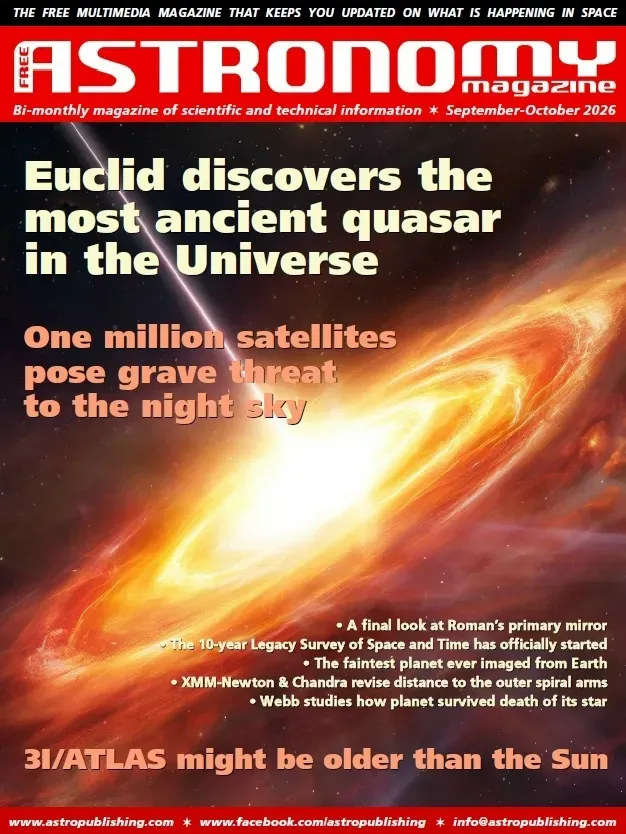
Euclid has discovered the most ancient quasar in the Universe pushing the known frontier of supermassive black hole formation deeper into cosmic time. Free Astronomy September-October 2026 leads with this finding while a companion piece warns that one million satellites pose a grave threat to the night sky.
The issue reports that 3I/ATLAS might be older than the Sun and that XMM-Newton and Chandra have revised the distance to the outer spiral arms of the Milky Way. Webb studies how a planet survived the death of its star. The faintest planet ever imaged from Earth is presented alongside a final look at Roman's primary mirror. The 10-year Legacy Survey of Space and Time has officially started at Rubin Observatory. A persistent mismatch in the expansion of the local Universe continues to baffle cosmologists. The conference Charting the Future of Stellar and Exoplanet Spectroscopy in honour of Luca Pasquini runs 21-25 September 2026 on Elba Island.
Regular columns cover the brightest-ever gamma-ray burst analysed by XMM-Newton and Chandra and a new view of a familiar nebula by NRAO.
—————
Content Guide
▸ Research Highlights
Euclid Discovers the Most Ancient Quasar in the Universe
ESA's Euclid mission has identified a quasar at a redshift that places it earlier than any previously known. The supermassive black hole powering it challenges growth models that require billions of years. The specific redshift value and implied cosmic age are given in the report.
One Million Satellites Pose Grave Threat to the Night Sky
The projected mega-constellation traffic is quantified and the impact on professional and amateur astronomy is assessed. The article names the major operators and their planned fleet sizes. Mitigation strategies—darkening coatings and orbital altitude restrictions—are compared.
3I/ATLAS Might Be Older Than the Sun
The interstellar comet shows isotopic ratios consistent with a molecular cloud origin predating our Solar System. The trajectory data that confirms its interstellar origin is presented. The finding ties 3I/ATLAS to a specific type of star-forming region.
▸ Space Science
XMM-Newton and Chandra Revise Distance to the Outer Spiral Arms
The two X-ray observatories combined data to produce a new measurement of the Milky Way's structure. The revised distance in kiloparsecs shifts some arm assignments. The implications for the Galaxy's mass estimate are explained.
Webb Studies How Planet Survived Death of Its Star
JWST observed a planet orbiting a white dwarf to understand how it escaped being engulfed. The atmospheric composition data suggests the planet migrated outward as the star expanded. The timescale of the migration is estimated in millions of years.
The Faintest Planet Ever Imaged From Earth
A direct imaging campaign using ground-based adaptive optics has set a new contrast record. The planet's mass and orbital separation are stated. The instrument and exposure time used are detailed for imaging specialists.
▸ Missions
DESI Completes Planned 3D Map of the Universe
Follow-up report on the Dark Energy Spectroscopic Instrument's completed survey. The map covers the largest volume of space ever charted. The baryon acoustic oscillation signal extracted from the data is quantified.
Rubin Observatory Reveals Over 11,000 New Asteroids
The LSST camera's first major data release. The survey covers the southern sky with unprecedented depth and cadence.
—————
Editor's Take
Free Astronomy September-October is a research-driven issue that punches above its free-magazine weight. The Euclid ancient quasar discovery is a legitimate front-page science story. The satellite threat piece offers concrete policy grounding. The magazine remains light on practical sky charts which limits its value for the observing amateur. This issue is best for the reader who prioritises discovery news over observing guides.
Strengths
• Euclid ancient quasar is a genuine cosmology milestone
• Satellite threat piece is timely and policy-relevant
• 3I/ATLAS origin story connects interstellar science to Solar System formation
Weaknesses
• No practical sky charts for autumn observing
• Research brief format again prioritises quantity over narrative
Verdict: Recommended — strong discovery news makes this the better of the two 2026 Free Astronomy issues.
