
Shipping Today Yesterday – September 2026
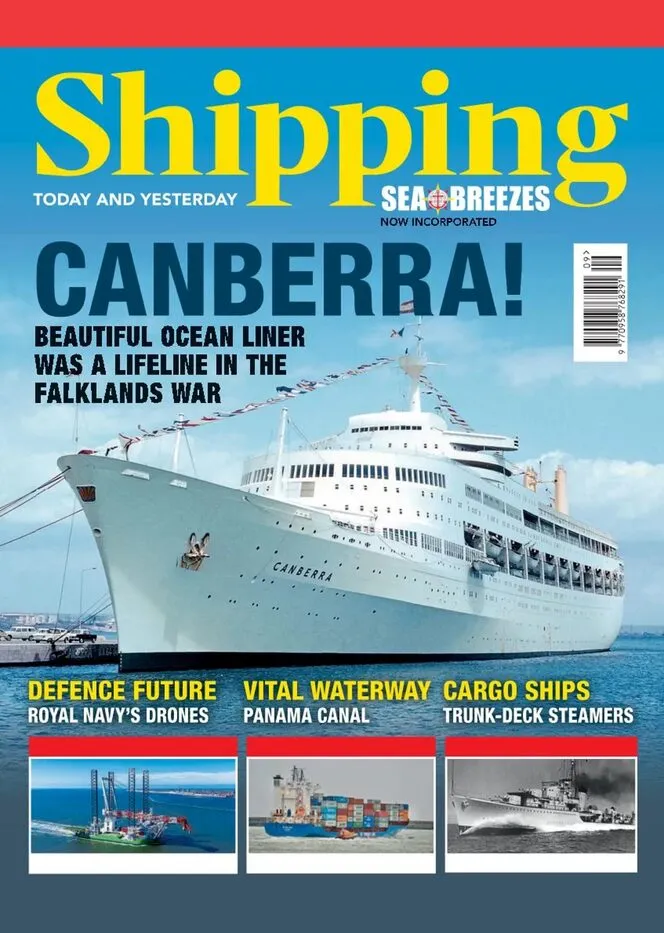
Summary
SS Canberra, the iconic ocean liner that carried troops to the Falklands in 1982, gets a full-career retrospective in Shipping Today & Yesterday's September 2026 issue — No. 438, priced at £5.50. David F Hutchings traces the 65-year story from her 1961 Southampton send-off to her 1997 scrapping in India, while this month's coverage also spans Panama Canal drought challenges, HMS Kelly's 21-month WWII destroyer career, and the Queen Mary 2's starring role in America's 250th Independence Day parade. For anyone who follows maritime heritage, naval history or commercial shipping, this issue packs 66 pages of fleet movements, shipspotting and engineering deep-dives.
Inside, the cover feature on SS Canberra anchors a wide-ranging lineup. Wendy Laursen examines the Panama Canal's 112-year history and its struggle to conserve water in a drought-prone region. Ian Richardson returns with a Port of Tyne decade-on shipspotting retrospective, tracking which vessels still sail and which were scrapped. The Royal Navy section profiles HMS Kelly, the destroyer sunk off Crete in 1941 whose exploits inspired the 1942 propaganda film "In Which We Serve." A newbuild feature covers the Norse Energi, described as the king of wind-turbine installation vessels, while the Design column revisits Edwardian-era trunk-deck steamers built to minimise canal fees.
Regulars include News UK and RNLI updates, the Picture This photo essay from Tuzla, Turkey, and a Modelling section featuring Maersk ship builders who work at incredible detail. Port of Call highlights Ramsgate, the UK's only Royal Harbour, and a Letters page invites readers to Speak Your Mind. Annual UK subscriptions run £60, and the next issue lands September 8, 2026 — making this a solid reference for anyone tracking the global fleet.
—————
Content Guide
▸ Cover Story / Maritime Heritage
p.26 · Ocean Liner SS Canberra
David F Hutchings charts the full life of P&O's 45,000-ton flagship, from her 1961 maiden voyage to her Falklands war service and 1997 scrapping. The article draws on period illustrations from Eagle magazine and Don Smith's cover photograph. Hutchings notes the widespread public interest in ocean liners during the late 1950s, before jet travel sidelined them. Readers finish with a clear sense of why Canberra — not贠 the fastest or largest — became a national symbol.
▸ Infrastructure / Engineering
p.48 · Panama Canal
Wendy Laursen examines how the 51-mile shortcut, now 112 years old, faces a new enemy: drought. The article moves beyond ship-transit statistics to explain how Panama manages fresh water consumption in the canal's lock system. Laursen ties recent infrastructure upgrades to the canal's long-term viability. Anyone planning a canal transit in 2026 should understand the booking slot system and the drought surcharges now in effect.
▸ Naval History
p.54 · Royal Navy: HMS Kelly
A destroyer that served only 21 months before a German dive-bomber sank her off Crete, HMS Kelly survived repeated damage and kept returning to action — enough to inspire Noel Coward's 1942 film "In Which We Serve." The article places her in the dark 1941 Mediterranean campaign when Britain was losing destroyers at an alarming rate. The lesson: resilience, not tonnage, defined a warship's reputation in that theatre.
▸ Shipspotting
p.42 · Port of Tyne
Ian Richardson digs into his back catalogue to compare ships that visited the Tyne a decade ago with their fate today. Some are still regular callers, some renamed, some scrapped — and a few still trading worldwide. Two pages of photographs let readers play the spotting game themselves. Regular port-watchers will pick up tips on tracking vessel name changes and flag-state updates.
▸ Newbuild / Offshore
p.36 · Norse Energi
The wind-turbine installation sector keeps scaling up, and Norse Energi represents the latest leap in specialised lifting capacity. While the article body was not available in full from the source material, the cover line "King of the Wind Turbine Lifters" signals record-breaking specs. Operators evaluating next-gen installation vessels should watch for this class's jacking system and deck-load ratings.
▸ Design History
p.20 · Trunk Deck Ships
Before containerisation, Edwardian-era engineers designed hulls with a raised midship section — the "trunk deck" — to reduce measured dimensions for canal tolls. This column explains how a quirk of naval architecture saved owners thousands of pounds in Suez and Panama fees. Ship-modellers will find the hull-form diagrams especially useful for period builds.
▸ Mining / Trade
p.22 · Phosphate Fleet
A specialised fleet shipped phosphate from tiny Pacific islands to fertilizer plants worldwide. The article traces the boom-and-bust cycles of this niche trade and the unique ships built for it. Cargo-ship enthusiasts get a glimpse of a nearly vanished vessel type.
▸ Port of Call
p.60 · Ramsgate
The UK's only Royal Harbour plays second fiddle to Dover in commercial traffic, but Ramsgate holds its own as a marina, ferry port and heritage site. The piece covers its historic harbour wall, current operators and role in cross-Channel leisure traffic. Cruisers planning a Kent stopover will find mooring and provisioning details.
▸ News
p.14 · News United Kingdom / News RNLI
Corporate and local stories from around the UK, plus the latest on the RNLI's lifeboat crews and fundraising. Cunard's Queen Mary 2 gets a dedicated spread: she anchored at the heart of New York Harbour for America's 250th Independence Day on July 4, 2026, leading a 100-vessel International Parade of Sail with 46 tall ships and 42 naval vessels. The Blue Angels and Red Arrows flew overhead.
▸ Picture This
p.34 · Tuzla, Turkey
A single-image photo essay from photo-transport.com, founded by Dave Smith and his father Don in 2009. The centre spread shows Kumdas and Kumdas 2 laid up in Tuzla, part of a collection of 20,000 ship images dating back to the 1960s.
▸ Modelling
p.66 · Maersk Ships
Hobbyist modellers who build highly detailed replicas of Maersk vessels share their techniques and references. The column proves that accurate colour matching and rigging data can be sourced from operators' official fleet guides.
▸ Regulars
p.24 · Letters: Speak Your Mind!
p.65 · Next Month (October 2026 issue teasers)
p.52 · Puzzles
—————
Editor's Take
This is a strong, cohesive issue for anyone serious about shipping. The Canberra retrospective is the standout — Hutchings writes with genuine affection without sliding into sentimentality, and the Eagle magazine ephemera adds visual punch. The Panama Canal drought story is timely and practical. Weakest element: the "Next Month" teaser and the RNLI page are filler-thin, and Dragados / Associated British Ports entries are one-line placeholders rather than articles. The cover photo by Don Smith is competent but not striking. Still, for £5.50 you get 66 pages with real reporting on ship movements, naval history and infrastructure — better value than many glossier maritime titles. Best suited to naval-history readers and commercial-fleet spotters; leisure-boat readers will find less here.
Strengths
• Canberra feature traces 65-year career with period illustrations
• Panama Canal drought analysis is current and operational
• Port of Tyne before-and-after shipspotting is creatively framed
Weaknesses
• RNLI and Next Month pages offer minimal substance
• Dragados entry is a headline placeholder, not an article
Verdict: Recommended — Substantial maritime coverage for £5.50, anchored by a well-researched Canberra retrospective and a timely Panama Canal piece.
