
High Country News – September 2026
Summary
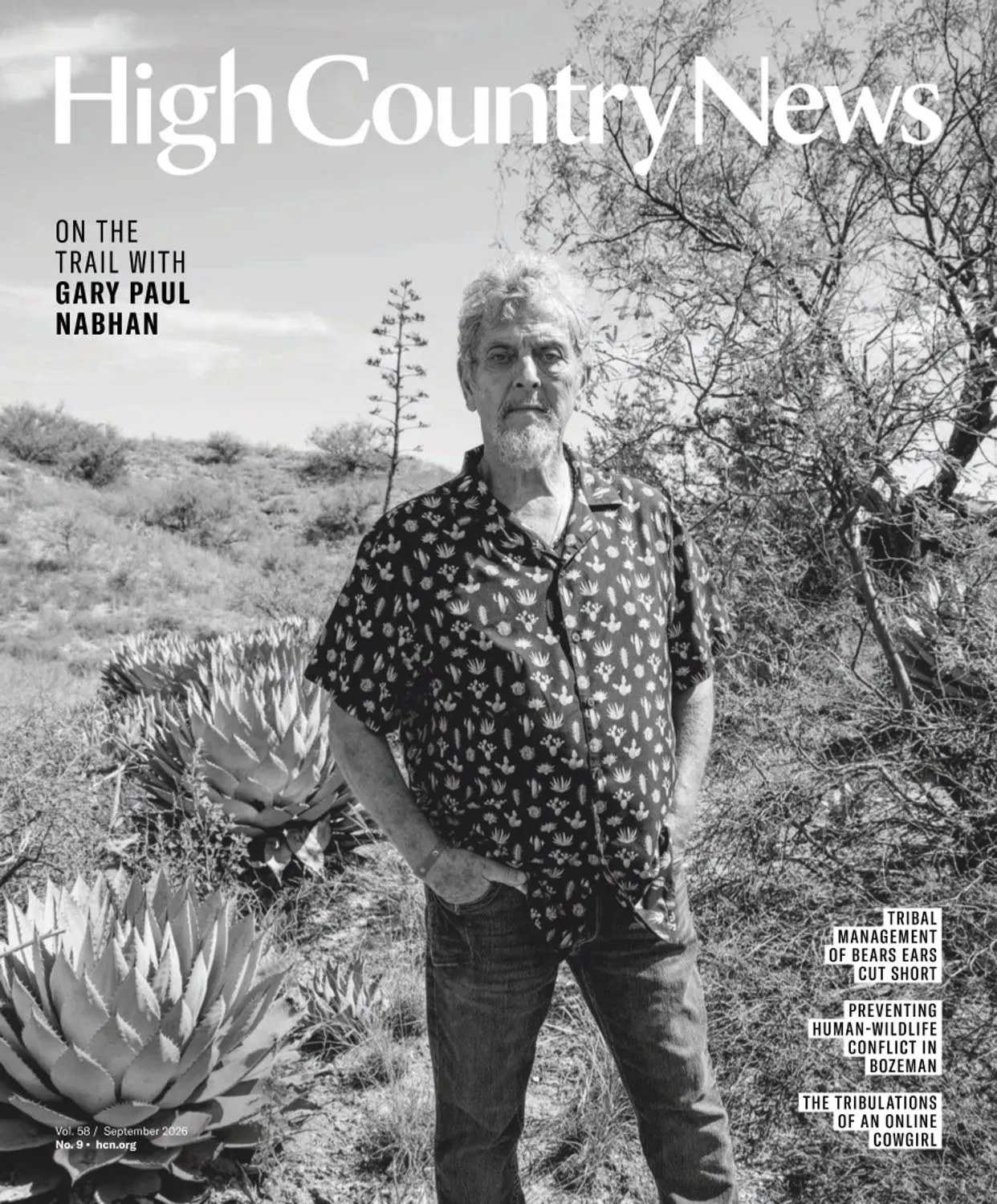
On the road in the Borderlands with writer and ethnobotanist Gary Paul Nabhan — who has lived and worked in the region for 50 years — Rubén Martínez's cover profile anchors the September 2026 issue of High Country News (Vol. 58 No. 9, $45/year), alongside features on California's aqueduct empire, Bears Ears cut by 90 percent, and Arctic Alaska at a crossroads.
The issue leads with California's Aqueduct Empire by Ryan Christopher Jones, examining how post-war optimism built the state's massive water infrastructure. Anna V. Smith reports that the Bears Ears presidential proclamation slashed the monument by 90 percent and ended the first-of-its-kind tribal land commission (Reportage). Emily Senkosky, photographed by Sam Wilson, profiles a Bozeman 'wildlife first responder' developing a tool for human-wildlife coexistence. Sarah Gilman reports that land transfers around the remote Dalton Highway could pave the way for industrialisation of Arctic Alaska. Christopher Lomahquahu examines a large-scale solar project on the Navajo Nation that exposes gaps in lease and tax policies. Darby Minow Smith asks what is lost when a Montana rancher shares her Western life on Instagram. Editor-in-Chief Jennifer Sahn opens with "Shine on."
—–
Content Guide
▸ Cover Story
p.XX · Desert Sage — by Rubén Martínez; photos by Roberto (Bear) Guerra
On the road in the Borderlands with Gary Paul Nabhan, the writer and ethnobotanist who has lived and worked in the region for 50 years. Martínez accompanies Nabhan through the landscapes that have shaped his work, from the San Rafael Valley to the border wall's damaged panels — at least four panels are noted as breached. Nabhan's half-century of field knowledge makes him an irreplaceable voice on desert ecology and cross-border culture. Read this before visiting the Borderlands: Nabhan's plant guides are the difference between seeing sage and understanding it.
▸ Reportage
p.XX · Bears Ears Cuts Also Sideline Tribes — by Anna V. Smith
The presidential proclamation slashed the Bears Ears National Monument by 90 percent and ended the first-of-its-kind tribal land commission that gave five tribes joint management authority. Smith reports on the on-the-ground consequences for the Bears Ears Inter-Tribal Coalition and what tribal leaders say has been lost since the reduction. The legal challenges continue, but the commission's dismantling is already a fact on the ground.
p.XX · Preventing Human-Wildlife Conflicts Before They Start — by Emily Senkosky; photos by Sam Wilson
In Bozeman, Montana, a 'wildlife first responder' is developing a tool for coexistence as development pushes deeper into wildlife habitat. The feature profiles the responder's methods — from non-lethal hazing to public education — and the data showing conflict reduction. Bozeman's Gallatin Valley is photographed from the deer's perspective on the cover. The tool is shareable with any Western community facing deer, elk or bear incursions.
▸ Features
p.XX · California's Aqueduct Empire — by Ryan Christopher Jones
How post-war optimism built the state's massive water infrastructure, from the Oroville Dam (dedicated 1968; crowd estimated at 3,500; construction initiated 1961, embankment topped 1967) to the network of canals and pumps that move water from north to south. Jones traces the engineering ambition and the ecological cost. California's next water crisis will be a test of whether the 20th-century infrastructure can handle 21st-century climate.
p.XX · Arctic Alaska at a Crossroads — by Sarah Gilman (text and illustration)
Land transfers around the remote Dalton Highway could pave the way for industrialisation of Arctic Alaska. Gilman reports on the regulatory shifts and corporate interest converging on a region that has remained largely inaccessible. The stakes include caribou migration routes, permafrost stability and Indigenous subsistence rights.
p.XX · Solar Skepticism on the Navajo Nation — by Christopher Lomahquahu (text and photos)
A large-scale renewable energy project exposes gaps in lease and tax policies, leaving questions about regulations on Diné land. Lomahquahu reports on the tensions between clean-energy development and tribal sovereignty, naming the companies involved and the specific lease terms that have caused concern. Diné landowners should compare any solar lease against the model template referenced in this story.
▸ Books, Culture & Commentary
p.46 · Even Cowgirls Get the Instagram Blues — by Darby Minow Smith; illustration by Gabriella Trujillo
A Montana rancher wonders what is lost in her urge to share her Western life online. Smith's essay examines the tension between authentic ranch work and the curated version that social media demands. The illustration by Trujillo captures the loneliness behind the filtered frame.
p.XX · How to Construct a Queer Cosmology — by Miles W. Griffis (Confetti Westerns column)
Recent exhibits across the Southwest focus on LGBTQ+ artists and their alternative spiritualities. Griffis reviews specific shows and the artists reimagining Western iconography through queer and Indigenous perspectives.
▸ Departments
p.03 · Editor's Note — Jennifer Sahn
Sahn opens with "Shine on," reflecting on the role of community-supported journalism in covering the West's most urgent stories. She frames the Nabhan cover profile as an example of the long-form, place-based reporting that HCN exists to publish.
p.06 · Letters
Readers respond to recent features, including glaciologist Andrew Fountain on glacier change documentation and Randy Welch of Lakewood, Colorado, on Western water policy.
p.19 · Community Pages
Classifieds, announcements and reader-submitted content for the HCN community.
p.50 · Heard Around the West
Short, sharp items from across the region: the Oroville Dam then-and-now photo (May 4, 1968 — construction complete but water not yet at the crest); the Old Trails Fire near Spokane; and the damaged border-wall panels in the San Rafael Valley.
—–
Editor's Take
This is High Country News at its best — a single issue that connects desert ethnobotany, tribal sovereignty, water infrastructure, Arctic industrialisation and energy justice without feeling scattered. Martínez's Nabhan profile is the anchor: the 50-year Borderlands detail and the damaged-border-panel observation give it lived authority rather than literary tourism. Anna V. Smith's Bears Ears piece is the most important news feature — the 90-percent reduction figure and the dismantled tribal commission are facts every Western voter should know. Sarah Gilman's Arctic Alaska reporting is strong on regulatory detail but would benefit from more Indigenous voices quoted directly rather than summarised. The weakest item is Confetti Westerns: the queer-cosmology column is well-intentioned but reads more like a press-release round-up than criticism — specific exhibits are named but no individual artist gets more than a sentence. The advertising is minimal (a single full-page REI co-op ad and a back-cover Utah Office of Tourism promotion), which preserves the editorial density that HCN subscribers value. This issue suits the reader who wants to understand the West as a system — water, energy, tribes, wildlife and culture all connected — rather than a collection of single-issue stories.
Strengths
• Martínez's Nabhan profile with 50-year Borderlands authority
• Smith's Bears Ears reporting with 90-percent cut and tribal commission loss
• Lomahquahu's Navajo solar skepticism with specific lease-policy gaps
Weaknesses
• Confetti Westerns column reads like a round-up rather than criticism
• Gilman's Arctic piece lacks direct Indigenous-voice quotes
Verdict: Essential — Every major feature delivers original reporting that connects Western ecosystems to policy; this is the kind of issue that HCN exists to publish and that its subscribers pay $45 a year to read.
