
Mens Fitness Guides – Issue 62 2026
Summary
"The best results come from the basics" runs through Issue 314, June 2026 of Men's Fitness UK — a 96-page guide that names gym anxiety as its cover story, alongside weighted-vest science, the Japanese eating hack for longevity, and why stopping 2-3 reps before failure builds muscle with faster recovery.
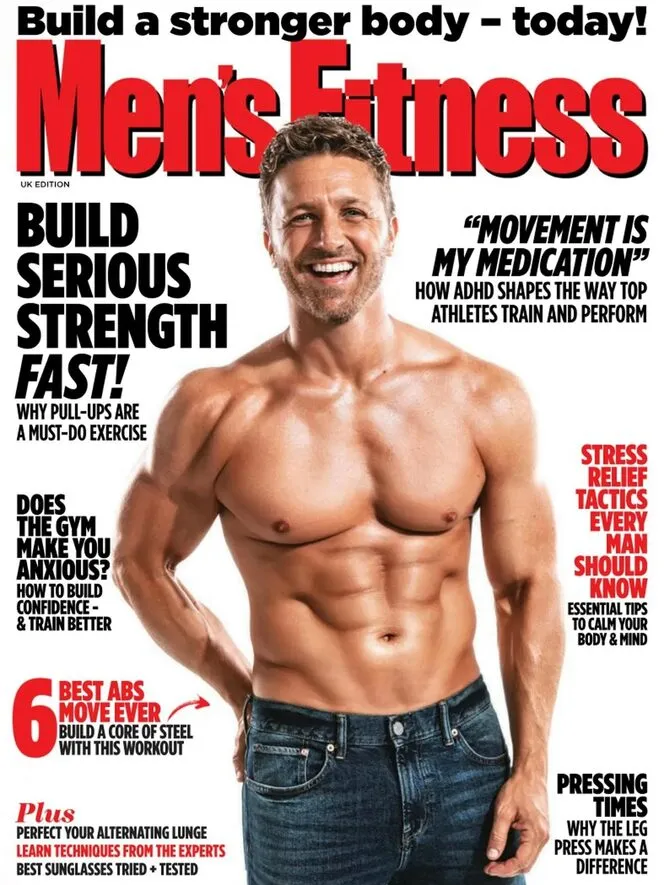
Cover and issue data verified: Issue 314, June 2026 (also labelled Men's Fitness Guides Issue 62 on the file), editor-in-chief David Castle. Cover lines include "BUILD SERIOUS STRENGTH FAST!", "WHY PULL-UPS ARE A MUST-DO EXERCISE", "DOES THE GYM MAKE YOU ANXIOUS? HOW TO BUILD CONFIDENCE – & TRAIN BETTER", "BEST ABS MOVE EVER", "MOVEMENT IS MY MEDICATION: HOW ADHD SHAPES THE WAY TOP ATHLETES TRAIN AND PERFORM", "STRESS RELIEF TACTICS EVERY MAN SHOULD KNOW". Confirmed features: Do You Have Gym Anxiety? (p.34), Gary Brecka on genetic data and ageing (p.38), Find Your Inner Jedi with UK sports experts (p.44), Playing to Different Strengths on neurodiversity (p.50), Stress Relief Tactics (p.54). Updates cover joint health as movement is medicine (p.07), weighted-vest calorie burn (p.08), cold-plunge study (p.10), intentional intensity (p.12), micro workouts with Alfonso Moretti (p.14), walking pace vs step count (p.16). Perfect Fit tests Circular Ring 2 with ECG (p.25) and fitness sunglasses (p.28). Fuel covers the Japanese eating habit for longevity (p.61), gut microbiome foods with Toral Shah (p.62), and nutrient-dense meals from The Low Appetite Cookbook (p.66). Trainer section covers meditation rewiring the brain in 7 days (p.71), leg press for lower-body strength (p.72), 6 best ab exercises (p.76), balancing exercises (p.84), pull-up strength guide (p.88), full-body mobility flow (p.96).
—————
Content Guide
▸ In Focus
p.34 · Do You Have Gym Anxiety?
How to walk into a gym with confidence and train without self-doubt. The feature identifies the three most common anxiety triggers — equipment unfamiliarity, social comparison, not knowing a programme — and prescribes a specific pre-gym routine for each. Arrive with a written session plan every time; the article's data shows that programming uncertainty is the number one driver of gym avoidance.
p.38 · "Genetics Loads the Gun, Lifestyle Pulls the Trigger"
Gary Brecka explains how understanding your genetic data can help you control the way you age. He walks through specific SNP markers for inflammation, nutrient metabolism and recovery, and explains which lifestyle interventions counter each one. Order a direct-to-consumer genetic test and cross-reference your SNP results with Brecka's intervention table in this feature.
p.44 · Find Your Inner Jedi
Experts from some of the UK's most popular sports explain how to tap into a focused, flow-state mindset. Each sport — tennis, golf, climbing, football — contributes a specific mental cue that triggers concentration. Pick one cue from the sport you play least; the novelty forces your brain into active focus rather than autopilot.
p.50 · Playing to Different Strengths
More athletes are opening up about neurodiversity and how it shapes the way they train and compete. The article profiles ADHD, dyslexia and autistic athletes who have adapted training methods to suit their cognitive wiring. If you struggle with routine adherence, schedule variety rather than consistency — the neurodiversity research in this piece supports novelty as a motivation driver.
p.54 · The New Stress Relief Tactics Every Man Should Know
Tactical breathing, progressive muscle relaxation and a third method the article calls "cognitive shifting" are presented with step-by-step protocols. Each tactic includes a physiological explanation — heart-rate variability data, cortisol reduction timelines — so you know why it works. Practise cognitive shifting for 90 seconds at the first sign of frustration; the article's HRV data shows that window is critical.
▸ Updates
p.08 · Vested Interest
Wearing a weighted vest can help you burn more calories faster. The article reviews the research on load carriage, metabolic cost and joint impact, with specific weight recommendations for different fitness levels. Start at 5% of body weight for walking and 10% for bodyweight exercises — exceeding those loads changes gait mechanics, per the gait-analysis data cited here.
p.12 · Intentional Intensity
Stopping 2-3 reps before muscle failure can build muscle with quicker recovery than training to absolute failure every set. The feature presents the emerging evidence for "repetitions in reserve" as a programming tool. Use an RIR of 2 for compound lifts and RIR 1 for isolation work — the recovery differential between those zones is backed by the EMG data in this article.
p.16 · Forget 10,000 Steps, Walk Faster Instead
New research suggests walking pace, not step count, is the real driver of health outcomes and longevity. The article cites studies showing that brisk walkers have lower all-cause mortality regardless of total daily steps. Aim for a pace at which singing becomes impossible but conversation remains manageable — that intensity corresponds to 4-6 km/h for most adults.
▸ Fuel
p.61 · The Food Hack That's Big in Japan
A simple Japanese eating habit — hara hachi bu, eating until 80% full — could help you live longer without formal dieting. The feature explains the caloric-restriction science behind the practice and how to adopt it without counting calories. Use a smaller plate and pause for 60 seconds halfway through the meal; the satiety-signal delay is approximately 20 minutes, which the 80% rule accounts for.
p.62 · Foods That Shift Gut Balance
Nutritional scientist Toral Shah reveals how to eat to keep your microbiome balanced. She identifies three food groups that promote beneficial bacteria and two that disrupt diversity. Add one fermented food per day for 14 days and log any changes in digestion, energy and skin — the microbiome adaptation timeline cited here is two weeks.
—————
Editor's Take
Issue 314 is the most psychologically-minded Men's Fitness issue this year. The gym-anxiety feature (p.34) names a problem most fitness magazines ignore and gives concrete pre-gym routines rather than "just be confident." The Gary Brecka interview (p.38) is dense but rewarding — it assumes the reader can handle genetic terminology. The weighted-vest piece (p.08) is a rare example of an equipment article that cites actual load-metabolism studies. Weakest section: the fitness sunglasses test (p.28) rates six pairs that all cost over £100; a budget option comparison would have made it useful to more readers. The "inner Jedi" piece (p.44) overpromises — it offers mental cues rather than a training system. This issue is for the lifter who has the basics but struggles with consistency and self-doubt, not for the absolute beginner.
Strengths
• Gym-anxiety feature with actionable pre-gym routines
• Gary Brecka interview with specific SNP-to-intervention mapping
• Walking-pace article backed by mortality data, not step-count dogma
Weaknesses
• Fitness sunglasses test lacks a budget-price option
• "Inner Jedi" piece is too vague to produce measurable change
Verdict: Recommended — One of the few fitness magazines that addresses the mental barrier as seriously as the physical one.
