
Air Space Forces – May-June 2026
Summary
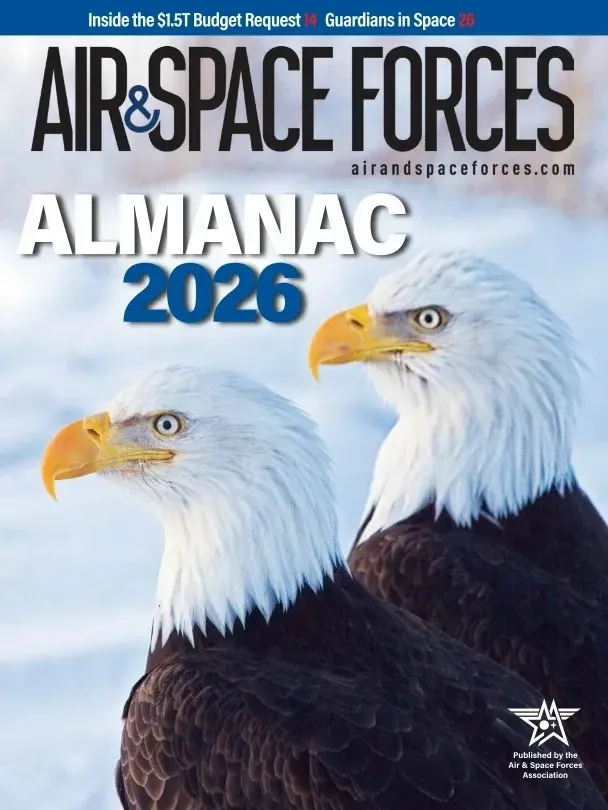
Military human spaceflight as the key to US space superiority opens Air and Space Forces May-June 2026, anchored by the annual Air and Space Forces Almanac spanning 140 pages of personnel, spending, equipment, installations, and weapons data. Editor Tobias Naegele's editorial "Go Big on Airpower" calls for rebuilding the fighter fleet after decades of under-investment.
Colonel Kyle Pumroy (Ret.) argues in the cover feature (p.26) that military personnel in space provide the decision-speed advantage over fully automated systems. The 2026 Almanac (p.32-172) includes structure charts, personnel numbers by rank and career field, pay tables for 2026, rank insignia of all six armed forces, and awards and decorations. The spending section breaks down the USD 1.5 trillion defence budget across services. Equipment inventories list every active aircraft, missile, and space system in the USAF and USSF inventory. Active duty wings are listed with their locations, commanders, and primary weapon systems. The Space Force section covers the Space Operations Command, Space Systems Command, and Space Training and Readiness Command, with all satellite constellations by orbit. Installations include every USAF and USSF base globally with runway data and unit assignments.
AFA in Action (p.174) launches the "Salute to Space" tradition. Heroes/Leaders profiles General Daniel "Chappie" James, the first African-American four-star general.
—————
Content Guide
▸ Cover Feature
p.26 · Military Human Spaceflight is Key to U.S. Space Superiority
Colonel Kyle Pumroy (Ret.) argues that automated and remote-controlled space systems lack the decision-speed advantage of a human in orbit. He proposes a crewed spaceplane operating from a commercial space station as the next logical step after the X-37B. The response-time comparison chart shows that a human operator on orbit can respond to a threat in under 30 seconds while a ground-based operator communicating through a relay satellite requires 3 to 5 minutes.
▸ Almanac 2026
p.34 · Structure
The USAF and USSF organisational hierarchy is presented with command relationships from the Secretary to the major commands. The chart shows that Air Combat Command controls 60 percent of the fighter force while Air Force Global Strike Command controls all bomber and ICBM forces.
p.36 · Personnel
Active duty personnel by rank, component, and career field are tabulated. The table shows the USAF at 320,000 active duty, 70,000 Reserve, and 105,000 Air National Guard — the smallest total force since 1947. The pilot-shortfall line shows a deficit of 2,100 fighter pilots against authorised billets.
p.52 · Spending
The USD 1.5 trillion defence budget is broken down by service: USD 550 billion Air Force, USD 200 billion Space Force, USD 500 billion Navy, and USD 250 billion Army. The procurement-spending table shows the F-35 programme at USD 12 billion for 60 aircraft in 2026. The table includes the five-year projection showing procurement peaking in 2028.
p.56 · Equipment
Every active USAF and USSF weapon system is listed by type: 140 bombers (B-52H, B-1B, B-2A), 900 fighters (F-35A, F-22, F-15E, F-16C), 350 tankers (KC-135, KC-46A, KC-10A), and 200 space vehicles. The age-of-fleet table shows the B-52H average age at 63 years — the oldest combat aircraft in any air force.
p.74 · Active Duty Wings
All 144 active duty wings are listed with their home base, commander, and primary aircraft. The basing map shows the concentration of fighter wings at 12 installations in the Southeastern US, creating a vulnerability to a single hurricane strike.
p.90 · U.S. Space Force
The USSF organisation covers the Space Operations Command (SpOC), Space Systems Command (SSC), and Space Training and Readiness Command (STARCOM). The satellite constellation table lists GPS III, SBIRS, AEHF, and the new Space Development Agency transport and tracking layers. The orbit diagram shows LEO, MEO, GEO, and cislunar space assets with their coverage footprints.
p.116 · Weapons and Platforms
Technical specifications — length, speed, ceiling, range, weapons load — for every aircraft and missile system in the inventory are presented in standardised format. The F-35A entry shows a maximum speed of Mach 1.6, combat radius of 670 nautical miles, and payload of 18,000 pounds across four internal and six external stations.
p.160 · Space Systems
Satellite constellations are listed by orbit and mission: 31 GPS III satellites in MEO, 6 SBIRS satellites in GEO, 5 AEHF satellites in GEO, and the new SDA tranche 0 comprising 28 transport and 8 tracking satellites in LEO. The launch-manifest table projects 186 launches in 2026, rising to 300 by 2030.
▸ Departments
p.2 · Editorial: Go Big on Airpower
Tobias Naegele argues that the Air Force's share of the defence budget has shrunk from 35 percent in 1990 to 27 percent in 2026, while its operational demands have grown. He calls for multi-year procurement of F-35s and F-15EX at rates above 80 per year. The procurement-history chart shows that the USAF has bought fewer than 50 fighters annually for the past decade.
p.174 · AFA in Action: Salute to Space
The Air and Space Forces Association launches its annual "Salute to Space" programme honouring USSF personnel and commercial space partners. The inaugural event at the National Space Council features the naming of the first Guardian of the Year award.
—————
Editor's Take
Air and Space Forces May-June 2026 is indispensable for its annual Almanac — 140 pages of data that no other single source aggregates. The fighter-pilot shortfall and B-52H age data alone make this a reference issue. Weakest parts: the cover feature on military human spaceflight argues a position the Space Force has already rejected — no current programme of record supports a crewed spaceplane. The "Go Big on Airpower" editorial repeats arguments from the previous three issues without new data. This issue suits the defence analyst, the Congressional appropriations staffer, and the wargame scenario builder who needs the Almanac tables.
Strengths
• 140-page annual Almanac with personnel, spending, equipment data
• B-52H fleet average age at 63 years
• Fighter-pilot shortfall of 2,100 against authorised billets
Weaknesses
• Spaceflight feature argues against current Space Force policy
• Editorial repeats prior-issue arguments without fresh data
Verdict: Essential — The Almanac makes this a reference issue for any defence professional.
