
Astronomy Now – October 2026
Summary
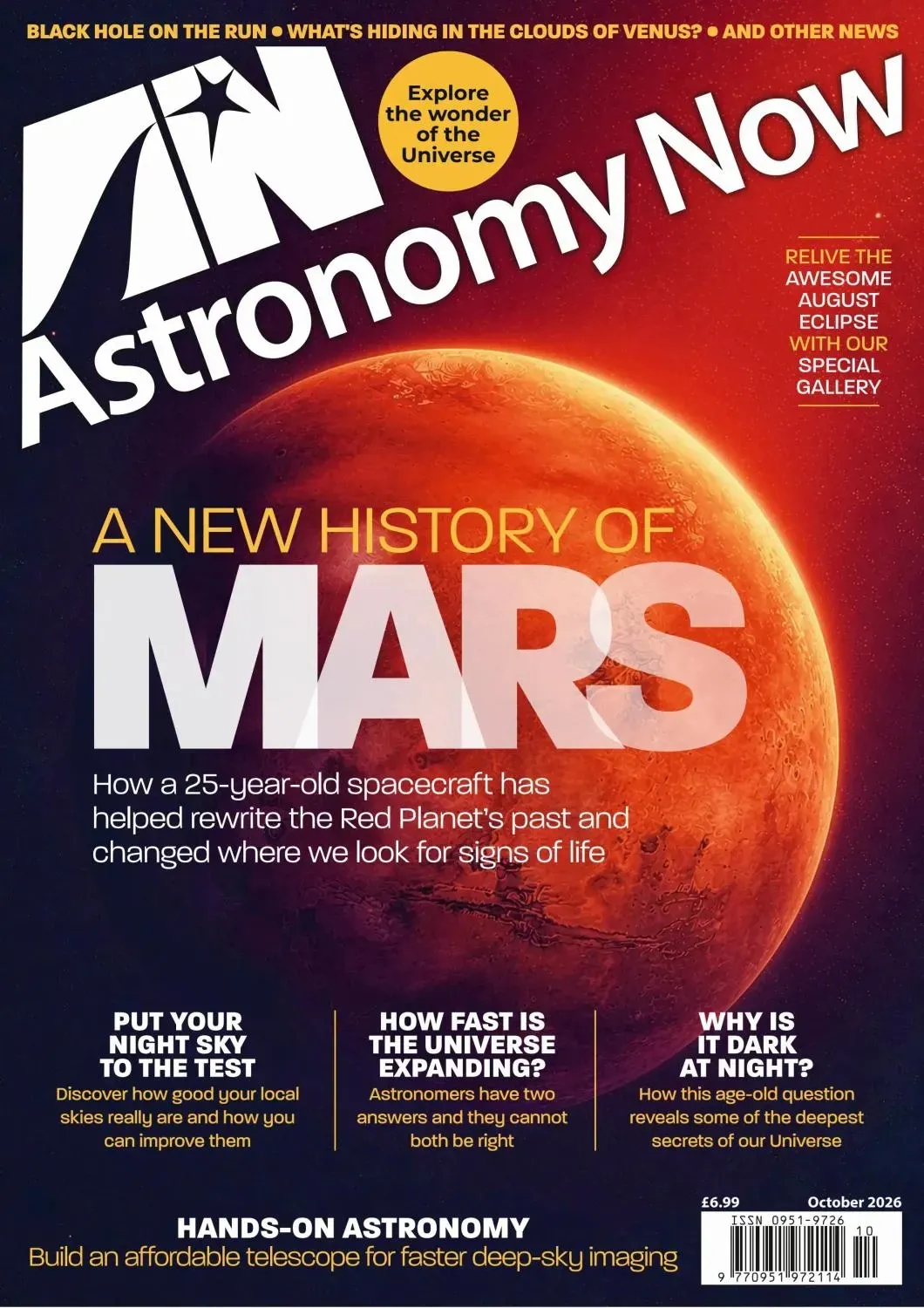
A 150 mm Newtonian becomes a fast f/3.45 deep-sky imager for under £500 in Astronomy Now October 2026, while repeated water epochs on Mars rewrite the Red Planet's habitability story and a citizen-science guide targets local light pollution.
This issue leads with The new history of the Red Planet (p.24), where repeated surface-water episodes challenge long-held assumptions about Martian climate. Stuart Clark's team tackles the Hubble tension in The trouble with precision cosmology (p.32), laying out why cosmologists still cannot agree on the Universe's expansion rate. Peter Mugridge's practical light-pollution guide (p.42) gives suburban observers a street-level action plan. Kevin Reid's budget astrophotography build (p.74) proves deep-sky imaging does not require a four-figure budget. The August eclipse gallery (p.20) collects reader-submitted shots from around the UK.
Regulars include Tom McCrorie's Digital Astronomer column on app-assisted observing, Nik Szymanek's galaxy-imaging masterclass, Colin Stuart's The big question answering why the night sky is dark, and a Society profile of Chester Astronomical Society. News pages cover a runaway black-hole trajectory, Venus cloud anomalies, and the Nancy Grace Roman Telescope launch countdown. The issue closes with a reader gallery, weather outlook, and event listings including Herstmonceux Observatory's railing fund.
—————
Content Guide
▸ Cover Story
p.24 · The new history of the Red Planet
Repeated epochs of surface water on Mars are forcing scientists to rethink everything about the planet's climate history and its capacity to support life. Steve Kelly's cover image sets the tone for a feature that draws on the latest orbiter and rover data to build a timeline of wet-dry cycles stretching back billions of years. Each wet period may have lasted long enough for microbial life to gain a foothold. Check the feature's timeline graphic before your next Mars-news debate — it puts each rover discovery in sequence.
▸ Features
p.20 · Eclipse Gallery
A full spread of reader-submitted images from the August 2026 solar eclipse, captured across the UK. The collection shows the partial phases through cloud breaks and, from a few lucky locations, a clear corona. Compare the exposures and filters used — three readers achieved crisp inner corona detail with nothing more than a DSLR and a 200 mm lens.
p.32 · The trouble with precision cosmology
Measurements of the Hubble constant from different methods still refuse to agree, and that gap now exceeds 5-sigma significance. Stuart Clark walks through the Planck satellite's CMB-based value versus the local distance-ladder measurement from SH0ES, explaining why the mismatch may signal new physics rather than a measurement error. Use the sidebar table to compare the six major data sets at a glance.
p.42 · How dark is your sky and what can you do about it?
Peter Mugridge shifts the light-pollution conversation from complaint to action, with a step-by-step guide to measuring your local sky brightness and lobbying your council for better street-lighting ordinances. He recommends the Globe at Night citizen-science programme as a free starting tool. One hour of data collection per month is enough to build a credible case for your local authority.
p.74 · A fast telephone on a budget
Kevin Reid converted a standard 150 mm Newtonian into a fast f/3.45 deep-sky imager for under £500, using off-the-shelf parts and a simple coma corrector. The article includes a full parts list, cost breakdown, and before-and-after comparison images of the same galaxy. Anyone with basic workshop skills can replicate the build in a weekend.
▸ Regulars
p.48 · The big question: Why is the night sky dark?
Colin Stuart tackles Olbers' paradox with a clear explanation: the Universe's finite age and the redshift of distant starlight combine to keep the sky dark. He walks through the reasoning without a single equation, making the argument accessible to a teenager. Read this before your next school outreach session — it answers the question children ask most often.
p.83 · Digital Astronomer
Tom McCrorie reviews the latest planetarium apps for tablet and phone, with a focus on real-time push-to capabilities for Dobsonian owners. He tests three free apps against a £200 handset and finds the gap is closing fast. Download SkySafari 7 before your next observing night and pair it with a Wi-Fi encoders kit.
p.87 · Imaging masterclass
Nik Szymanek demonstrates a three-layer processing workflow for galaxy images that preserves faint outer halo detail without burning out the core. He uses PixInsight's dynamic crop and masks, showing each step on a single M81 frame. The session can be paused at any stage, making it suitable for intermediate imagers who learn by doing.
▸ News & Events
p.8 · News
A supermassive black hole ejected from its host galaxy at 8 million km/h leads the news section, alongside tentative spectroscopic hints of phosphine in Venus' cloud deck. The Nancy Grace Roman Telescope launch countdown passes the 6-month mark. Each news item includes a reference to the original paper or NASA press release for follow-up reading.
—————
Editor's Take
Astronomy Now October 2026 delivers its strongest feature lineup of the year. The Mars water-history piece and the Hubble-tension explainer offer genuine context for anyone who follows space news without a PhD. The budget astrophotography build is a rare piece of practical engineering that a motivated amateur can execute. Weakest parts: the Eclipse Gallery, while beautiful, is mostly filler — eight pages of reader images with minimal editorial annotation. And the Big Question piece, though well written, rehashes a topic covered in almost every入门 astronomy title of the past decade. This issue best suits the active observer who wants both sky-news context and a weekend project.
Strengths
• Budget f/3.45 Newtonian build with full parts list
• Mars water-history timeline based on latest rover data
• Citizen-science light-pollution action plan
Weaknesses
• Eclipse Gallery lacks editorial depth across 8 pages
• "Why is the night sky dark?" covers well-trodden ground
Verdict: Recommended — Best for the amateur who builds, measures, and observes rather than just reads.
