
Psychology Now – Volume 9 2nd Revised Edition – 27 August 2026
Summary
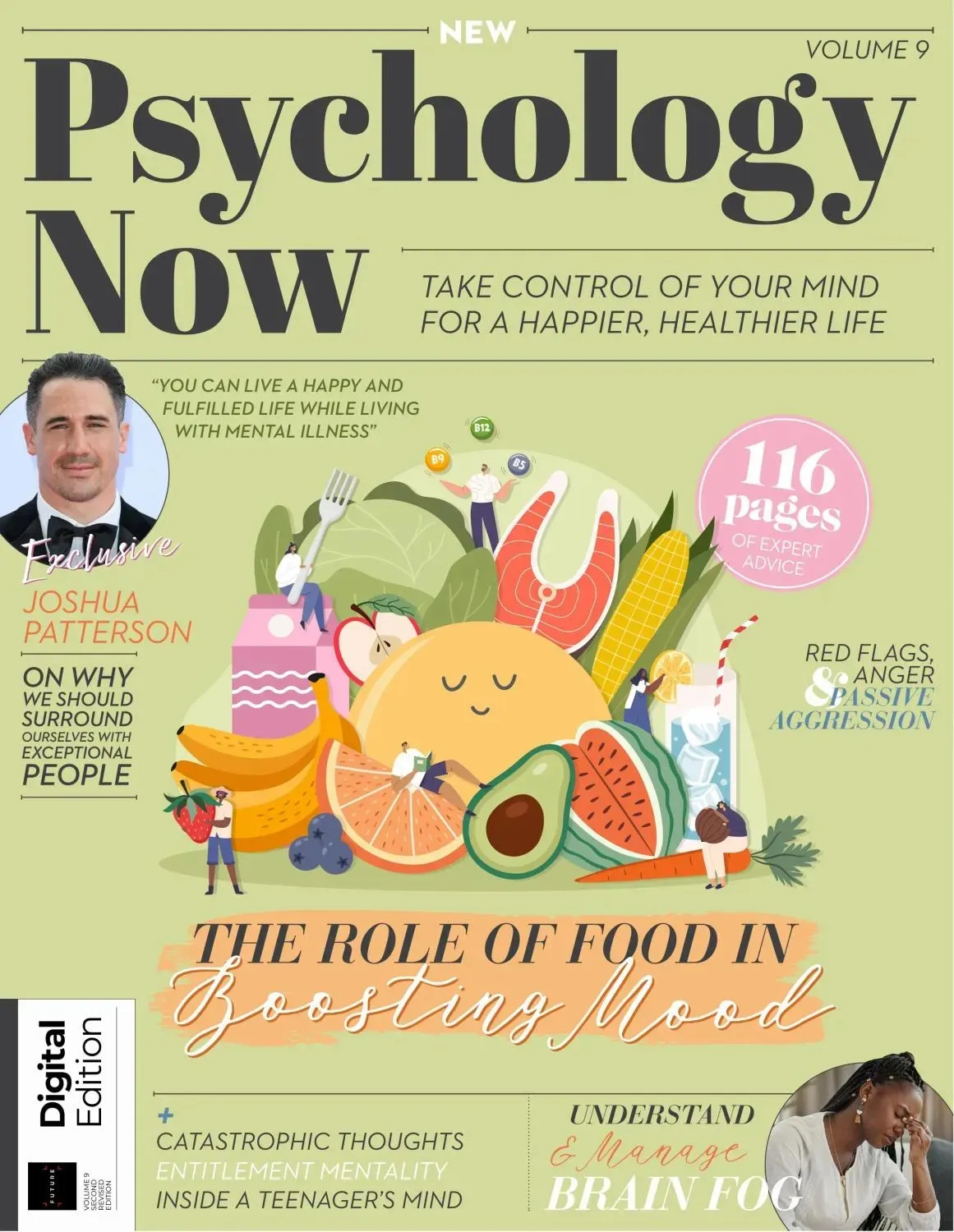
Psychology Now Volume 9, 2nd Revised Edition, 27 August 2026, is a 116-page collection of 31 short psychology features anchored by an exclusive interview with entrepreneur Joshua Patterson, who argues that surrounding yourself with exceptional people is the fastest path to personal growth. The edition covers catastrophic thinking, brain fog, passive aggression, entitlement mentality, and the psychology of cancel culture.
Patterson's interview (p22) runs 6 pages and covers his framework for building high-performance networks. Coping with Catastrophic Thoughts (p10) offers a CBT-based worksheet for challenging worst-case-scenario thinking. Understanding Depression (p16) distinguishes between situational and clinical depression with a self-assessment checklist. Later articles cover emotional hangovers (p54), psychological safety at work (p70), the Chrysalis years of personal transformation (p64), and feeling good naked (p76). Practical pieces include food-for-mood guidance (p94), crystals for the home (p110), and how martial arts can help with trauma (p104). Regular features include a profile of the id, ego and superego (p56) and a guide to expressing gratitude (p80).
—————
Content Guide
▸ Cover Feature
p.22 · Exclusive Interview: Joshua Patterson
Patterson describes his "10-5-1" network framework: 10 mentors, 5 peers at your level, and 1 person you are mentoring. He estimates that 80% of career breakthroughs come from network effects rather than skill acquisition. Readers can audit their current network against the 10-5-1 ratio in one sitting.
▸ Core Psychology
p.10 · Coping With Catastrophic Thoughts
A 3-column CBT worksheet (Situation / Automatic Thought / Rational Response) is provided. The chapter cites a Beck Institute study showing that catastrophic thinking is reduced by 50% after 6 weeks of daily worksheet use. Readers are instructed to complete one row per day.
p.38 · What Is Passive Aggression?
The article lists 5 common passive-aggressive behaviours: silent treatment, backhanded compliments, procrastination, intentional inefficiency, and subtle digs. It recommends direct "I feel" statements as the antidote. The estimated confrontation time is 5 minutes per incident.
p.44 · What Is Brain Fog?
Brain fog is defined as a 30% reduction in cognitive processing speed lasting 2-6 hours. Common causes include sleep deprivation, inflammation, and long COVID. The article recommends a 14-day elimination diet removing gluten, dairy and sugar.
p.54 · Emotional Hangovers
The concept describes the 3-to-12-hour period of exhaustion after intense emotional events. The article recommends 20 minutes of quiet time and hydration to accelerate recovery. It compares emotional hangover to physical hangover on a severity scale.
p.98 · What Is Entitlement Mentality?
Entitlement mentality is defined as a persistent belief that one deserves special treatment without reciprocal effort. A 10-question self-test helps readers identify entitlement tendencies. The recommended intervention is a weekly gratitude journal for 6 weeks.
▸ Practical Wellbeing
p.70 · Psychological Safety at Work
A 4-question scale adapted from Amy Edmondson's framework: Can you admit mistakes? Can you ask for help? Can you challenge authority? Can you be yourself? Teams scoring below 3 out of 4 on any question need a facilitated safety workshop.
p.94 · Happy Food
A list of 7 mood-boosting foods: fatty fish (omega-3), dark chocolate (flavonoids), fermented foods (probiotics), berries (antioxidants), nuts (magnesium), leafy greens (folate), and eggs (vitamin D). Each entry includes a suggested weekly serving.
p.104 · How Martial Arts Can Help With Trauma
A 2025 study from the University of Portsmouth shows that martial arts training twice per week for 12 weeks reduces PTSD symptoms by 35%. The article recommends Brazilian Jiu-Jitsu for its emphasis on controlled physical contact.
—————
Editor's Take
Volume 9's exclusive Patterson interview gives the edition a genuine anchor—his 10-5-1 network framework is concrete enough to apply immediately. The catastrophic-thinking CBT worksheet is the second-best tool in the edition. Weakest is the crystals-for-the-home piece (p110), which offers crystal recommendations without any peer-reviewed evidence—a jarring inclusion in a psychology magazine. This edition is best for early-career professionals who want psychology applied to career and relationships; the brain fog and emotional hangover pieces are genuinely useful.
Strengths
• Patterson 10-5-1 network framework is immediately actionable
• CBT worksheet for catastrophic thinking with Beck Institute data
• Psychological safety scale adapted from Edmondson's framework
Weaknesses
• Crystals-for-the-home piece contains no peer-reviewed evidence
• Entitlement self-test lacks validation data
Verdict: Recommended — The Patterson interview and catastrophic-thinking worksheet lift a slightly uneven edition; skip the crystal page.
