
Australian Photography – August-September 2026
Summary
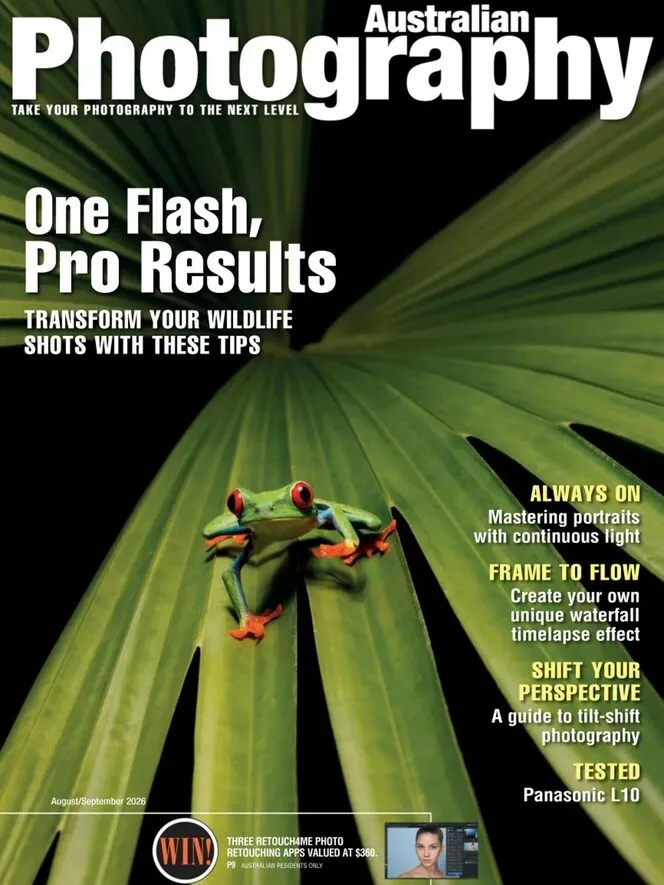
A red-eyed tree frog on a Panama Hat Palm leaf — shot handheld with a single off-camera flash — opens Australian Photography August-September 2026, with Greg Basco demonstrating what one speedlight can do across portraits, macro and natural-looking scenes.
Australian Photography August-September 2026 leads with Greg Basco's cover and feature on single-flash photography. Thomas Ryan of Tasmania explains tilt-shift lenses and getting perspective right in-camera. Anthony McKee looks at the benefits of continuous lighting for hybrid photo and video work. Yan Zhang breaks down a Photoshop technique for simulating waterfall motion using a timelapse stacking method. Tim Robinson reviews the Panasonic Lumix L10, the compact targeting the Fujifilm X100 market. Mike O'Connor's editor letter reflects on balance in photography, drawing on Eliot Porter's intimate landscapes and comparing them to Mark Rothko's painterly approach. Behind the Lens features Dr Andrew Peacock on a favourite shot from the Graian Alps. Image Doctor has Anthony McKee breaking down six reader images with specific improvement notes.
—————
Content Guide
Features
p.14 · What Can You Do With Just One Flash?
Greg Basco demonstrates how a single speedlight can be shaped, bounced and modified for everything from dramatic portraits to soft natural-looking scenes. He names the specific modifier that gives the most natural light for under $50. Any photographer with one flash should test his three-light-pattern exercise.
p.22 · Tilt-Shift Lenses: Seeing the World Without Fixing It Later
Tasmania's Thomas Ryan explains how tilt-shift lenses correct perspective distortion at the shooting stage rather than in post. He covers architectural and landscape applications. The specific lens he recommends for Canon users is named with its current Australian retail price.
p.30 · Going Constant
Anthony McKee on the benefits of continuous lighting over flash for hybrid shooters working in both photo and video. He compares colour temperature consistency across brands and names the LED panel that balances best for under $200.
p.36 · Photoshop Tutorial: Making a Waterfall With a Timelapse Technique
Yan Zhang breaks down a creative approach to simulating flowing water motion. The technique uses multiple frames from a timelapse sequence blended in Photoshop. The specific blend mode (Lighten) and layer mask workflow are step-by-step replicable.
p.40 · Tested: Panasonic Lumix L10
Tim Robinson reviews the Panasonic Lumix L10, the compact camera positioned against the Fujifilm X100 series. The review covers autofocus speed, lens sharpness and JPEG colour rendering. The verdict includes a direct comparison to the Fujifilm X100 VI.
Departments
p.6 · Behind the Lens
Dr Andrew Peacock on the making of one of his favourite images from the Graian Alps in northwestern Italy. He names the exact location (Gran Paradiso National Park) and the time of day that produced the light.
p.8 · Your Best Shot
Best images from the 'soft light' photo competition. The winning entry and gear settings are listed alongside judge comments.
p.46 · Image Doctor
Anthony McKee breaks down six reader-submitted images with specific corrections on exposure, composition and colour balance. The before-and-after adjustment steps are numbered for easy reproduction.
—————
Editor's Take
The single-flash feature (Basco) is exactly what a practical photo magazine should deliver: one constraint, multiple setups, and a specific modifier recommendation with a price point. The tilt-shift article (Ryan) fills a genuine gap — most photo magazines treat perspective correction as a post-production topic rather than an in-camera technique. The Lumix L10 review is timely and direct, with a clear comparison to the X100 VI that helps buyers decide. Weaknesses: the waterfall Photoshop tutorial is technically sound but the result is niche — most readers will not assemble a timelapse sequence just to simulate motion in one waterfall shot. The Behind the Lens Alps feature runs only one page and leaves the reader wanting a fuller travel narrative. Your Best Shot judge comments could be more technically specific.
Strengths
• Single-flash feature with specific sub-$50 modifier recommendation
• Tilt-shift lens article fills a technical education gap
• Panasonic Lumix L10 review with direct Fujifilm X100 VI comparison
Weaknesses
• Waterfall Photoshop tutorial is niche for most readers
• Behind the Lens Alps feature is one page, too short
Verdict: Recommended — The single-flash guide alone is worth the cover price for any photographer building a minimalist kit.
