
BBC Sky at Night – August 2026
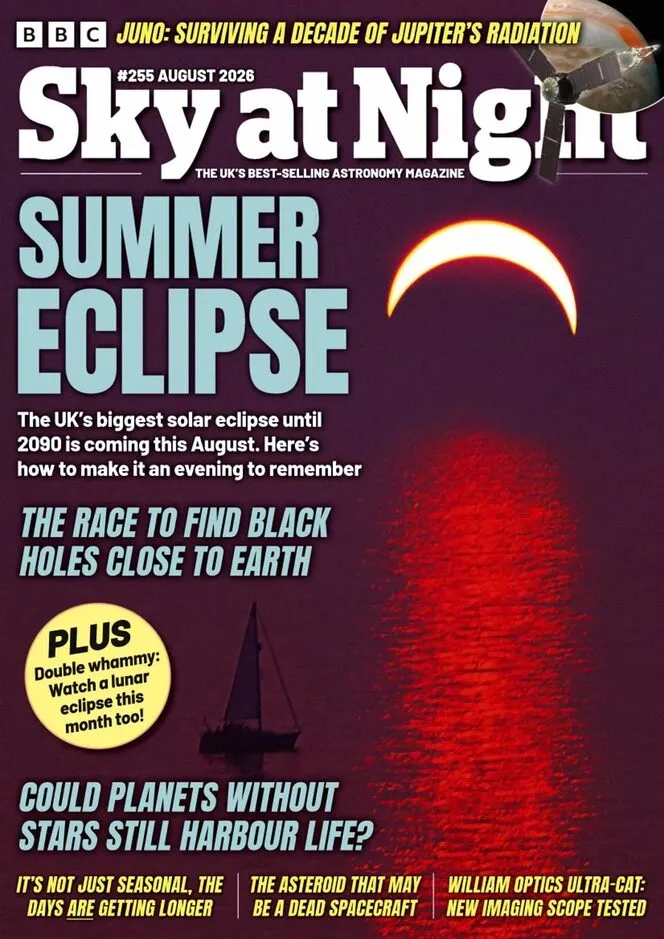
Summary
The UK's biggest solar eclipse until 2090 is coming on 12 August 2026 and BBC Sky at Night August 2026 provides the complete viewing guide from 18:00 to 20:15 BST. The issue also covers rogue worlds without stars Earth's slowing rotation and the closest black holes to our planet.
Jamie Carter delivers the eclipse feature explaining exactly how to see the rare near-total eclipse at sunset on 12 August including how to watch the Perseid meteor shower on the same night. Keith Cooper investigates rogue worlds discovering why they exist unmoored from stars and whether there could be more rogue worlds in the Milky Way than planets orbiting stars. Earth is slowing down explains why days are getting longer with the geological data behind the change. The closest black holes feature identifies Gaia BH1 at 1,560 light-years away as the nearest known. Juno's decade at Jupiter reveals the secrets of the king of the planets including the Great Red Spot extending 320 kilometres down. The issue includes a 16-page centre pullout Sky Guide for August.
—————
Content Guide
▸ Cover Story
p.28 · The UK's Great Solar Eclipse
Jamie Carter explains exactly how to see the rare near-total eclipse at sunset on 12 August. The article provides the path of totality from near the North Pole through Greenland past western Iceland across the Atlantic and to Spain. The timing from 18:00 to 20:15 BST is given. The Perseid meteor shower peaks the same night creating a celestial double-feature. Clear skies conditions at the southern end of the track are described.
▸ Features
p.34 · Rogue Worlds
Keith Cooper investigates the latest research into planets without stars. The article explains how they become unmoored from their parent systems. The number of rogue worlds in the Milky Way is estimated and could exceed the number of stars. The possibility of life on such worlds is explored.
p.40 · Earth Is Slowing Down
The geological and astronomical evidence for Earth's slowing rotation is presented. The article identifies the tidal forces from the Moon as the primary cause. The specific rate of deceleration is quantified in milliseconds per century.
p.60 · Earth's Closest Black Holes
Colossal gravitational sinkholes exist right on our cosmic doorstep. The article identifies Gaia BH1 at 1,560 light-years away as the closest known black hole. The detection method through the wobble of its Sun-like companion star is explained. The difference between stellar-mass supermassive and intermediate-mass black holes is described.
p.66 · A Decade at Jupiter
How Juno revealed the secrets of the king of the planets. The article describes the Great Red Spot extending 320 kilometres down with windspeeds reaching 500 km/h. The specific discoveries Juno made about Jupiter's composition and magnetic field are listed.
▸ Skills for Stargazers
p.74 · Create a Deep-Sky Mosaic
Practical guide to assembling multiple exposures into a single wide-field astrophoto. The equipment and software required are named. The step-by-step process is explained.
▸ Reviews
p.86 · William Optics Ultra-Cat 108 WIFD
A review of this f/4.8 Petzval refractor. The optical performance and build quality are assessed. The price point and target user are identified.
p.90 · ZWO AM7 Harmonic Drive Mount
Review of the latest harmonic drive mount. The payload capacity and tracking accuracy are measured. The mount's suitability for portable astrophotography is evaluated.
—————
Editor's Take
The solar eclipse coverage makes this a must-have issue for any UK-based observer with exact timings and location data. The Juno decade feature with the Great Red Spot depth and wind-speed data provides the best non-eclipse content. The rogue worlds piece by Cooper offers a genuinely thought-provoking angle on planetary science. The mount and telescope reviews serve the equipment buyer but take up significant space. This issue is essential for anyone planning to observe the 12 August eclipse.
Strengths
• Solar eclipse guide with exact timings for the UK event
• Juno decade feature with Great Red Spot depth and wind-speed data
• Perseids-eclipse double-feature coverage is a smart editorial choice
Weaknesses
• Equipment reviews consume disproportionate space
• Rogue worlds conclusion speculative beyond current data
Verdict: Essential — indispensable for the UK eclipse with strong supporting features.
