
BBC Wildlife – Spring 2026
Summary
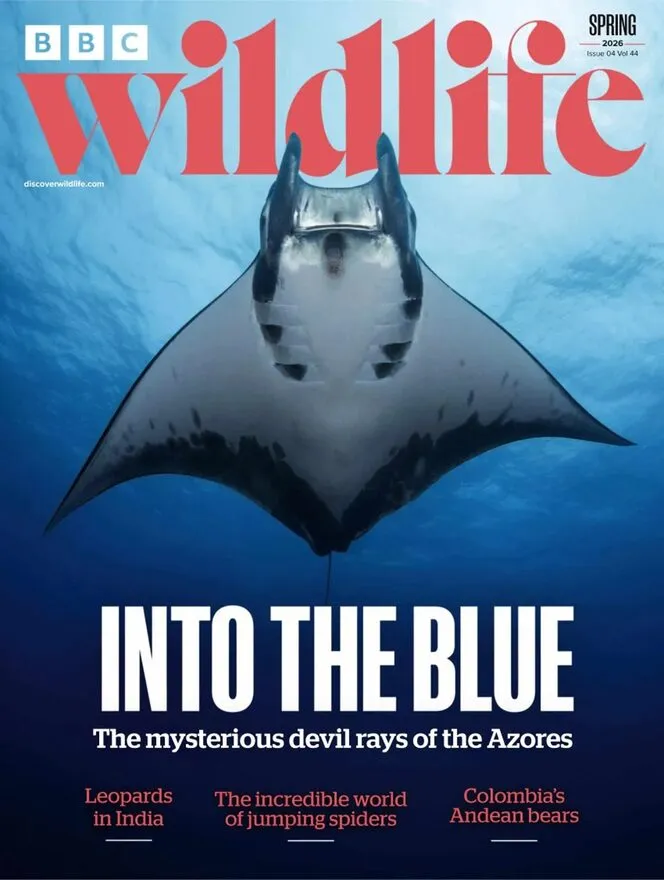
Sicklefin devil rays uplisted to CITES Appendix I in November 2025 anchor BBC Wildlife Spring 2026's cover, leading an issue that tracks moor frog courtship in the Netherlands, Rajasthani leopards in the Aravalli Hills, necrobiome work across the Southern Ocean, and Andean bears in Chingaza. Issue 04, Vol 44.
Marine biologist Pipa turns an April-dive hunch about the sicklefin devil ray's belly markings into a 339-individual photo-ID catalogue off the Azores. Her photography-led database is now the backbone of Manta Catalog Azores and underpins the IUCN's October 2025 Critically Endangered reassessment. We follow her from the Ambrosio seamount – where photographer Jasmine Corbett captured this issue's cover image – through to CITES CoP20, where delegates voted unanimously in late 2025 to grant all manta and devil rays the highest level of international trade protection.
Travel-writing strengths carry the rest of the magazine. Andy Rouse trails Bera's 14,000 Indian leopards across the granite Aravalli Hills with guide Harshpal Singh, working 200m back to avoid disturbing mothers and three-month-old cubs. Manuel Fonseca and Sebastian Di Domenico chase Andean bears at 3,600m inside Chingaza National Natural Park – where the 'gardeners of the forest' now pull in ecotourism instead of revenge killings. The issue also delivers a Mike Dilger mating-moor-frogs dispatch, a five-toed worm-lizard trek with Nick Baker in Baja, and James O'Hanlon's eight-legged wonders.
Wild Times news stays grim: a Kyoto University study finds Jigokudani snow monkeys' hot-spring bathing shifts their gut microbiome, and mother jaguars have now been recorded meowing to cubs in Iguacu National Park. The Special Report on avian flu makes the heavier reading – an estimated 50,000 southern elephant seal females died on South Georgia between 2022 and 2024, while 76 per cent of British great skuas had been killed by HPAI by 2023.
—————
Content Guide
▸ Cover Story
p.50 · Devils and the deep blue sea
Marine biologist Pipa has been photo-identifying sicklefin devil rays off the Azores since 2012. The 339 individuals in her Manta Catalog Azores database underpin the IUCN's October 2025 reassessment as Critically Endangered, and the CITES CoP20 vote in November 2025 to list all manta and devil rays under Appendix I. Read for the science, then dive responsibly with the published Manta Trust codes of conduct.
▸ Wildlife
p.36 · Lair of the shadow cat
Andy Rouse and local guide Harshpal Singh lead a portfolio through the Aravalli Hills around Bera, Rajasthan, working 200m back to avoid disturbing mothers and three-month-old cubs. India's government estimate puts leopard numbers at almost 14,000 – a stable figure that hides how rabbits, langurs and feral dogs feature in the diet. Takeaway: book a Bera trip for the April-June window and check the Rabari herders' tolerance policy before going.
p.20 · Wild Spring
Ben Hoare's seven spring encounters – wild garlic pesto in March, black grouse leks at dawn, great-crested newt courtship in fish-free ponds, the jazzy thricecock song of the song thrush, the early-emerging large red damselfly, Easter pasqueflowers on Therfield Heath in Hertfordshire and spawning perch shoals – each fit a UK day-trip. Use the page timings to plan a single weekend in April or May that catches at least three of the seven.
p.32 · Nick Baker's hidden world
Nick Baker heads to La Paz on the peninsula of Baja California for a five-toed worm lizard (Bipes biporus) encounter under concrete rubble. The piece tracks peristaltic movement, thigmothermic basking and the vestigial pelvic girdle that leaves experts arguing over whether the species is gaining or losing limbs. Takeaway: read it before you book a Mexico herping trip – Baker gives the field marks and the right substrate clues you actually need.
p.58 · Hot fuzz
James O'Hanlon rewires the reader on Salticidae: over 6,000 species make jumping spiders the largest family at 13 per cent of all spider species. Portia spiders plan attack routes through mazes, and the peacock spiders Maratus volans have become internet stars since Jurgen Otto's 2008 mating-dance footage. Use the UK species list to plan garden photography, and skip the astronaut-anecdote section if you want only field use.
p.66 · High and mighty
Manuel Fonseca and photographer Sebastian Di Domenico follow Andean bears – also called spectacled bears – across Chingaza National Natural Park, 50km from Bogota. Puya bromeliads at 3,600m sustain the adults, and the bears' canopy-nest building earns them the 'gardeners of the forest' nickname. Once shot as cattle-killers, they are now the focal point of La Laja Nature Reserve's tourism. Plan: visit in the dry season and book through a community enterprise to keep the conservation finance local.
▸ Conservation
p.16 · Special report: Battling bird flu
The HPAI outbreak that started in Chinese geese in 1996 has now reached South Georgia, killing an estimated 50,000 southern elephant seal females – about 25 per cent of the global population – between 2022 and 2024. Brown skuas carried it from Patagonian feeders. UK readers should note the 76 per cent collapse in British great skuas by 2023 and the 30 per cent loss of Svalbard barnacle geese in 2021-22. Use RSPB scientist Susie Gold's guidance: waterfowl recover; seabirds don't.
p.46 · Remains of the day
The necrobiome – bacteria, blowflies, beetles, vultures and hadal amphipods that dismantle corpses – is reframed here as the engine room of nutrient cycling. Australian invasive wasps, declining vultures and the slow disappearance of large scavengers all disrupt that chain. Read it for the global picture, then look at the nearest roadkill patch on your next walk and you will see the cast list in action.
▸ Regulars
p.28 · Mike Dilger's wildlife spectacles
Mike Dilger's column hits the four most reliable European moor-frog breeding sites: Kampina in Noord-Brabant, the UNESCO Upper Lusatian Heath & Pond Landscape in Saxony, Biebrza National Park in Poland and Ljubljansko barje in Slovenia. Each location gets a habitat sketch and access notes. Good for planning a March pond visit if you live near the Continent; less useful if you are looking for UK moor-frog dates, which the column glosses over.
p.75 · Q&A
Three sharp answers this issue: cattle create around 10 per cent of global greenhouse gas emissions, well above chickens (1 per cent) or pets (0.5 per cent); crickets chirp most in summer because warmer muscle speeds up the forewing rub; rough-skinned newts can survive being swallowed because their skin toxins kill the predator's stomach. Each item links to a new study, so use the mammal-answers section to settle bar-bet arguments with one search.
p.86 · Photo Club: Snap-Chat with Guy Edwardes
Guy Edwardes' Snap-Chat covers everything from Shetland's orcas hunting eider ducks to a wandering spider that crawled out of his shirt while dressing. Quotes about the Sycamore Gap Northern Lights shot of 2014 and the 100-day International Space Station spider Nefertiti are the takeaway lines for your own photography CV. Use the question-and-answer structure to copy his technique when starting out in macro focus-stacking on slime moulds.
p.84 · Species guide: Margay
Jo Caird's species guide frames the margay (Leopardus wiedii) as the rainforest cat built for the canopy, with mobile toes and freakishly flexible ankles that let it hang by a single hind foot. Three recognised subspecies, 46-69cm body plus a tail that's up to 70 per cent of head-body length. Use the identification notes to separate margays from ocelots before a Neotropical birding trip – eye size, tail length, cheek stripes all matter.
—————
Editor's Take
Issue 04 of BBC Wildlife's 44th year earns a Recommended tag. Pipa's sicklefin devil-ray piece is the standout – original fieldwork, an IUCN red-list trigger, and a cover photo by Jasmine Corbett that earns its front-of-magazine billing. Andy Rouse's Aravalli leopard portfolio and Manuel Fonseca's Andean bear report from Chingaza both bring strong conservation context plus voices that rarely surface in UK wildlife press. Weak spots: the moor-frog column could have named a UK pond-visiting date, and James O'Hanlon's jumping spider feature is padded with REM-sleep speculation that adds little for field naturalists. Best suited to readers planning a spring 2026 trip; less useful for armchair-only fans.
Strengths
• Devil-ray feature anchors Azores fieldwork to the October 2025 CITES Appendix I vote
• Andy Rouse's Bera portfolio documents mothers and three-month-old cubs from 200m
• Fonseca brings fresh Colombian reporting from 3,600m Chingaza with photographer Di Domenico
Weaknesses
• Mike Dilger moor-frog column lists European sites but skips UK sighting dates
• Jumping-spider feature relies on REM-sleep filler rather than ID field marks
Verdict: Recommended — Field-tested features and a strong cover, but uneven on UK-specific spring action.
