
Coin News – January 2025
Summary
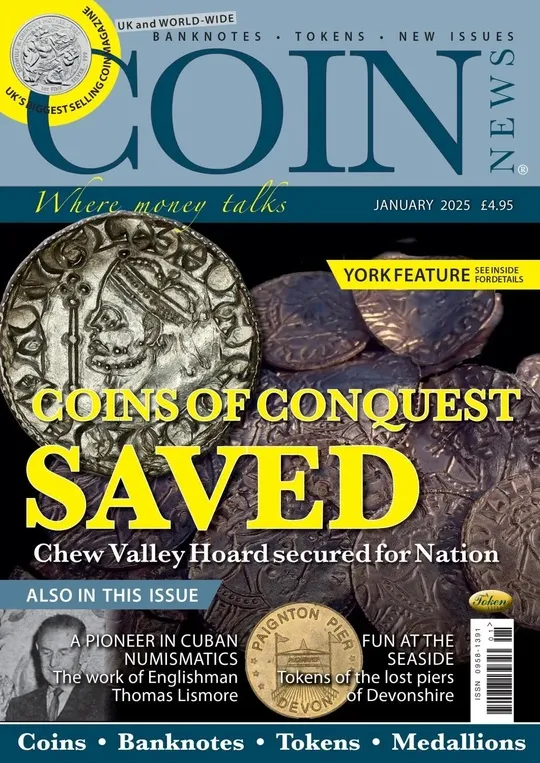
The Chew Valley Hoard is secured for the nation on page 12 of Coin News January 2025 (Vol. 62 No. 01, £4.95), anchoring an issue that balances treasure-sale reporting with technical numismatic columns. Laurence Chard gives an anniversary interview, Ed Archer traces the origins of coinage from East meets West in Part 1, and Les Robinson puts the 1920 Dots mint-mark theory to rest. The 100-page issue packs 14 regular departments from Auction Highlights to the Dealer Directory.
The hoard coverage includes the hammer price and the acquisition by the South West Heritage Trust, with photographs of the 2,500 silver coins from the Norman Conquest era. Archers East-meets-West piece argues the first coins emerged in Lydia and China independently within 50 years of each other. Elizabeth Norfolk's British Milled Coinage series reaches Part V — the Age of the Wyons. Roberto Menchaca profiles an Englishman who became a pioneer of Cuban numismatics.
The regular departments include Coin News & Views, Around the Auctions, New Issues Coin Update, Royal Mint Bulletin, and Auction Highlights with realised prices from 6 UK sales. The Price Guide to Decimals covers Five Pounds. David Pickup's Where There is a Will advises on passing on your collection, and the Coffee Break Quiz tests knowledge from the issue's content.
—————
Content Guide
▸ Cover Story / Features
p.12 · Chew Valley Hoard secured for Nation
The 2,500-coin Norman silver hoard, discovered by metal-detectorists in North Somerset, was acquired by the South West Heritage Trust following a fundraising campaign. The hoard's value was assessed at £4.3 million under the Treasure Act. The catalogue included 1,238 coins from William I's reign alone.
p.36 · Anniversary Interview with Laurence Chard
The veteran dealer discusses 50 years in the numismatic trade, from the 1975 silver boom to the modern online auction market. He names the three coins he most regrets selling — a 1937 Edward VIII pattern crown tops the list.
p.41 · East meets West — The origins of coinage — Part 1
Ed Archer traces the independent emergence of coinage in Lydia (c. 600 BC) and China (c. 550 BC). The Lydian coins were struck in electrum, while Chinese coins were cast in bronze. Part 2 will cover the Silk Road convergence.
p.45 · An Introduction to British Milled Coinage 1662-1971 — Part V
Elizabeth Norfolk covers the Age of the Wyons, the family of engravers who dominated Royal Mint design from 1816 to 1914. Leonard Wyon's Gothic crown of 1847 is illustrated with the original die-mark variations.
p.52 · 1920 Dots — Putting the Mint Mark Theory to Rest
Les Robinson uses mint records from the Royal Mint Archive to disprove the long-held theory that dots on 1920 pennies indicate branch-mint origin. The dots are die-axis alignment marks.
▸ Regulars
p.55 · Where there is a Will — Passing on your collection
David Pickup advises collectors to create a coin-by-coin bequest list with estimated values and a named executor who knows the market. He cites a case where a 1797 cartwheel penny collection was sold for £60 at a house-clearance auction because the heirs did not know what it was worth.
p.84 · Coffee Break Quiz
10 questions drawn from the issue's features. One question asks for the specific gravity of electrum (the Lydian coin alloy). The answers are on page 96.
p.87 · From the Archives
A reprint of a 1975 Coin News article on decimalisation's first 5 years, showing the original pre-decimal price comparisons.
—————
Editor's Take
Coin News delivers reliable monthly value for the serious collector, and January's issue is particularly strong on technical content. Les Robinson's 1920 Dots piece is the standout — it uses primary archive sources to settle a debate that has run in the letters pages for years. The Chew Valley Hoard coverage is thorough, with auction results and acquisition details that pure news outlets skip. The weakness is the density: 14 regular departments in 100 pages means some sections (New Issues Coin Update, Numismarket) feel like data dumps rather than editorial content. The Laurence Chard interview is respectful but soft — the hard questions about market manipulation are not asked. This issue is for the dedicated coin collector who reads every department, not for the casual metal-detectorist.
Strengths
• Les Robinson's mint-archives debunking of the 1920 Dots theory
• Chew Valley Hoard coverage with full auction and acquisition details
• Elizabeth Norfolk's Wyons engraver series with die-mark illustrations
Weaknesses
• Laurence Chard interview asks no challenging market questions
• Regular departments (Numismarket, New Issues) run as raw data rather than editorial
Verdict: Recommended — Top-tier technical numismatic content held back by back-of-book data dumps.
