
The Complete Photography Manual – Issue 4 – December 2023
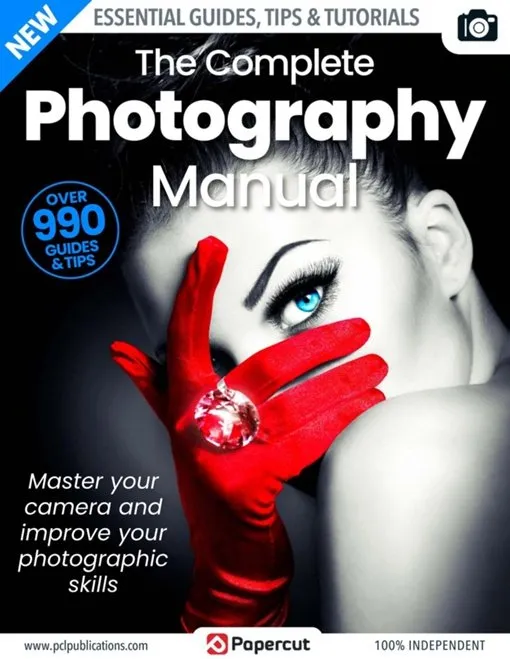
The Complete Photography Manual – Issue 4 – December 2023
More than 990 guides and tips covering camera basics, composition, lighting, and genre-specific techniques — this fourth-edition manual from the Complete Manual range targets beginners who own their first interchangeable-lens camera and want a printed reference they can keep in a camera bag.
The book is organised into seven sections: Getting Started (camera types, lenses, tripods, flashes, software, filters), Using Your Camera (composition, shutter speed, aperture, ISO, focusing, exposure, white balance), Take Better Photographs (a dense collection of quick technique tips), Explore Further (portraits, landscapes, macro, sunsets, pet photography), Home Photo Projects (high-speed, macro, shallow depth of field, scanner photography, food photography), Black and White Photography (landscapes and portraits), and Outdoor Photography (rural landscapes, plants, astrophotography, beaches and snow, infrared, HDR).
Content Highlights
Mastering Exterior Lighting Conditions (p.72) — Practical tips for shooting in harsh midday sun, overcast skies, and golden hour. Venue for portrait photographers who cannot control outdoor light but need to deliver consistent results.
High Speed Photography (p.92) — A home studio project that uses a flash trigger and a dark room to freeze motion. The equipment list is realistic for a hobbyist budget — no high-speed video cameras required.
Astrophotography with Your Digital Camera (p.148) — Covers star trails, the Milky Way, and basic deep-sky imaging using standard DSLR equipment. The exposure-time and stacking advice is practical for first-time night-sky shooters.
Black and White Photography (p.120-130) — Top 10 tips, mono landscapes, and black and white portraits. The tonal-range advice for landscape conversion is directly applicable to any post-processing software.
Food Photography (p.116) — A home project that uses natural window light and simple props. The styling tips — angle, layering, and negative space — translate directly to social-media content creation.
Glossary (p.176) — A reference of exposure, lens, and editing terms defined for readers who skip the earlier chapters. Useful as a quick lookup during a shoot.
Editor's Note
Adequate coverage for a beginner — the aperture/shutter/ISO triangle is explained clearly, and the home projects section gives readers something to try on the weekend. Weakness: the camera section is generic (no brand-specific guidance despite the cover implying comprehensive coverage), and the "Take Better Photographs" section is a scattershot list rather than a structured tutorial. Best for absolute beginners who want a single printed reference; disappointing for anyone who has already completed a beginner photography course.
Strengths
• Clear aperture/shutter/ISO fundamentals with practical examples
• Home projects (high-speed, macro, food) with realistic equipment lists for hobbyists
• Astrophotography and HDR sections for genre exploration beyond basic shooting
Weaknesses
• "Take Better Photographs" section is a disorganised tip list, not a structured guide
• No brand-specific camera menus or button-location references
Verdict: Selective read — Suitable for brand-new camera owners; intermediate photographers will find little they do not already know.
